
What's Pressoir Drinking? An Italian Interlude
Raj Vaidya
March 12, 2024
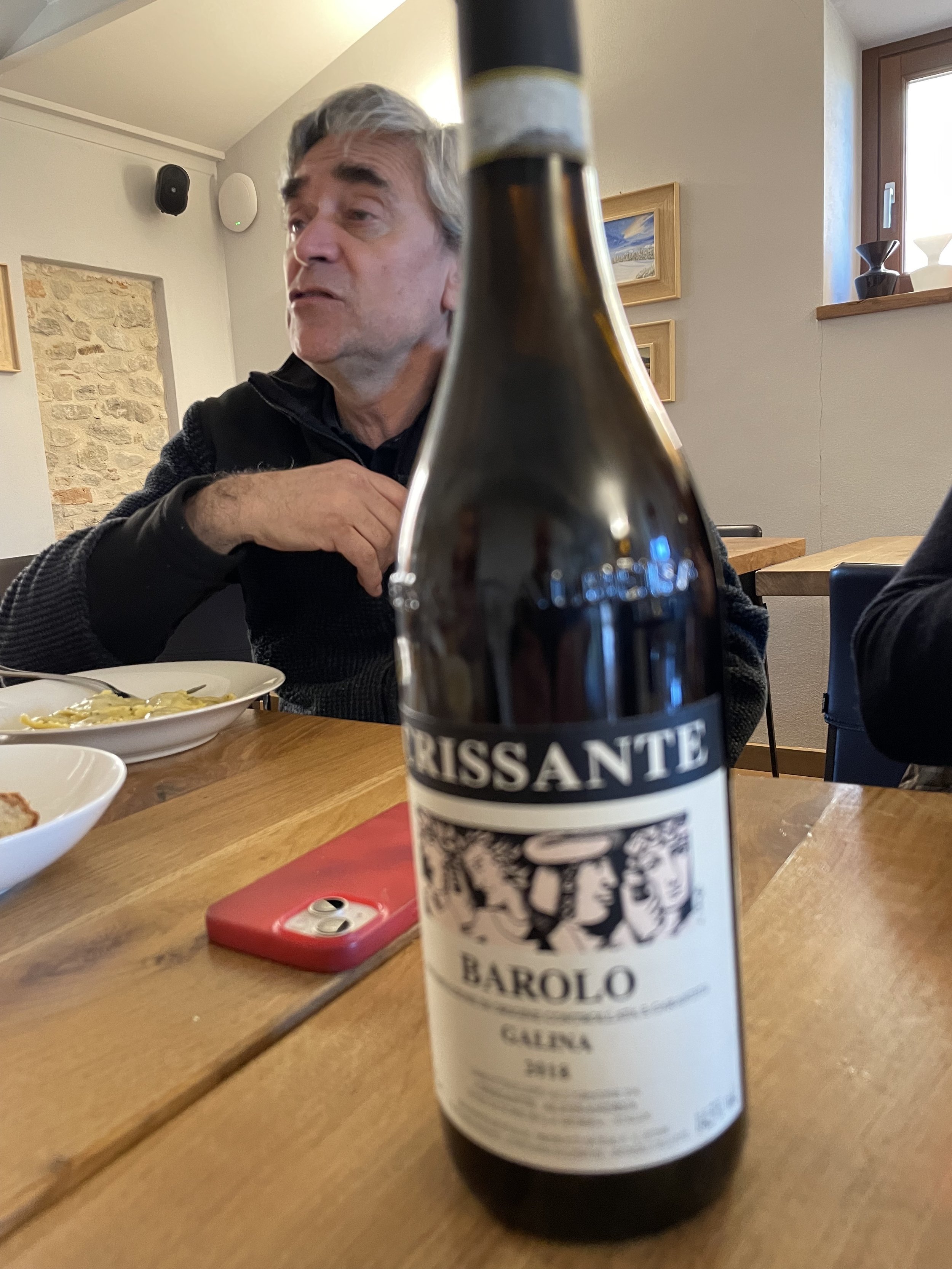
Over a lovely lunch filled with pasta and laughter, accompanied by dear friends and vignerons Luca and Elena Currado (formerly of Vietti Winery in Barolo), I made a cool discovery. Nebbiolo is well known to be a pretty tannic variety, indeed those wineries that hold to the rustic winemaking style of long macerations tend to be undrinkable when young, and always needed 10+ years of aging before becoming interesting. Because the grape itself has such a high level of tannin in the skins, it has been historically very rare to introduce whole cluster fermentation here in Piedmont. Not only does the additional tannin from the stems add to the rustic palate in the juice, the stems are also much higher in water content than the same vegetal matter in, say, Pinot Noir or Syrah where whole cluster is more common. Luca explained to me that the added tannin is exacerbated by this additional water content when whole cluster fermentation is used, because the water dilutes the acid levels which usually offer a balancing effect to the tannins.
That said, the appeal of the aromatic complexity of whole cluster fermentation, plus the added lift it can give to wines in warm vintages (which are, as everywhere else across Europe, more the norm than the exception these days) has led to more experimentation. In the region, there is one cru which is particularly well suited for such experiments, that of Monvigliero in Verduno; an excellent example would be the wines from this cru made by Burlotto with some whole cluster fermentation. Experiencing Burlotto’s Monvigliero for the first time inspired the young winemaker Alberto Crissante, of his family estate Crissante Alessandria, to begin experimenting with the technique. Today, he ferments all his Barolo with some percentage of whole clusters, and in the recent warm vintages has had some excellent success.

Alberto Crissante of Crissante Alessandria in Barolo.
We drank his 2018 Gallina (from the commune of La Morra), and I found it superbly balanced, without any overtly hard tannins. A very typical Nebbiolo nose of dried rose petals was enhanced by a peppery note and smokiness I attributed to the whole clusters. Indeed, for such a young wine it was super drinkable! The subsoil is calcareous and though the region is generally not thought to be suited for whole cluster, the balance was pretty wonderful.
A lovely discovery.

Luca Currado explaining the effects of whole cluster fermentation in Nebbiolo.

What's Pressoir Drinking
October 21, 2020
By Daniel Johnnes
In regards to the wines I choose to drink, some people would call me cheap. Some would call me reasonable. Others would call me a genius. Frankly, I don’t care. I know I’m not cheap and I know I’m not a genius.
Maybe I’m reasonable. One thing is for sure: I drink for pleasure. Normally, I’ll open a delicious Beaujolais, Coteaux du Lyonnais, village level Burgundy from a great producer or maybe a Barbera, Dolcetto or Nebbiolo from Piedmont. Or a Loire valley Anjou. Or maybe a German Riesling.
These are all wonderful wines, great values and easy to open and enjoy at home for a casual occasion. Though sometimes I just get thirsty for a real treat. A Grand Cru or a top level Premier Cru from Burgundy. Maybe a Bordeaux from a mature vintage or a great northern Rhone from Chave, Clape, Clusel-Roch.
The other night, was a “thirsty for a great wine” night so I opened a Burlotto Barolo Monvigliero 2011. What a treat. It is amazing how clear the difference is between a wine that has a noble voice speaking of place, grape variety and character and a wine that is a simple delicious wine. As I said earlier, the simple delicious wine is my “vin du jour” but I get so much joy when a wine causes me to reflect, savor and even on rare occasion brings a tear to my eye. These great wines are works of art with profound nuance, subtlety and length. The Burlotto did not bring a tear BUT, it was clearly a refined and special example of a great terroir in Piedmont. This area is Verduno in the north of Piedmont on a sandy soil that yields more subtle delicate examples of Barolo. This one from the 2011 vintage was fully open with the telltale aromas of dried roses, leather, and spice. It had a wonderful texture, almost velvet and perfect balance of ripe sweet fruit layered with black currant and raspberry accompanied by a luxurious long fresh finish.
I could not believe how quickly the bottle shared with two other people disappeared. Of course, the next bottle had to be at the same level of enjoyment or better. I’ll talk about that one another day.
