
What's Pressoir Cooking? Coq au Vin
November 11, 2020
By Jaime Dutton with guest chef Tony Warnke
As we amble into fall, its time to pull out the Dutch ovens and make warming stews and one pot meals. Over the weekend I visited a good friend in the Hudson Valley for a fall getaway. It was such a treat on so many levels to take a little space and breather in the beautiful countryside.
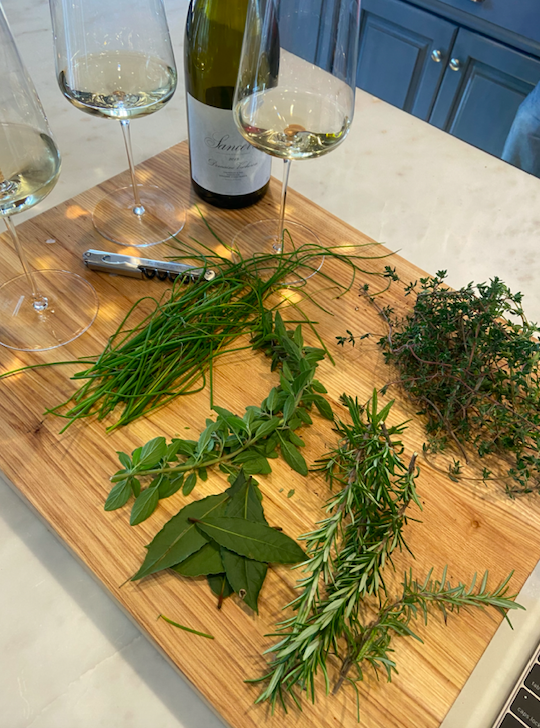
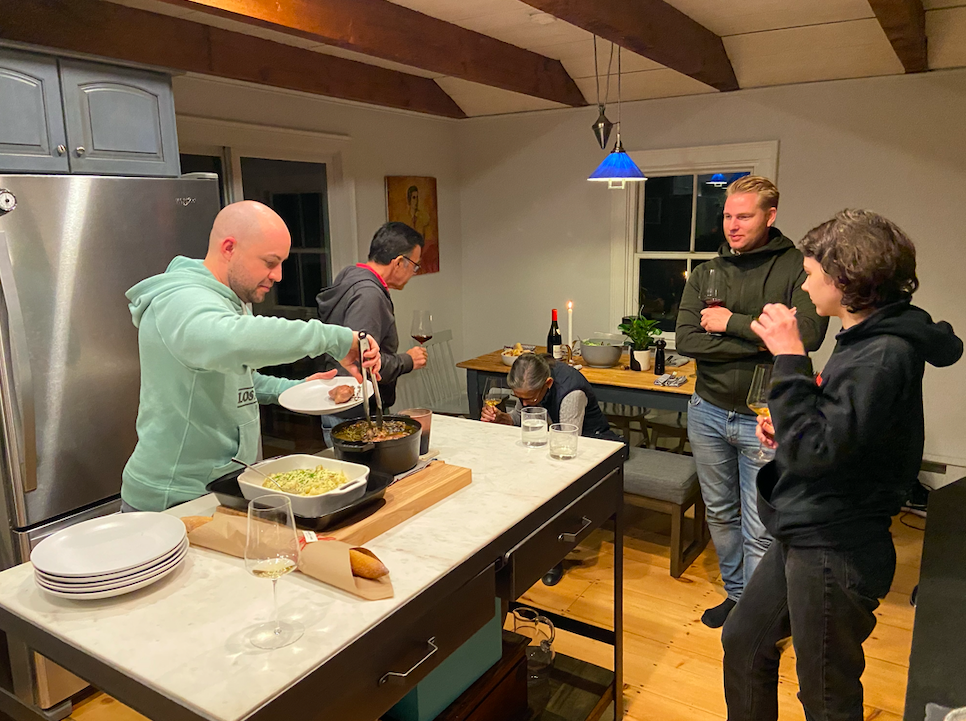
I had the fun job as sous chef to my friend Tony and we prepared a take on Julia Child’s Coq au Vin. Following his directions, I chopped onions and garlic, peeled carrots and cleaned and sliced mushrooms. We picked herbs from his garden and chatted over the bottle of Vacheron Sancerre that we opened during the At Home Session with Jean Laurent Vacheron.


We started cooking around 12pm and placed the lid on the Dutch oven around 3pm when we popped it in a low 250 degree oven where it stewed until we ate dinner around 7pm. Tony accompanied the meal with mashed potatoes and a fresh green salad.
We were spoiled with fantastic wines that Daniel brought and great company. Lots of laughs were shared as we heard Julia chuckling in the background while we cleaned up the mess.

We pretty much followed this recipe from PBS to a t with just a few additions - a bunch of fresh carrots in the end when we put it in the oven and tons of fresh herbs. In addition to the rosemary, we added fresh thyme and oregano.
Bon Appétit!

News from the Vineyard
Aÿ Grand Cru "La Côte Linguard"

Aÿ is one of the 9 Grand Cru villages in the center of the Grande Vallée de la Marne. Considered like “the champagne of kings”, this region is known for producing very high quality and full-bodied champagnes. While Aÿ is most notable for its Pinot Noir (90% of the vines planted), you can also find some excellent Chardonnay.
Aÿ is not a homogeneous terroir, which is also part of its magic. This large area is composed of various folds of the slope across the hillside which create sites of different exposition and elevation. The blend of cretaceous chalk and sedimentary slope wash create subtle and complex wines that exhibit power and finesse. Peter Liem says (and I’m sure Daniel will agree) “if Aÿ were in Burgundy, it would be in Vosne-Romanée”.
Today, we highlight one lieux-dit in particular in Aÿ, "La Côte Linguard". In the northern part of Aÿ, in the extension of La Côte Faron and La Côte Aux Enfers, you will find this tiny area of La Côte Linguard. It is a historic vineyard which is part of the UNESCO classification.
Our dear friends and fervent supporters of La Fête du Champagne, Bérêche et Fils* recently acquired 1 ha (2.5 acres) which represents exactly 8,010 Pinot Noir Vines and 846 Chardonnay vines. They are extremely proud and excited to add this beautiful Grand Cru vineyard composed of massale selections vines, flush chalk and steep slopes to their impressive array of holdings. Those characteristics should create beautiful wines with a lot of tension and complexity. Cheers to Raphaël Bérêche and his family - we look forward to tasting the juice!!

Bérêche et Fils (NM)In the village of Ludes, in the northern portion of the Montagne de Reims, brothers Raphael and Vincent are quietly crafting sophisticated, terroir-expressive champagnes that are poised to rival the region’s best. Their 22 acres of vines are located in several sectors of Champagne with the three primary areas being the immediate vicinity around Ludes. A portion of the vines are farmed biodynamically, and about three quarters of the production is vinified in barrels with indigenous yeasts. Unusually, Bereche bottles a number of cuvées with cork rather than crown caps for the second fermentation, which Raphael thinks results in greater depth and complexity in their wines. NM stands for Negociant Manipulant.
Information courtesy of Peter Liem's Champagne book.

Credit photo @philippemartineau_foodart