
What's Pressoir Cooking?
Truffle season
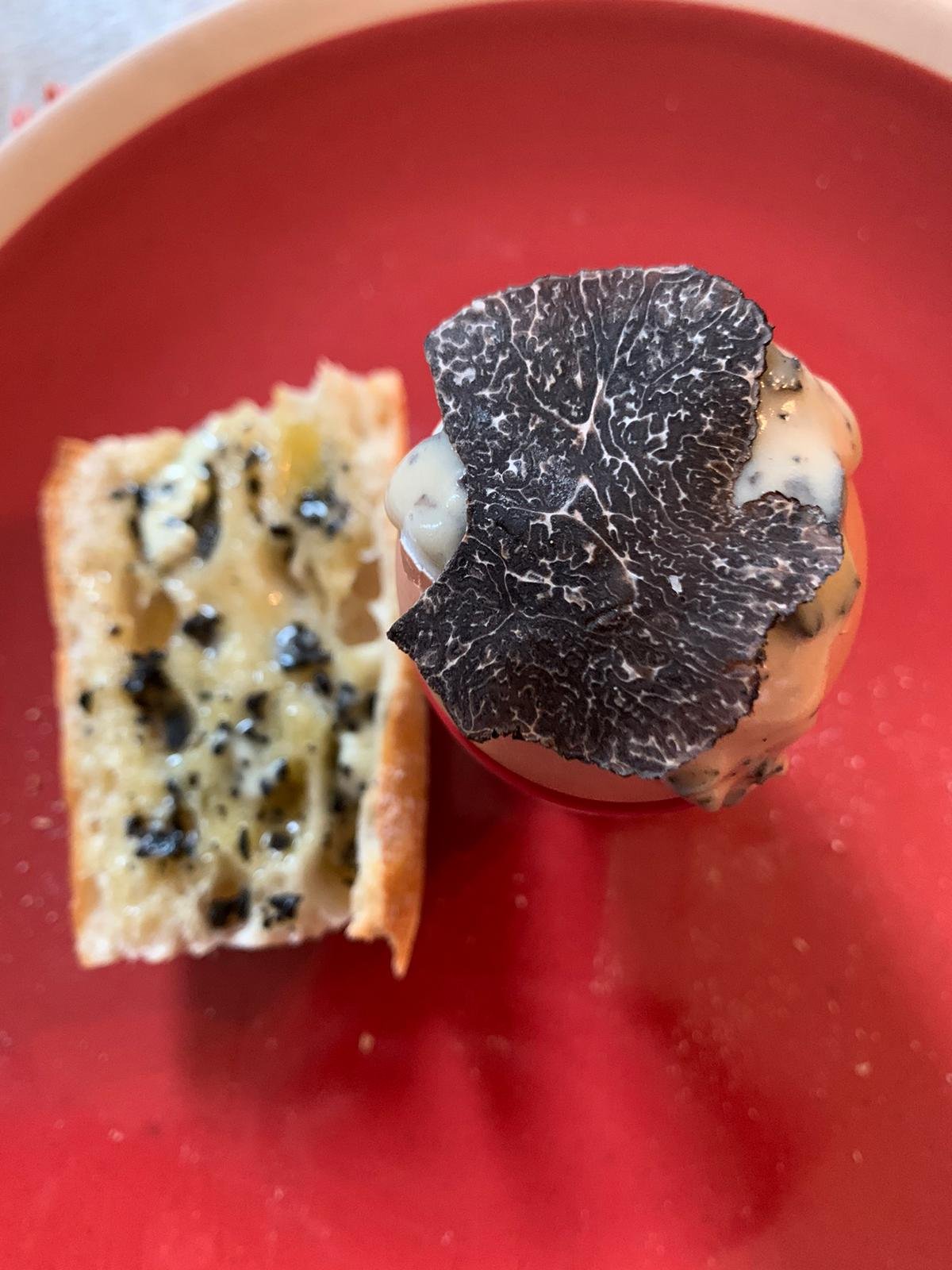
Eggs and truffle purée by Chef Jean-Michel Belin of Le Beauvallon Hotel in Provence
by Justine Puaud
January 18, 2023
We are in the middle of the truffle season. The famous truffle market is in Richerenches in France and is open from November to March every year. If you plan to visit the Provence region around this time of year, you have to make a stop there. It is not like a traditional farmer market. You enter a quiet street where there are a dozen mini vans and people will be selling truffles from the back of their cars…
The tuber melanosporum, also called black truffle, is quite strong on the palate. I tried many recipes with truffles and I think overall the simplest recipes are the best (omelette with truffle, pasta with truffle, French coquilles Saint-Jacques carpaccio) But, I have to say, the soft boiled egg with a truffle purée is among my favorites. The mix between truffle, béchamel sauce and madeira makes this recipe just delicious and really enhances the truffle.
Ingredients
12 fresh eggs
120g fresh truffle
30g béchamel sauce (if you don’t know how to make a béchamel, check out this recipe)
40 cl heavy cream
120g of butter
25 cl of madeira
25cl of truffle juice (buy a can of truffle juice from Plantin)
6 slices of bread (ie traditional baguette)
salt and pepper
Instructions
Sauce
Put the eggs and truffles in an airtight container in the refrigerator the night before.
Put the eggs in the blender to obtain a very fine purée or cut the truffle into very small pieces.
Make a béchamel.
Then, in the saucepan, reduce the Madeira and truffle juice to dryness, add the cream and the béchamel. Leave to cook for a few minutes, stirring.
Add the truffle purée and the béchamel to the Madeira and truffle juice and leave over low heat for 3 minutes.
Cook the eggs for 3 minutes in salted boiling water. Remove the egg from the shell, then using a teaspoon, remove the little white that is not cooked.
In a frying pan, brown the slices of bread with a little butter, then cut them into "mouillettes" and keep them warm.
It's almost ready to eat. Fill the egg cavity with the truffle purée, dip the bread in the egg with the sauce and enjoy.

What's Pressoir Cooking?
A Classic French Recipe: Pâté en Croûte
August 4, 2020
by Justine Puaud
You can make so many different pâtés en croûte but this recipe is THE CLASSIC that everyone should know.
This pâté is composed of 2 meats: pork and chicken, marinated in white wine. French cuisine always rhymes with patience. It takes about two and a half days of careful preparation, 50 minutes of baking, 8 hours of rest.
Pâté en Croûte ingredients
Pastry Dough
2/3 cups of water
2.5 teaspoons of white wine vinegar
1.5 cups of butter and butter for the mold
a pinch of salt
a pinch of sugar
1/2 cup of beaten egg
2 3/4 cups of flour
1 1/2 tsp of cornstarch
1 egg yolk
Jelly
3 cups of beef jelly with port (you can buy it at the supermarket)
Stuffing
22 oz of pork belly
12 oz of pork tenderloin
8.8 oz of de-boned chicken legs
10 oz of chicken breast
3 teaspoons of seasoning mix for stuffing (four spice mix, salt, pepper, sugar)
1/2 cup of white wine
3.5 oz of roasted chicken skin
some pistachios
Onion mixture (for about 3 tablespoons)
3.5 oz of onion
0.75 tablespoon of butter
a pinch of salt and pepper
1 sprig of thyme
1 bay leaf
Fine stuffing
0.7 oz of chicken supreme (or chicken breast)
1/10 cup of heavy whipping cream
a pinch of salt and pepper
Two days prior
Mix all together the ingredients into a pastry, make the dough and cool it in the refrigerator for about 2 days.
Remove bones and nerves of the meat and cut it.
Add salt and pepper and marinate the chicken in the white wine.
Leave the meat in the fridge all night.
Prep the onion mixture. Chop the onions and incorporate butter, salt, pepper, thyme and bay leaf. Cook the mixture for about 20 minutes. Make sure the mixture is dry enough and cool in the fridge.
The day before
Make the fine stuffing and leave in the refrigerator.
Cut the pork and chicken tenderloin and mix all the pieces together. Chop the pork breast and thigh.
Preheat the oven to 425 F.
Lower the dough to 1/4 inch, cut it to the size of the mold, cut out the hat.
Fill the dough with the stuffing.
Put the hat on the dough and add 3 chimneys on the top.
To make a chimney in a pie involves creating a small opening in the dough cover to allow steam to escape from the preparation during baking. To prevent it from closing, place a small tube of card stock, baking paper or a metal nozzle in the hole.
Bake at 425 F for 15 minutes to obtain a beautiful golden color. Then, lower the temperature to 325F and cook for 35 minutes.
Boil the jelly and add gently to fill in the pâté.
Please let cool completely and then refrigerate all night.
The big day
Boil the rest of the jelly and finish to fill in the pâté. Leave it in the fridge for 1 hour.
The Pâté en Croûte is ready. It is perfect for an aperitif with friends or for a meal with a green salad on a side. Enjoy!


