
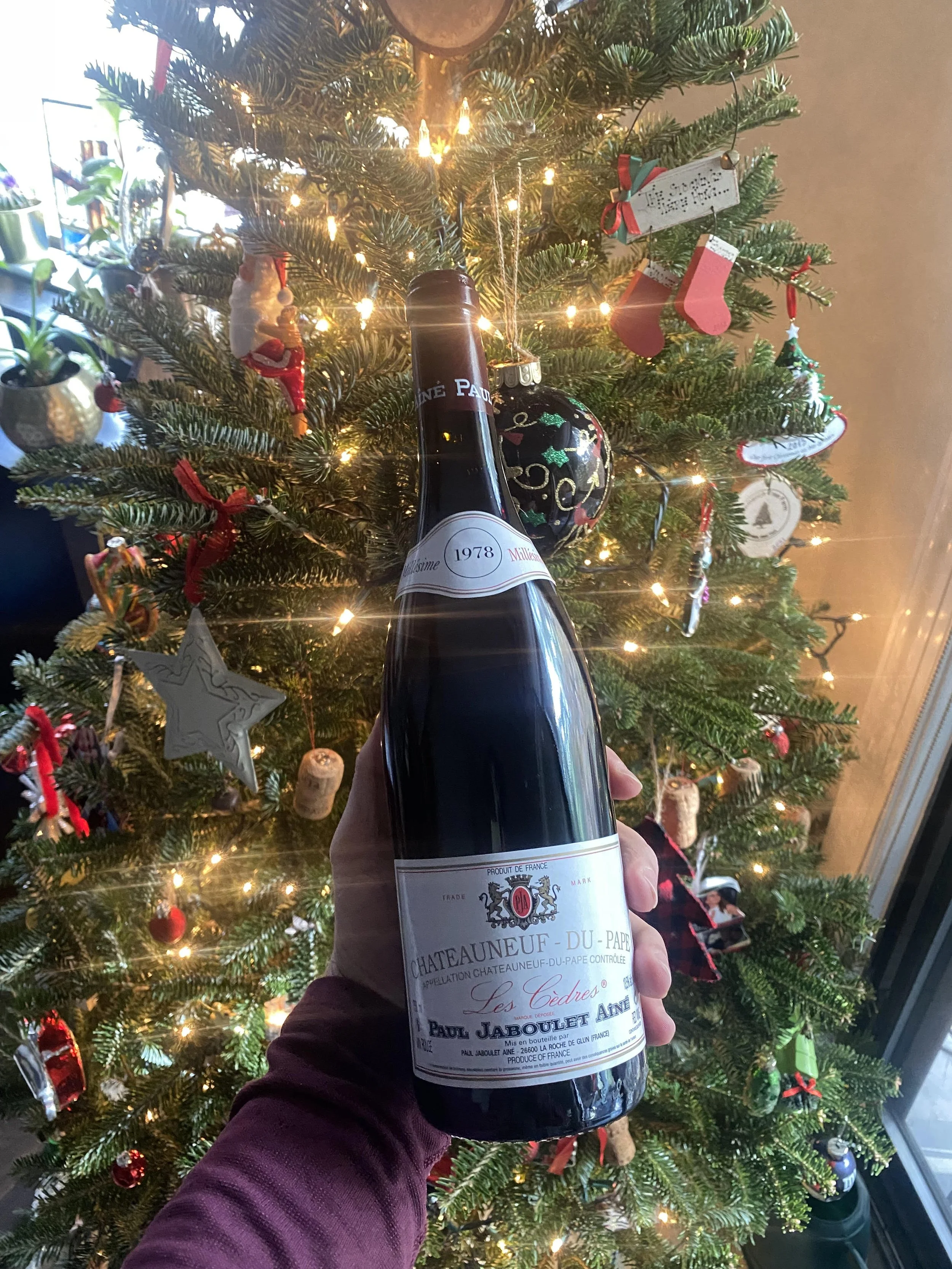
What's Pressoir Drinking - Jaboulet Ainé Chateauneuf du Pape "Les Cèdres" 1978
What’s Pressoir Drinking
By Edouard
12/5/23
Edouard Bourgeois
December 5, 2023
I Iike to get in the mood before our wine festivals by opening a nice bottle of the appropriate wine. So, a week before we kicked off La Tablee, I decided to taste a bottle of 1978 Chateauneuf du Pape “Les Cedres” from Jaboulet Aine. I had bought it just last month as a full twelve pack in original carton at one of the rolling Global Acker web auctions. I usually find amazing deals on this rolling auction and boy that lot surely was a hit! I couldn’t believe the perfectly impeccable conditions of each of the twelve bottles. Individually wrapped in plastic film by their previous owner, the fills were right under the cork, the color super healthy and the foils all spinning (a sign to look for in old wines that most likely mean no wine has leaked through the cork). When I pulled the cork, it appeared as a brand new one, as if the wine had just been bottled last year. At this point I thought it was too good to be true but then, the wine spoke, and it delivered the most satisfying pleasure. The nose immediately gave these typical roasted fig jam and herb aromatics Chateauneuf lovers crave. This rich palette kept intensifying as the wine opened up. I decided to decant it after judging a little oxygen would help amplify the richness. I was expecting heady alcohol and weight on the palate but found the most refined elegance instead. I am a strong believer in letting high quality Chateauneuf du Pape age and this bottle just confirmed my sentiment.

Les Cedres 1978 is no ordinary Chateauneuf du Pape. First, this was arguably the best vintage of the decade and maybe even until the exceptional 1989.
Back then, a typical Les Cèdres blend was two-thirds old-vine Grenache, with the balance largely Syrah. The winemaking was classic: whole-cluster fermentation in concrete tank, a month-long maceration and 12-18 months aging in foudres.
Jaboulet was known as the leading negociant in terms of volume produced but also as the one with access to some of the best fruit available. It is believed that sources may have been from Henri Bonneau and Domaine de Pegau among other growers, today known as reference producers.
I also like how these wines are somewhat mysterious. It is quite difficult to know exactly where the grapes came from but it is almost better that way, as it leaves the taster wondering. This wine will only become more sought after as Jaboulet is progressively stopping their production of Southern Rhône wine altogether.

What's Pressoir Drinking?
by Edouard
10/13/20
Produttori del Barbaresco, Barbaresco 1978, in magnum
by Edouard Bourgeois
October 13, 2020
We pair wine with food, with friends. I even like to push the envelope further by trying to find the right music to play when I sip on a particular cuvée. But what about matching wine and mood?
This morning, I woke up to a rainy, apparently uninviting Tuesday, cold and gloomy. Looking around my apartment, an empty magnum I opened last week and saved as a trophy caught my eye. When I pulled the cork from this 42 year old Nebbiolo, the wine initially seemed ugly, almost limping, and certainly the opposite of a “fruit bomb”. As often with old Nebbiolo, the initial funk character you may smell should not discourage you. The magic rule? Decant, and wait, a long time. The wine does change over the course of a few hours as oxygen seems to be Barolo and Barbaresco’s best friend. I’m also convinced the drinker should also adapt to this metamorphosis. It is a true intellectual exercise where the taster has to be willing to make an effort to understand the wine, just like the first time you heard the curious music of Thelonious Monk, not immediately being able to capture the beauty and humor in his choppy piano strides.
1978 blessed the Piedmont with grapes able to produce ideal, age-worthy wines. It was also the last vintage of the first cellar master at Produttori del Barbaresco Giorgio Boffa. This wine evolved so much, it felt like tasting multiple wines as each layer unveiled as time went by.
So, did I manage to pair the wine and mood? Yes. As the wine unfolded, the mood of the people who shared this magnum with me also evolved to eventually harmonize with the profile of the wine.
