

News from the Vineyard - Special Harvest Edition
August 25, 2020
by Justine Puaud & Max Goldberg Liu
August 25, 2020
by Justine Puaud & Max Goldberg Liu
NEWS FROM BURGUNDY
Côte de Beaune
This year is historically early for many growers in Burgundy.
Guillaume d’Angerville finished on August 25th which was the start date of his previous earliest harvest - 2003. This is a very different vintage than 2003, however - so far the grapes coming in have been very well balanced with good concentration due to the late summer drought, and are not at all overripe or dramatically low in acidity. Sanitary conditions are excellent as well - there is almost no need for a sorting table.
Thus far, weather conditions have been perfect - beautiful sunny days and cool nights, and growers are crossing their fingers that it continues.
Frédéric and Clothilde Lafarge finished the first day of harvest with a big smile, declaring the quality of the grapes to be amazing and forecasting 2020 as a great vintage. So far, the Lafarges are equally happy with the quality of both the whites and the reds. They should finish the harvest Friday evening and will be celebrating their Paulée with the vendangeurs.
Be sure to check out the video below with Fred Lafarge that our friends Richard and Carla Rza Betts captured the other day. Richard and Carla are in Burgundy this week capturing exclusive content for the Pressoir.wine Club, so be sure to look out for more footage from the harvest.

Beautiful cool harvest weather (Nicolas Rossignol, August 24, 2020)

Rapid fermentation of Clos du Château des Ducs (Clothilde Lafarge, Domaine Lafarge)
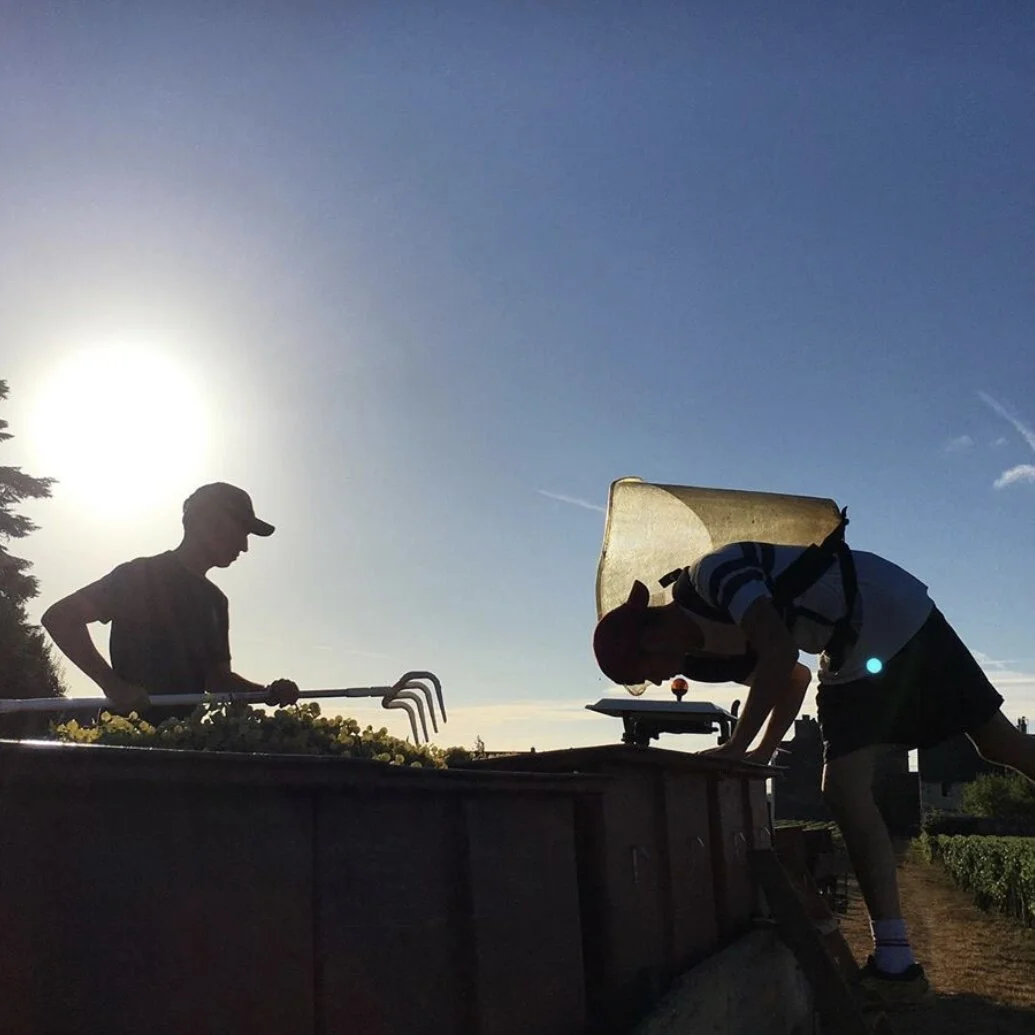
Early morning at Domaine des Comtes Lafon in Meursault Charmes (August 23, 2020)
Côte de Nuits
As is usually the case, the Côte de Nuits was generally a little behind the Côte de Beaune in starting the harvest, and the quality is looking to be equally as high.
Véronique Drouhin remarked that her Griotte-Chambertin was quite small in quantity but that the small bunches look magnificent.

Bonnes Mares (Domaine Hudelot-Baillet, August 25, 2020)

La Romanée being picked on August 26, 2020 (Louis-Michel Liger-Belair)

Griotte-Chambertin (Véronique Drouhin, August 22, 2020)
NEWS FROM CHAMPAGNE
2020 is also a historic vintage in Champagne: the earliest harvest on record.
This is the third warm year in a row producing beautifully ripe grapes. Many Champenois are comparing the trio of 2018, 2019, 2020 to the heralded trilogy of 1988, 1989, 1990. There are many similarities in growing conditions, precocity of the harvest, good ripeness, and clean fruit.
Many of the winemakers are finishing picking and pressing Pinot Meunier and Pinot Noir. Some of the Chardonnay is in but growers in the Côte des Blancs are waiting a bit longer to pick.
Rodolphe Péters of Pierre Péters is proud of how his Chardonnay vines have handled the changing climate: “This brings me to a thought about VERSATILITY, having a look back to the recent history of Champagne. What was the grape variety which used to be harvested the first when the climate was very challenging and cool and harvest was taken place in late September or October? And what is now the latest grape variety to be picked, while we face impacts of the global warming and must manage every year earlier and earlier harvests ? Only one answer in both cases: Chardonnay.”
Our friend Marie-Pascale Do-Dinh is in Champagne this week - we look forward to sharing the footage and photos of her visits with you in the coming weeks.

Pinot Noir from 1er Cru Les Noues in Ecueil at Champagne Frédéric Savart (August 26, 2020)

AR Lenoble is finishing pressing Pinot Noir and Pinot Meunier.

Harvest started simultaneously in Krug’s Clos d’Ambonnay and Clos du Mesnil. (Olivier Krug, August 26, 2020)

Chardonnay from the top part of Les Hautes Chèvres (Vincent Laval, August 25, 2020)