
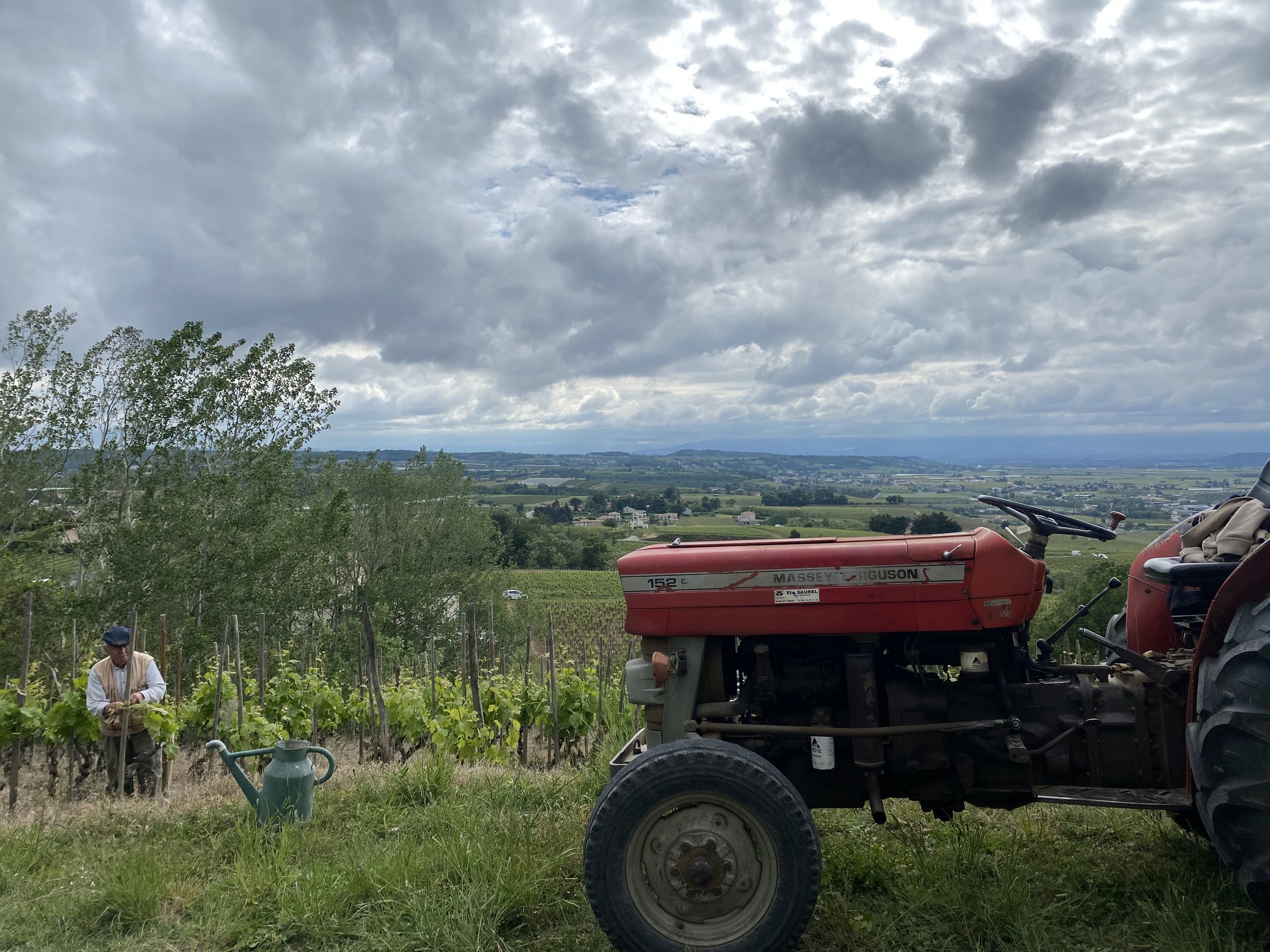
Irrigation allowed on Hermitage?
Irrigation on Hermitage?
by Edouard
6/14/23
June 15, 2023
Edouard Bourgeois
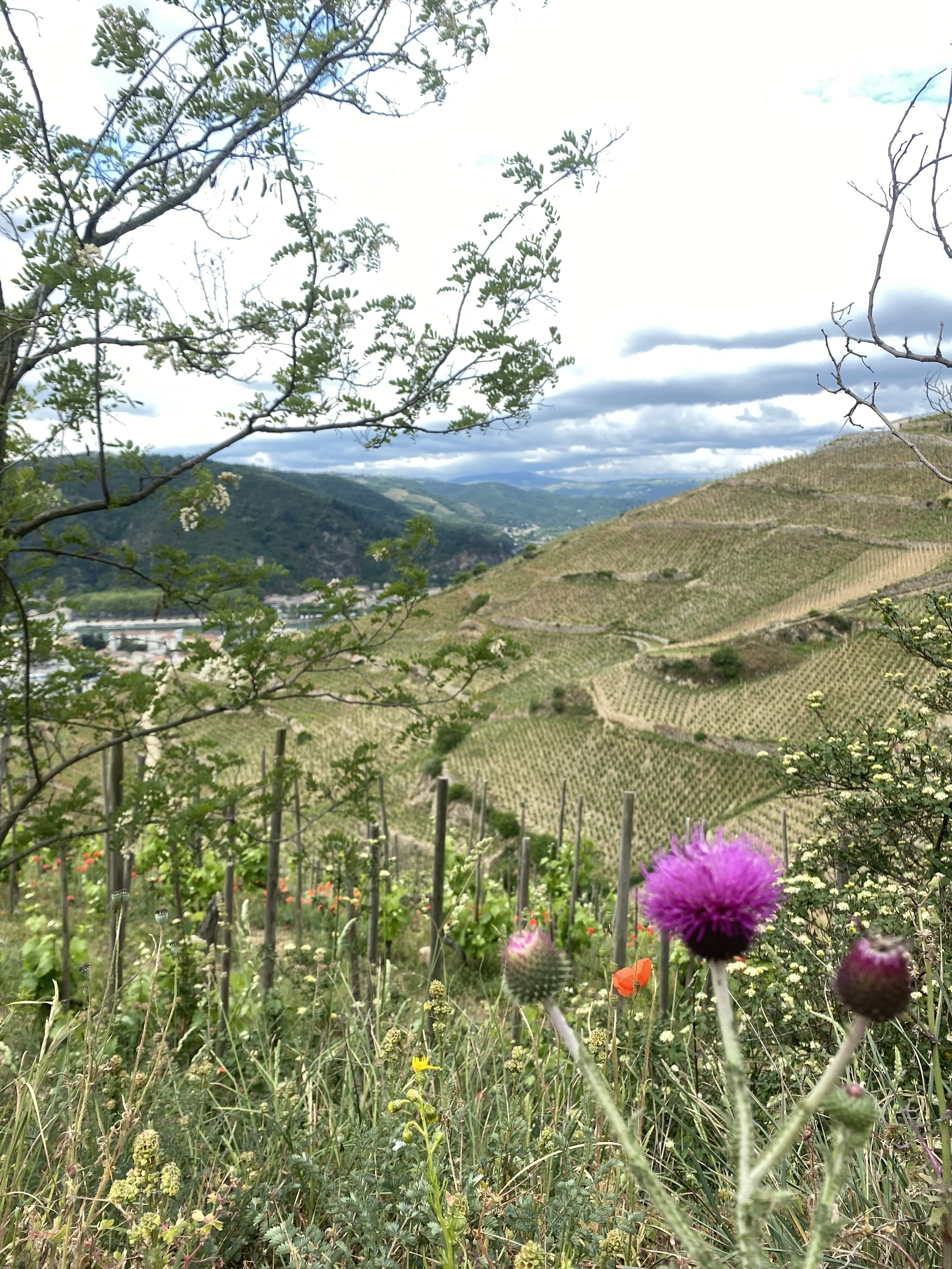
Hermitage: there is a bit of a mystical feel around “The Hill”. Hermitage distinguishes itself by many factors, starting with its location, along with Crozes-Hermitage, the only two appellations of the Northern Rhône on the left bank of the Rhône. All the other vineyards are on the other side of the river. Because the river turns a sharp ninety degrees there, the steep hill is perfectly nestled in the river’s elbow with ideal southern exposure providing plenty of sunlight.
It’s a small appellation, with just 137 hectares of vines, mostly planted with red grapes (exclusively Syrah), but there are some 30 hectares of white varieties (Marsanne, with a bit of Roussanne) that give ethereal and singular white wines. Although very discreet on wine lists and even among collectors due to its rarity, the white Hermitage is a wine of wonders. Once the most expensive white wine of France when Thomas Jefferson described it as the best white wine in the world in 1787, this blend of golden Roussanne and Marsanne is like nothing else and can age for decades.
There is a small group, about a dozen landowners, on the hill of Hermitage. Chapoutier owns the most with 34ha, followed by Jaboulet Ainé, with 25ha, including the vineyards of “Hermitage La Chapelle”, a wine on the list of “legends” with the 1961 vintage. The third place goes to one of the longest father-to-son-run wineries in the country, Domaine Chave, with its 25ha. A few others who grow grapes on Hermitage are Delas, Ferraton, Faurie and the Sorrels.
On a recent visit to the Rhône, it was brought to my attention from some of these producers that after the punishing drought in the regions they have experienced for the past few years, the question of irrigation surfaced. Allowing this practice on the Hill of Hermitage, dry-farmed for many centuries, would be groundbreaking news in the world of wine. It also raises another question. If Hermitage allows it, what about Côte-Rôtie, or even further north, dare I say Burgundy?
In Hermitage, the extreme 2020 vintage first raised the question of irrigation. Fortunately, rain eventually came that year. In 2022, a similar weather pattern brought a long period of drought and today, the conversation is no longer just gossip. Locals talk about using water pumped from the nearby Rhône River that would be stored in tanks at the top of the hill of Hermitage. It is also said that the vines would have to be watered manually (as if labor was not difficult enough on Hermitage!) so no drip system would be used.
And one important factor in the decision making of this proposition is that each landowner’s vote would weigh proportionally to the size of their land on the hill.
Although Michel Chapoutier was mentioned in a 2013 Decanter article as pretty confident in the future of winegrowing in the Rhône, I heard that he could accept the decision to irrigate on Hermitage and as the main owner of the appellation, that would make a substantial difference. Producer Guillaume Sorrel from Domaine Marc Sorrel is among those against irrigation. I haven’t heard about the others.
But after all, is irrigation even beneficial when rain fails? Grapevines originate from the Mediterranean basin where summers can make the thermometer rise over 100 degrees Fahrenheit. And these grapes have been producing wine for over two thousand years. So is the plant really suffering that much from the drought? Or is it adapting to the new environment as some of the most established vignerons suggest? In fact, many think that irrigation may be detrimental to making high quality wine since it may promote superficial growth of the root system, since water becomes available on the surface, roots don’t need to dig deep to find it, resulting in wines with less character. Irrigation may also give wines with higher alcohol, making them unbalanced and heady.

Napa Valley, a few words before our Pressoir.wine THIRST class
Napa Valley
by Edouard
7/20/21
by Edouard Bourgeois
July 20, 2021
The sun’s powerful light is key to promoting photosynthesis and its warm rays are another crucial factor to producing healthy grapes around the world. In the historically cold wine regions, wine growers may choose to capture as much sun exposure as possible. They often choose to plant their vineyards with a southern orientation (in the northern hemisphere) and on steep slopes. The space between the rows also plays a role and farming techniques such as deleafing can increase sunlight exposure.
However, in parts of California, especially the famous Napa Valley, the sun may become a dangerous ally.
The world of wine was shocked when terrible news of the Napa wildfires spread last year. But the sadly famous Glass Fire that remained active for 23 days was the beginning of even more disasters to come. Smoke taint, dried up water reservoirs and increased insurance policies deeply impacted the region.
Red wines were more affected by smoke taint because the process to make red involved skin maceration, which is not true for a classic white wine where grapes are directly pressed. The irony is that red wines, and of course the staple “Napa Cab” are close to twice as much profitable than white wines.
Today, the Napa wine growers are taking stock of the situation and thinking about next steps. In last week’s edition of the Pressoir wine “The Press”, we covered the subject of capturing and recycling the CO2 naturally produced during fermentation in wineries.
Another critical topic in California is water. Is irrigation absolutely necessary in a region known for its violent drought? The celebrated winery Diamond Creek of Napa Valley, a pioneer in terms of single vineyards in the region, has embraced dry farming in parts of its vineyards.
Today, waste water from household toilets and drains is being re-used in vineyards after intense treatments. It is even predicted that such recycled water could one day become potable.
Our Pressoir.wine live THIRST class this July 29th will feature exclusive videos filmed by our team while in Napa a few months ago, featuring legendary producers Diamond Creek, Corison, Eisele Vineyards and others. Author Kelli White will share her incredible knowledge of the region and we will discuss important topics such as the evolution of farming, the diversity of terroirs and grape varieties with fascinating insiders’ stories. We hope to see you on screen for this virtual event.
