

What's Pressoir Cooking?
by Victoire Chabert
March 24, 2022
Gnocchi
Italian gnocchi is a real family affair. In this case, my father’s side of the family is from the South of France which historically shares many cultural aspects with Italy. (My mother's family is from Meursault, whose recipes I will be happy to share with you soon, stay tuned!). I remember, when I was very young, going to my grandparents' house on dark winter days to help my grandmother make the gnocchi that everyone loved. Indeed, she needed little hands to help her make every single gnocchi and that could get the hang of the technique with the fork. You will see in the recipe exactly what I am talking about. Through that repetition, this age-old Italian recipe has become my specialty. Allow me to share the secrets with you...
Ingredients for 4 people
1kg (2.20 lbs) of potatoes (ideally an earthy type)
800g (1.76 lbs) flour
2 eggs
Pinch of salt and pepper
100g (0.2 lb) butter
Materials
Puree press
Spatula
Saucepan
Skimmer
Salad bowl
Large plank
Preparation for the Gnocchi
Put your unpeeled potatoes in a large saucepan, cover with cold water, bring to a boil, add a handful of coarse salt, lower the heat and cook at a gentle simmer for about 30 minutes. Check the cooking with the tip of a knife.
Once cooked, don't wait too long before peeling the potatoes, as the dough must remain hot as long as possible to form the gnocchi. In a bowl, mash them with a potato masher.
Gradually add the flour, and eggs, butter, pinch of fine salt and pepper. Start mixing with a spatula, then knead by hand until all the elements are well combined and the dough is smooth. Form a ball and flour your work surface. Be careful, the recipe says 800 g of flour but you may need more or less, depending on the water content of the potatoes. Work your dough for a few minutes but not too long.
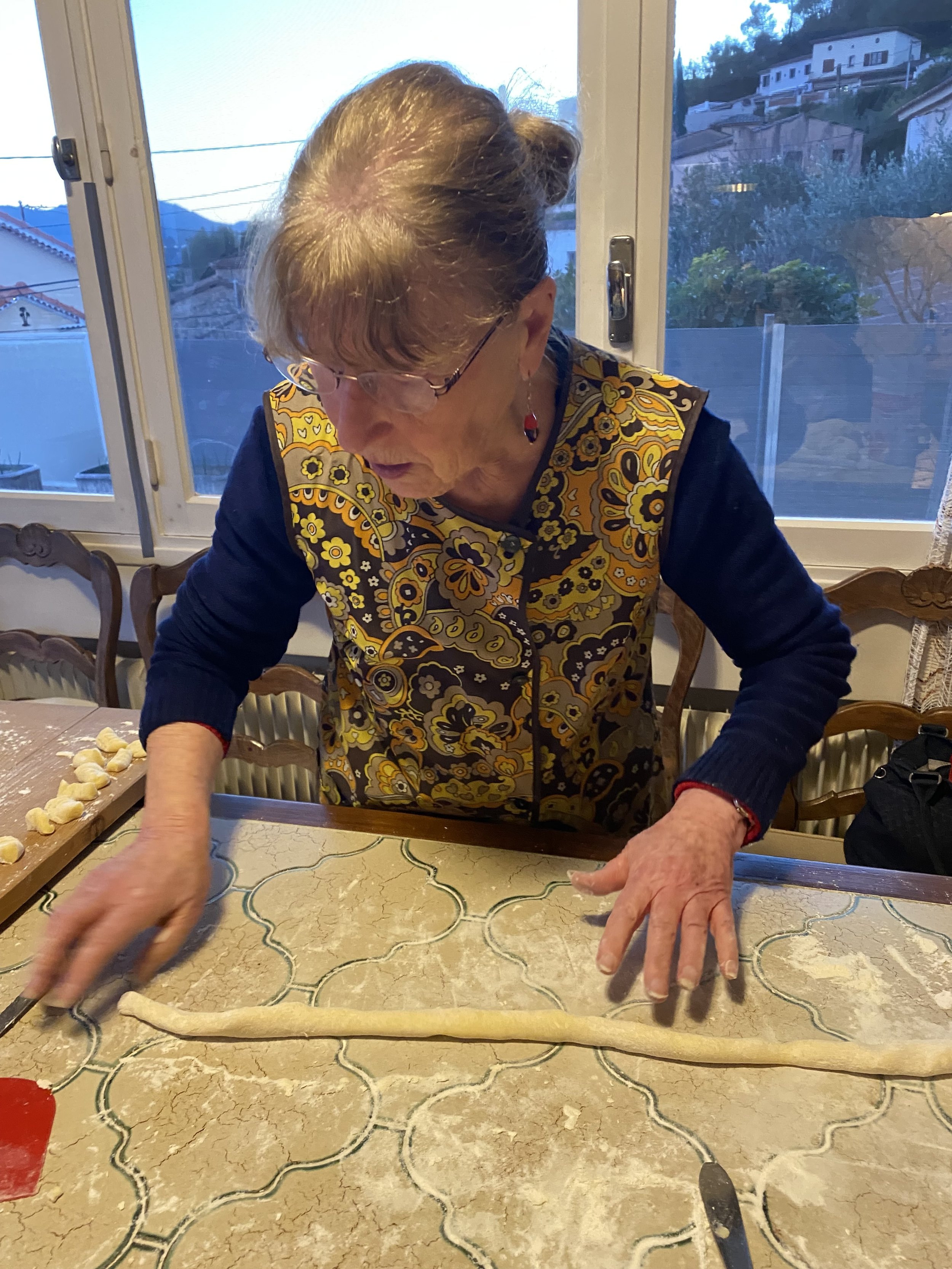
Once your dough is ready, cut into a first piece and form a long snake (see photo) and cut your gnocchi to about 2.5 cm (1 Inch) each.
Place each gnocchi on the tines of a fork. Press lightly in the center with your thumb, to create a hollow. It's not that easy at first, but you'll soon get the hang of it. Place your gnocchi on one or more boards, making sure to leave them all flat. You don't want to end up with a big ball of gnocchi sticking together. You can let them rest for a few hours in the fridge or in the open air covered with a dishcloth.
When ready to serve, boil some water in a saucepan and add a pinch of salt. Drop your gnocchi in it and after a few seconds they will rise to the surface, which means they are cooked. Using the skimmer, pick them up and place them on your serving dish. Add the sauce of your choice. My favorite is the Daube sauce (see recipe below) with grated cheese on top but they are also excellent with a tomato basil sauce, pesto or cheese sauce.

For the Daube sauce
Cut up pieces of beef (bourguignon) , flour them and fry them in hot oil with minced onion. Add garlic, some sliced carrots and mushrooms if you like. Season and add a bottle of red wine. There is no need to add a good wine... save the good ones for dinner! You can add a vegetable stock cube and some thyme leaves. Cook gently for 3 hours. It's so good. You can actually use this sauce for gnocchi as well as pastas, raviolis… anything you want.
Bon appetit !