

Recap: Dinner featuring the wines of Domaine Michel Lafarge @ Anton's
by Edouard Bourgeois
Friday, April 15, 2022
by Edouard Bourgeois
Friday, April 15, 2022
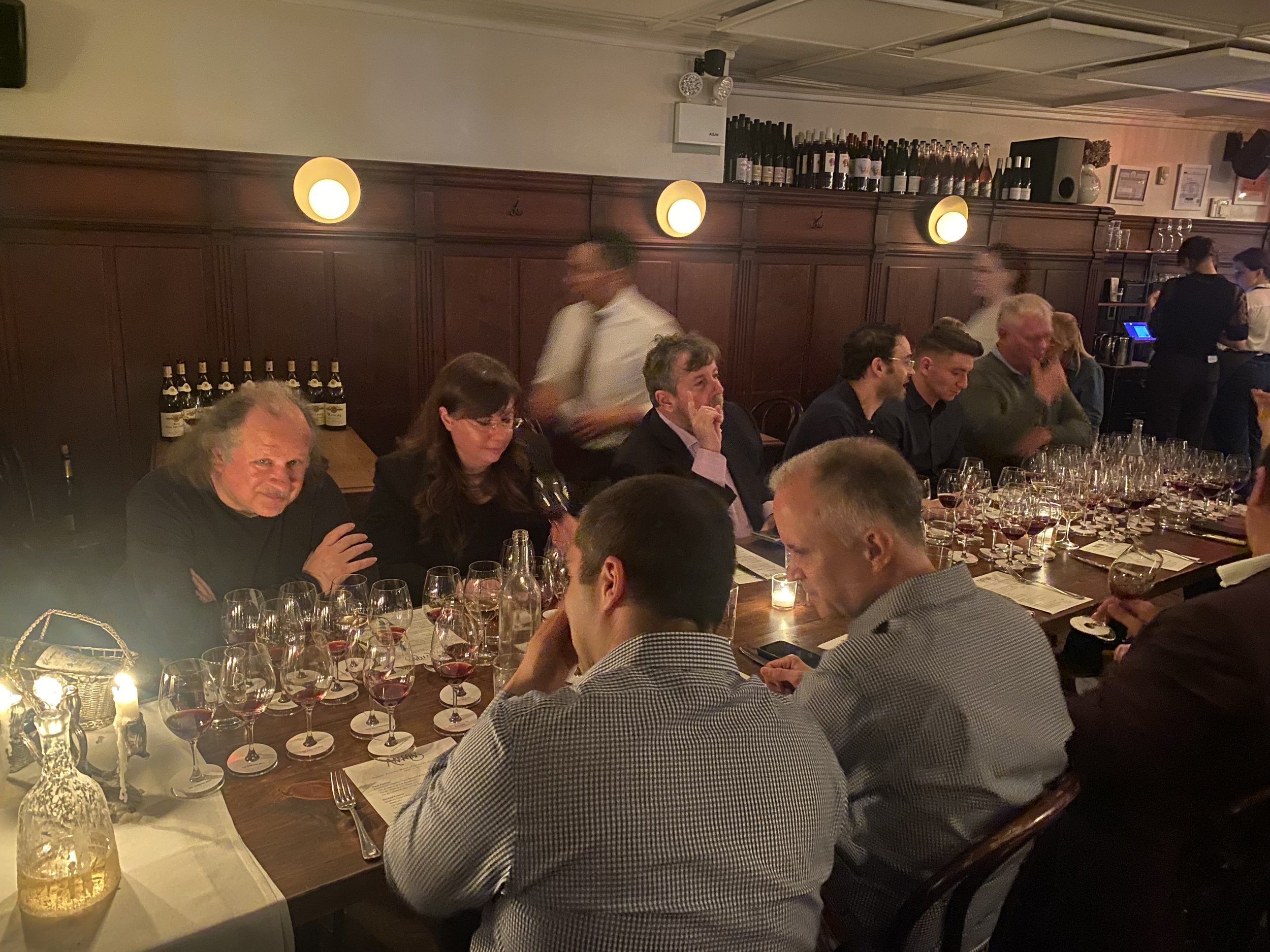
Everyone gathered last night at the charming neighborhood restaurant Anton’s in Greenwich Village to indulge in creamy Cacio e Pepe and perfectly roasted heritage chicken, but the star of the show at the table was certainly in the glass of our happy guests.
Twelve wines from Domaine Michel Lafarge were poured, all Volnay except for one Beaune from the Clos des Aigrots, drinking excellently by the way from the 2017 harvest.
In addition to this Beaune, the first flight included a very interesting comparison of two renowned Volnay Climats, Clos des Chenes 2017 and Clos du Chateau des Ducs 2018. Although only one year apart, the two wines were quite different and expressed the expected bright fruit from 2017 while the richer vintage of 2018, combined with the warmer site and rich soil of Clos du Chateau des Ducs, showed more weight and an almost authoritative personality.
If on paper the second flight may not have seemed to be the most exciting, all twelve guests and I ended up being very pleasantly surprised with the so-called “vegetal” 2011 vintage. Both the Volnay Vendanges Selectionnées, a wine sourced from different parcels including Les Mitans, and the Caillerets 2011 displayed great class and elegance. The greenish, stemmy character of the vintage seemed to be more present in the Cailleret but the finish was quite beautiful. I noted a touch of volatile acidity in the Volnay Vendanges Selectionnées, a trait that I find neither rare or disturbing in the Lafarge wines. And finally, 2012 Cailleret. In 2020, a portion of it got replanted in an intriguing spiral shape after an idea from Frederic Lafarge. Today, his daughter Clothilde, who represents the 9th generation at the estate, runs the operations and particularly enjoys ploughing this unique site with her beloved horse named “Quille”. Cailleret 2012 was a bit shy on the nose and the palate a bit tight. Some more time is needed for this vintage that I have always found quite heterogeneous among producers and therefore difficult to qualify overall.
The third flight really brought a smile upon everyone’s faces. This highly anticipated 2002 horizontal of Cailleret, Clos du Chateau des Ducs and Clos des Chenes, was admirable. Once again, I found the Clos du Chateau des Ducs to be a touch raisiny and stewy. A characteristic that did soften up a bit with oxygen though. I also understand that the chicken proved to be the ideal companion for that flight. Although a touch of volatile acidity was felt, I really enjoyed the damp, earthy notes of the Caillerets which paired well with the morels. My favorite performer was certainly the Clos des Chenes where I found the balance to be nearly perfect. Just enough flesh and volume while the crunchy cherry-like fruit made you beg for more.
I am pretty sure everyone could hear the imaginary drum roll that preceded the last flight: a 1990 duo of Clos des Chenes and Clos du Chateau des Ducs followed by the grand finale: a pristine bottle of 1980 Clos des Chenes, hands down the wine of the night. The same cooked fruit, jammy prune profile showed in the Clos du Chateau des Ducs. But once again, it was not so much “in the way”of the wine. Once again, I really thought the Clos des Chenes won the medal. Reading my notes from last night, this is what words came rushing down my pen: Incredible, pure, very long, majestic. Yep, I really liked that wine!
Nothing makes me happier than finishing a wine dinner with the wine of the night. If this is certainly a goal, it is also quite ambitious since typically the older wine is supposed to be the most memorable, it can also easily be faded or too old. This was certainly not the case last night. Another large vintage of very variable quality as magazine “Decanter” qualifies it, 1980 is easily overlooked. I was lucky enough to taste several amazing red burgundies from that vintage that also happened to be Raj’s birthyear, hence my multiple, lucky opportunities to taste it.

