
News from the Vineyard - Science of Olfaction
Victoire Chabert
July 1, 2022
Today I wanted to present an article from my uncle Patrick Essa, who leads the Domaine Buisson Charles estate with my aunt Catherine and their son, my cousin and oenologist Louis. Patrick is passionate about wine and his writing skills prove it. I propose that you learn more through one of his texts that he published last April and that could allow you to know more about the aromatic olfactory notes.
“A short while ago, I mentioned in these columns the aromatic deviations, empyreumatic and roasted, that affect white wines. As I delved deeper into my sensory memory, I had the idea of memory, I had the idea to list here the main defects that can be found in the wines made from Chardonnay of the Côte de Beaune. Indeed, the wine lover - who is not always a beginner of course - does not have the chance to observe the birth and evolution of its scents and aromas and can be led to confuse them with an aromatic complexity to be linked in priority to the grape variety or the terroir.
These varietal and/or terroir-specific notes can thus be parasitized by the balance of the harvested fruits and/or the residues of the vinification and maturation which are almost systematically "impure". These two poles that could be qualified as "natural" and "artificial" are opposed and lead the winemakers to make choices that tend towards a magnetic" orientation that marks their wines significantly. In a more insidious way, the wines produced since time immemorial have always been at the crossroads of these two orientations and are culturally singled out by them. Those who do not understand that the terroir alone cannot explain the image that characterizes an appellation will always try to find "extra natural/artificial" accents in the wines he tastes because these indelible accents carry in them a part of the implementation that observe those who who make them.
To clarify my point about the roasted drifts that a bottle can carry, I listed in my previous article a number of perceptions - not exhaustive - that affect the wines
Here, I will start from the aromatic note to better try to explain its genesis and its different perceptions and interpretations in the finished wine during olfaction.
1- The iodized olfactory note: this scent, which can be discreet if it comes from a slightly botrytized "wet" harvest, is often invasive in wines marked by non-noble rot, known as "grey". Impossible to eradicate without using pure lees - possible when the same appellation is produced on different climates and some are not affected by rot. Frequently impacted years: 1981, 2001 and 2010.
2- The "apple" olfactory note (of green or warm apple): the must or wine has taken on air between alcoholic fermentation and malolactic fermentation or the latter has lasted a very long time at a slow pace. This last case frequently occurs in musts with high acid potential. Impacted years: 1994, 2008.
3- The "vegetal" olfactory note: the scents of cut hay, sage or iris come from a maturation without sun in a late year combined with a slightly too loose settling. Thick skins, quite high degrees but rarely exceeding 13, small desiccation of the berries by the wind. The pressings of these berries often give little juice and the wine turns to gentian flower on the nose. Years: 1991, 2004, 2011.
4- The "waxy" or "honeyed" olfactory note: an overripe harvest, not very acidic and sometimes marked by a real botrytis. Often the sign of a premature evolution unless the color remains golden with green reflections. The wine starts its life under glass with scents of mirabelle plum and then evolves more or less quickly towards aromas close to mead. Year 1983, 2006.
5- The olfactory note of "candied orange": a year of botrytis which is often combined with pronounced golden colors. Very aromatic when young, sometimes refining with ageing but never on the most noble fresh notes. The viscous texture can seduce. Year: 1989, 1992, 1995.
6- The olfactory note of white truffle: from raisined and/or wilted grapes. Not unpleasant if discreet but unfortunately often combined with low acidity: 2003.
7- The toasted olfactory note: see the text written about it in my previous review.
8- The "buttery" olfactory note: fresh or rancid, it is due to a lactic bacterium working during the MLF, oenococcus oeni, which generates during a tumultuous fermentation a metabolite precursor of aroma, the diacetile. All years can be impacted, but curiously, especially highly concentrated musts marked by intense malolactic fermentation.
9- The olfactory note called "reduced": heady nasal nebula which evokes in turn the sulphuric wick or which goes under its evolving form H2S towards the famous mercaptan, a thiol which smells the egg punaie. It is the worst organoleptic deviation. It is generated by muddy lees which come from fruit marked by residual sulphurs combined with containers which do not allow any micro-oxygenation. It must imperatively be circumscribed before bottling by treatment with copper. Its olfactory "residue" is the blackcurrant bud.
10- The "asparagus" olfactory note: massive addition of sulfite at bottling and slow combination with the so-called total SO2 part under glass. The free SO2 generally remains at a high level. The wine ages well but is lean and not very complex.
11- The amylic note which marks the wines having fermented at low temperatures in large inert containers. Aromas of "scotch glue" that oversimplify the olfactory pole of the wine by giving the illusion of white fruit notes when aired. It is often coupled with residual sugars and the absence of malolactic fermentation. Not to mention doses of CO2 gas.
To produce a white wine free of all these scents is a challenge as the vintages, by their characters, characterize the wines but it is undoubtedly necessary to seek discrete expressions that do not dominate the ultimate finesse that comes from the note of terroir combined more or less frankly with those of the grape.
We also consider that the wines should not be under the influence of the container in which they were vinified. The sweetness of a woody wine should never dominate the balance of the fruit. Similarly, neutral containers such as stainless steel should not produce residual reducing effects and should only enhance the freshness of the initial aromas without erasing them with sulphurous accents.
Among the most used terms in the wine literature, I think that "reduction" follows very closely to "minerality". A somewhat nebulous term often used incorrectly, it is one of those used to justify gustatory odors that are as varied as they are misunderstood, and if for a long time it was synonymous with defects and unpleasant odors, it is curiously becoming one of the vectors necessary for a happy conservation.
Is the hunt for the natural organoleptic qualities of a product now going to involve a search for living things that do not smell like roses? One could believe it sometimes if I judge some wines that are born on olfactory registers expressing themselves on the grilled match - white wines - or cabbage - red wines - for example. What exactly is the origin of this reduction? Is it the simple effect of a liquid loaded with alcohol placed in an anaerobic environment or is it the result of some process linked to the wine making process? As is often the case, reality is more complex than it seems and the causes of its development are multiple. But let's not be mistaken, it is not a path taken serenely by a winemaker wishing to use its benefits.
It is a frequent consequence of fermentation in containers with little or no oxygen permeability. It can have multiple origins and is, whatever one may say, always to be monitored in terms of its intensity because it can irreparably spoil a wine.
Following the cycle of conception of a wine, the first element that could generate reducing effects has to do with the phytosanitary treatment program used by the producer on his vine plants, because it can leave sulfur residues on the fruits and in the musts. The same is true for wines from soils with high nitrogen deficiencies. Thus, we observe with constancy vintages regularly impacted by significant reducing phenomena while according to the same procedures, other vines located next to them seem never to be affected. A frequent headache linked to the balance of the soils - and above all to their geological and cultural history - which very often leads the producer to be the follower of his wine rather than its instigator, even if this may delight "by default" the supporters of reductions under glass as a "freshness" argument.
An analysis of the soils and their composition crossed with a reflection on the possible amendments is necessary here to understand the causal relations at the origin of their "functioning" and consequently to optimize their incidence.
Once the grapes are in, the vatting stage for the reds and pressing for the whites is essential. It is necessary to manage the white or red vintages according to an essential parameter, the oxidation of the vacuolar juices released. The musts obtained are then fragile and oxidizable and must be protected. For this purpose, an aqueous solution mixed with SO2 (sulfur dioxide) is most of the time used. This anti-oxidant product has the effect of covering the fermenting musts by preventing their redox potential - see below for an explanation of the term - from dragging them to the dark/oxidative side of the force.
If all fermentative activity consumes oxygen, for any cell in aerobiosis, which breathes, as for any cell in anaerobiosis, which ferments, there is recovery of energy stored in the form of phosphorylated compounds. This oxidation energy is essential for the growth of the cell and then for its aging.
The fermenting wine is also marked by its oxidation-reduction phenomena due to the effect of oenological treatments. The birth of a must occurs at the pressing. At this technological stage of elaboration, the future wine released by the berries is under the influence of atmospheric oxygen and this oxygen is a substrate of choice for polyphenol-oxidases whose activity is very detrimental to its aging potential. The winemaker must act by a reductive treatment of the musts with a sulphite solution according to doses that he will interpret according to the characteristics of his press juice. Inhibited by these reductive treatments, the different enzymes - tyrosinase and laccase - will not be able to generate casse brune which considerably reduces the complexity of the phenolic compounds. The must, during its settling and racking, will even be able to dissolve a few milligrams of oxygen that the yeasts, true "electron factories", will consume and reduce in order to multiply better. It is therefore obvious that the first steps in the treatment of a must for its transformation into wine correspond to oxidation phases followed by reduction phases.
It is the same for the rest of the elaboration, during the maturation and then, in the final phases, during the last steps that precede the bottling: the racking and the possible fining and filtering. This succession of oxidation and reduction defines from the beginning of the fermentations a REDOX potential which is the expression of the electrical activity which is automatically generated by fermentations and oxidations. Expressed in millivolts, it sanctions the functioning of the must according to its evolution between its two poles and obviously it can be analyzed and controlled by the winemaker whose strategy aims at never leading it to extremes.
Thus, during the maturation process, the game consists in preserving a reducing matter without it evolving towards a heavy reduction which would strongly impact the wine's scents, or even its matter itself. In particular when the reducing wine evolves towards the famous defective nose of mercaptan which can be assimilated to the smell of punished egg.
Without going towards these compounds, the excessive reductive markers that pull the Redox potential down - the top being here oxidation - are commonly the notes of green asparagus and grilled matches in whites and blackberry, viandox then blackcurrant bud and cooked cabbage in red wines. Grilled in the whites and iridescent notes and animality in the reds are thus - at high intensity - serious defects that should never be blamed on a possible expression of terroir.
The winemaker has simple remedies to eradicate these harmful olfactory expressions as soon as they appear or in a later, more curative mode. I am not going to list them here, but you should know that it is not necessary to preserve a reductive material for a wine to keep well. It is not necessary to over-sulphite a juice with an oxidative tendency to fossilize it... It is all a question of balance.
In the absolute, a very fine toasted nasal line underlining an ageing carried out on the middle line of the Redox potential associated with an olfactory volatility conferred by an imperceptible but present CO2, authorizes a lively and relaxed wine matter to face time by embracing fresh scents and by preserving an overall purity absolutely essential to the expression of a well born wine... Or rather a good nose!
How can we accept that obvious deviations are taken for aromatic complexity by sharp palates while explaining that a residual note of maturation is most often the result of an unfinished work?
To illustrate my point, I will try to isolate what generates this famous toasted note that would sign the noblest aromas of a couple of advanced winemaking / maturation in the world of white winemakers. Of what order are they:
The "sulphurous" toasted note: more or less intense perception on the Swedish match and the rubbed flint. Most of the time, it is sulfur residues that have been spread for a long time and at a late stage by dry spraying. Leachable by rain, these repeated applications end up impregnating the skins of the grapes and they durably mark the musts during vinification and maturation. Impure.
The "roasted" note: an artifice of an ageing process carried out with a generous proportion of new, heavily heated wood. It "peanuts" or "caffeine" or even gives off a smell of "toast" depending on the heaviness of its imprint... always vulgar. An impurity that many people love and even seek. The ageing in large barrels has a clear tendency to amplify this phenomenon.
The "roasted" note: discreet nasal scents that evoke fresh hazelnut and apricot skin - or grape skin - gilded in the sun. A sign of right maturity without botrytis, it ennobles the wine. Pure.
The "reduced" toasted note: it appears during the maturation when the proportion of lees is a little high compared to the micro-oxygenation potential of the container. Fine notes during a well-managed maturing process that wishes to be little interventionist on sulfites, it can irremediably mask the finest aromas of white wines - and in particular those that are floral - if it is too marked. Pure if it only traces finely during maturation. Impure as soon as the wine is under glass because a single racking should be enough to make it disappear. Highly impure when combined with the "match" toast that leads the taster to feel an unpleasant olfactory note of "firecracker" after use.
The toasted "praline": the ultimate and fresh note of hazelnut lignifying, it evokes the limit between the fruit and the vegetable and marks the terroirs most capable of bearing great grapes at full maturity without too many natural degrees. Lost if the fruit meets under-ripeness, overload of yield or excess of alcohol, this noble toast is delivered only in great years. The last one was for example in the Côte des blancs, 2009, but we could evoke 1999, 92 or 89,82,79,76 and 73. Pure.
The "toasted vanilla/coconut" note: heavy note brought by the over-ripeness of the fruit and a very present woodiness. Less unpleasant than the match or the empyreumatic roasting at first sight, it is undoubtedly worse because it signals an unbalanced matter. Impure.
Therefore, be aware that the toasted expression of a white Burgundy must always be retained and that if it is superimposed "in front" of the aromatic spectrum of the wine, it spoils it irreparably. Its olfactory place is therefore naturally subjacent, subtle and infinitely discreet.”
-Patrick Essa


Clos Rougeard Saumur Champigny 2011
What’s Pressoir Drinking
By Edouard
6/30/22
by Edouard Bourgeois
July 1, 2022
A friend of mine once told me that the smell of Cabernet Franc sometimes reminded him of a pizza box, steaming with bell peppers. I always think of the analogy when I taste these delicious wines from the Loire. When kept in check, the vegetal aromas of Cabernet Franc can be really charming indeed.
I opened a memorable bottle of Saumur Champagny from one of the most respected producers in the region, Clos Rougeard. Of course, I nostalgically ordered a pizza from my favorite local joint to go with it.
A few words about Clos Rougeard are needed.
Charles Joguet, the great winemaker of Chinon, once said: “There are two suns. One shines outside for everybody. The second shines in the Foucaults’ cellar.”
Brothers Charlie et Nady Foucault took over the family domaine as the 8th generation. A mere 10 hectares of vineyards planted on soils composed of sand (silica) and the typical limestone locally called Tuffeau. If the wines today can easily fetch $500 per bottle, it is because of the incredible consistency of the quality, even in challenging vintages.
While the synthetic chemicals were the norm in the 60’s and 70’s, the Foucault family kept everything the same and they have been organic forever. Back then also, while their neighbors were buying modern stainless steel vats, the brothers kept buying oak barriques.
In a video I strongly recommend to watch here, Nady explains the anecdote of the 1970 vintage. That year, the summer promised a generous harvest, so Clos Rougeard decided to remove some grapes to control the yields. Back then, such practice was not exactly fashionable and producing more meant selling more, leading to better business, but inevitably less interesting wines. The Foucaults would then bury these cut off grapes so the locals wouldn’t gossip behind their back. It is rather amusing to see, as Nady points out in the video, that today, not only almost everyone limit the yields in July, but they also ostentatiously expose the cut off grapes in the vineyard for everyone to see…
The revolution at Clos Rougeard was to change nothing, always striving for concentration and finesse.
After the death of Charlie Foucault in 2015, the estate was briefly ran by Nady Foucault and his nephew Antoine (who also produces the excellent Domaine du Collier wines).
In 2017, Nady chose to sell the estate to Martin Bouyges, owner of many French wineries, most notably Château Montrose in Bordeaux. Under the direction of Jacques-Antoine Toublanc, the new ownership has vowed to keep things exactly the same in the vines and the cellar.

No bell pepper on that pizza but great pairing nonetheless.

What's Pressoir Cooking - Carotte Râpées
June 22, 2022
By Justine Puaud
Summer is here!
Carotte Râpées
From three-Michelin-star Chef Alain Passard
In the summer, I try to be innovative and find some delicious, fresh and easy recipes. This one is for Daniel Johnnes who is a huge fan of “carottes rapées”. He cannot go to France without eating this traditional/super easy appetizer. I hope he will try and will love it!
This recipe is from Chef Alain Passard. The 3-Michelin star chef is known for designing menus only with vegetables. Chef of the restaurant Arpège in Paris, he sublimates the plant world like a painter in his canvas. Fifteen years ago, at the turn of the millennium, Alain Passard began a radical change of his era. Goodbye veal, cow, pig... The chef decided to break with meat, marrying beets, celery and turnips for a second time, and manages two large vegetable gardens in Sarthe and Eure, to satisfy his desire. In the land of veal blanquette and coq au vin, this vegetable love song could seem very daring. He was at the time the precursor of a new trend, and when ecology, food scandals and awareness of animal suffering were not really important problems to face, he was pleading for the reasonable consumption of meat.
This recipe is known for the dressing. He created the “citronette” which is a vinaigrette made only with lime, honey and olive oil. This dressing is absolutely delicious.
Ingredients
7 carrots (I usually like to mix colors)
1 apple (I recommend the pink lady apple which is juicy, tart and crunchy)
a handful of hazelnuts
a handful of raisins
some fresh parsley
2 limes
honey
olive oil
salt and pepper
Instructions
Grated carrots “Carottes râpées”
peel and grate the carrots
roast and crush the hazelnuts
prepare a julienne with the apple
add carrots, hazelnuts, raisins, apple and fresh chopped parsley in a bowl
“Citronette” dressing
squeeze lime juice in a bowl
add a good pinch of salt (ideally choose the “fleur de sel” salt")
add 1 tablespoon of honey (would recommend a liquid acacia honey)
Mix everything together to find the perfect balance between the acidity of the lime and the sweetness of the honey. Then, add 5-6 tablespoons of olive oil and continue to mix. The texture of the dressing will start to be creamy and smooth.

What's Pressoir Drinking? Champagne Chartogne-Taillet
by Jaime Dutton
June 23, 2022
Last week I celebrated my birthday with a bottle of Chartogne-Taillet Les Couarres Champagne and it did not disappoint. Every time I pop the cork on a bottle of Alex’s wines I am amazed by their precision and depth. This wine was so good and had a wonderful balance of power and subtlety, with a richness on the palate - a broad character that was enjoyed with our roast chicken dinner.
From the 2010 vintage, this bottle was disgorged in June 2014. Not a baby any more! Predominantly Pinot Noir (60%) blended with Chardonnay (40%). Les Couarres is a terroir in the center of Merfy, its soils are sand over clay.
Don’t miss the opportunity to taste this wine alongside 11 other cuvées at the upcoming Pressoir Dinner featuring the wines of Chartogne-Taillet at Momofuku on July 13. The details are here!


Podcast "The Northern Rhône with Mannie Berk & Rajat Parr"
Raj Vaidya
6/23/2022
Part 3, Hermitage
I’ve had the Northern Rhône on my mind of late, partly because of some special time spent there in April and also because I’m getting excited about hosting our next Sommelier Scholarship Fund trip back to the region in a few weeks, where I’ll have the pleasure of introducing the region to four scholars who will travel with me to learn the nuances of the region. I took this current infatuation as an excuse to tap into two of the great minds and palates I know of when it comes to the region: Mannie Berk, the proprietor of the Rare Wine Company and Rajat Parr, former sommelier turned vigneron in California. We had a lovely chat about the various red wine appellations which I’ve split up into digestible segments for you to listen to at your leisure. Hope you enjoy listening in, they are truly some of the most knowledgable and experienced minds in the business.
-Raj
Podcast "The Northern Rhône with Mannie Berk & Rajat Parr"
Raj Vaidya
6/30/2022
Part 4, Crozes-Hermitage & Cornas
I’ve had the Northern Rhône on my mind of late, partly because of some special time spent there in April and also because i’m getting excited about hosting our next Sommelier Scholarship Fund trip back to the region in a few weeks, where i’ll have the pleasure of introducing the region to 4 scholars who will travel with me to learn the nuances of the region. I took this current infatuation as an excuse to tap into two of the great minds and palates I know of when it comes to the region, Mannie Berk, the proprietor of the Rare Wine Company and Rajat Parr, former sommelier turned vigneron in California. We had a lovely chat about the various red wine appellations which i’ve split up into digestible segments for you to listen to at your leisure. Hope you enjoy listening in, they are truly some of the most knowledgable and experienced minds in the business.
-Raj
Podcast "The Northern Rhône with Mannie Berk & Rajat Parr"
Raj Vaidya
6/15/2022
Part 2, Saint-Joseph
I’ve had the Northern Rhône on my mind of late, partly because of some special time spent there in April and also because i’m getting excited about hosting our next Sommelier Scholarship Fund trip back to the region in a few weeks, where I’ll have the pleasure of introducing the region to 4 scholars who will travel with me to learn the nuances of the region. I took this current infatuation as an excuse to tap into two of the great minds and palates I know of when it comes to the region: Mannie Berk, the proprietor of the Rare Wine Company and Rajat Parr, former sommelier turned vigneron in California. We had a lovely chat about the various red wine appellations which I’ve split up into digestible segments for you to listen to at your leisure. Hope you enjoy listening in, they are truly some of the most knowledgeable and experienced minds in the business.
-Raj

What's Pressoir Drinking - Réné Engel, yes, again....
by Raj Vaidya
Thursday, May 26, 2022
June 16, 2022
by Raj Vaidya

A proper Friday Apero ala Pressoir!
A couple of weeks ago we kicked off the summer season in our Pressoir office with a celebration, Daniel’s birthday! In celebration I thought a special bottle was in order….
Sourced recently yet from a great cellar in pristine condition, this bottle of Engel Vosne-Romanée Brûlées was all that one could hope for from a great mature Burgundy, all spice and jasmine flowers in the nose, a touch of beet sugary sweetness to the palate and lovely length and vivacity on the palate. A proper kickoff to that weekend, and to toast Daniel’s special day!
We started off with this beautiful Ledru Cuvée Goulté, making the theme of the evening ‘the defunct winery apero’, and it was no slouch!
Podcast "The Northern Rhône with Mannie Berk & Rajat Parr"
Raj Vaidya
6/9/2022
Part 1, Côte-Rôtie
I’ve had the Northern Rhône on my mind of late, partly because of some special time spent there in April and also because i’m getting excited about hosting our next Sommelier Scholarship Fund trip back to the region in a few weeks, where i’ll have the pleasure of introducing the region to 4 scholars who will travel with me to learn the nuances of the region. I took this current infatuation as an excuse to tap into two of the great minds and palates I know of when it comes to the region, Mannie Berk, the proprietor of the Rare Wine Company and Rajat Parr, former sommelier turned vigneron in California. We had a lovely chat about the various red wine appellations which i’ve split up into digestible segments for you to listen to at your leisure. Hope you enjoy listening in, they are truly some of the most knowledgable and experienced minds in the business.
-Raj
What's Pressoir ... Watching!
by Victoire Chabert
June 9, 2022
What is Pressoir watching? I came to the idea that it would be interesting to offer you film content suggestions that are related to Burgundy, wines... or simply French culture.
To begin this series, how not to mention the film La Grande Vadrouille (meaning the "The Great Stroll"), directed by Gérard Oury and in theaters in 1966, it is a "must" of French comedy, shot and directed in Paris and Burgundy.

In 1942, an English plane was shot down by the Germans over Paris. The three pilots parachute and land in different places in the capital. They are helped by two French civilians, a conductor and a house painter who accept taking them the pilots to the free zone; they thus become, in spite of themselves, actors of the Resistance. Pursued by the Germans, the fugitives go through many adventures during their journey to Burgundy.
Without revealing too much to you, La Grande Vadrouille is an absolute gem that I will never tire of seeing again! You can normally find it streaming on Apple TV or Amazon Prime Video.
This film is indeed one of the best popular comedies in French cinema (it reached admission records for almost 40 years) but it is also dear to my heart because it was partly shot in Meursault, in particular at the city hall. At that time, my grandfather, in addition to being a winegrower, was a volunteer firefighter and had the chance to shoot the scene of the fire alongside the legendary duo Louis de Funès and Bourvil.
La Grande Vadrouille is finally one of the first films in France to dare to mix a real quirky humor in the face of the grandeur of recent history.
Justine who lives in Beaune was able to take a picture... a fresco representing the Grande Vadrouille to tell how much the Burgundians are attached to the film and proud!


Recap Dinner Volnay - Pommard
Recap Dinner Volnay - Pommard
by Edouard
6/8/22
by Edouard Bourgeois
June 8, 2022
So, is Volnay indeed a lighter version of its neighbor Pommard, known for its rustic edges and powerful structure?
Tuesday’s dinner at Winner may have provided some answer to that question. Ultimately, defining each village’s wine style in broad strokes seems pointless. It is no secret that each commune offers a wide diversity of styles depending on their specific climat, winemaking apart.
A special kudos to Chef Daniel Eddy who once again prepared an impeccable menu, featuring his signature roasted chicken and one of the best bread in New York.
Below are my tasting notes:
1st course
Domaine Clos de la Chapelle Volnay 1er Cru En Carelle 2018
Created 150 years ago, the domaine has been recently purchased by American Burgundy lover Mark O’Connell. “En Carelle” is in fact in the climat “Carelle sous la Chapelle” which, as the name indicates is located right below the 16th century chapel. Carelle was already designated “Tete de Cuvée”, the highest classification by Dr. Jules Lavalle in 1855. In a recent exchange with Mark, he explained to me that he preferred to change the label to “En Carelle” instead of Carelle sous la Chapelle” to avoid confusion with their flagship cuvee “Clos de la Chapelle”.
The wine provided an excellent start for the dinner, with fresh aromas of small, concentrated black fruits, certainly a signature of the heatwave from the 2018 summer.
Domaine de la Pousse d’Or Volnay 1er Cru Clos de la Bousse d’Or 2018
Great showing here. The illustrious domaine that was once part of Domaine de la Romanée Conti and Clos de Tart became an icon when in the hands of winemaker Gerard Potel. It was eventually acquired by the Landanger family in 1996 who converted the winery into a state-of-the-art facility with modern, gravity fed equipment. I found the wines from this new era to become a bit too polished for my taste, with sometimes a lack of “rusticity”. But this bottle made me (and all the guests I spoke to at dinner) very happy. A bit shy at the opening, it developed great depth and an intricate multi layered profile. A beauty.
Domaine Clos de la Chapelle Pommard 1er Cru Les Grands Epenots 2018
Back to the first producer featured here, and entering Pommard with the famous “Grands Epenots” climat, located on the northern portion of the Pommard vineyards, closer to Beaune. If there is no Grand Cru in Pommard (and in Volnay in fact) “Grands Epenots” has been in serious consideration to be elevated to that rank. The wine felt much more youthful than the first two - promise for graceful and long aging. Aeration helped but more time will be needed to tame its strong personality and let the fruit express itself more. The alcohol can be felt here.
Domaine de la Vougeraie Pommard Les Petits Noizons 2018
Created in 1999, the empire of Domaine de la Vougeraie, owned by the Boisset family, covers top vineyards. This village level “Petit Noizon”, located rather high on the slope, enjoys a southern exposure and overlooks the Premiers Crus of Pommard’s northern section. It seems that the village level ranking of this wine was felt, providing a bit less length and density than the other wines thus far. A bit thin in my opinion but a sound bottle.
2nd course
Domaine Rougeot Père et Fils Volnay 1er Cru Santenots 2017
This organic producer is an advocate of whole cluster winemaking. The bottle showed a touch of volatile acidity that seemed to linger, even after aeration. Outside of that distraction, this Volnay was elegant and pure, with high notes of fresh fruit. Quite surprising for a “Santenots”, a unique climat effectively located in Meursault, but allowed to register as Volnay when planted with Pinot Noir. Typically the Volnay Santenots is a much denser wine, quite the opposite of what one might expect of the delicate reputation of Volnay wines,
Domaine Yvon Clerget Pommard 1er Cru Les Rugiens 2017
For these Pressoir dinners, I usually start by opening most if not all the wines right before starting the dinner (depending on the age of the wines presented). For this Volnay-Pommard event, I opened all the bottles at around 6pm. First, I just smell each one without tasting them, which I do later in the evening. When I put my nose on this “Rugiens”, it was the most expressive wine. The palate later confirmed the strong personality of this excellent climat. To those who think of Pommard for its flesh and grandiose stature, this is the perfect example. The iron rich clay soils of “Rugiens”, perched over 300 meters on the hill, give this bloody aromatic characteristic to the wine. One of the wines of the night for sure.
3rd course
Domaine Nicolas Rossignol Volnay 1er Cru Chevret 2011
This wine reminded me once again that “Nico” Rossignol does very well in cool vintages. 2011 was far from easy. The rot pressure in the vineyard forced producers to meticulously sort the harvest. If the signature green notes of the vintage could be felt at first, they quickly vanish to let the fruit shine and deliver a very pretty wine. Located right under the magnificent “Cailleret” climat, “Chevret” is usually a delicate wine.
Domaine Pierre Morey Pommard 1er Cru Les Grands Epenots 2011
Pierre Morey, and now his daughter Anne, are certainly known for their superior white wines, but this Pommard was excellent. Biodynamic and fully destemmed, this wine also dodged the unappealing vegetal notes one expects from the vintage. A bit more earthiness in this “Grands Epenots” compared to the one from Domaine Clos de La Chapelle tasted earlier.
Benjamin Leroux Volnay 1er Cru Clos de la Cave des Ducs 2010
Ben Leroux’s ability to make really fine wines, even from modest appellations and in both colors makes him quite a prodigy. The young man runs a 28-hectare operation, 8 of which are vineyards he owns, the rest being purchased from trusted growers. The Clos de la Cave des Ducs is located just outside of the village of Volnay and often seem overlooked. A bit shy at first, the wine quickly gained some weight and confidence. Excellent mouthfeel, full and rounded with juicy, sweet cherry.
Nicolas Rossignol Pommard 1er Cru Les Fremiers 2010
Nico Rossignol likes to show that Pommard can be elegant and not necessarily this powerhouse tasters may expect. Note: the climat “Fremiers” has the particularity of being in both Pommard and Volnay. In the latter, it is spelled “Fremiets”. This was a great showing with plenty of violet aromas and earthiness.
4th course
Bouchard Pere Fils Volnay 1er Cru Les Caillerets Ancienne Cuvee Carnot 1999
I always like to finish these dinners on a high note and this wine really put a smile on everyone’s face. “Cailleret” is a magnificent site and among the best Premiers Crus of Volnay, perfectly located mid-slope, with many small rocks that add a lift of minerality to the wine. Once owned by the Carnot family, this plot, right below the “Clos des 60 Ouvrées”, was the first acquisition of Domaine Bouchard in 1775. The beautiful secondary notes here were truly delectable. Unlike some of the younger wines of the previous flights, this Volnay was in full bloom, exploding with violet, truffle and juicy small red berries. Great bottle.
Domaine de Montille Pommard 1er Cru Les Pezerolles 1999
The heavyweight champion of the night. 1999 is a superb vintage all along the Cote d’Or but it performed particularly well in the Cote de Beaune, where a bit less rain fell. Sometimes compared to 2017 because of the generous quantity produced, 1999 is marked by a little more concentration which today is rewarding those who waited to open their bottles. Once again here, just like with the “Rugiens”, this “Pezerolles” had an iron rich aromatic profile and the power of the wine stretched its wings in a lingering finish.

Domaine Roulot, Meursault "Les Luchets" 2007, en magnum
by Daniel Johnnes
June 8, 2022
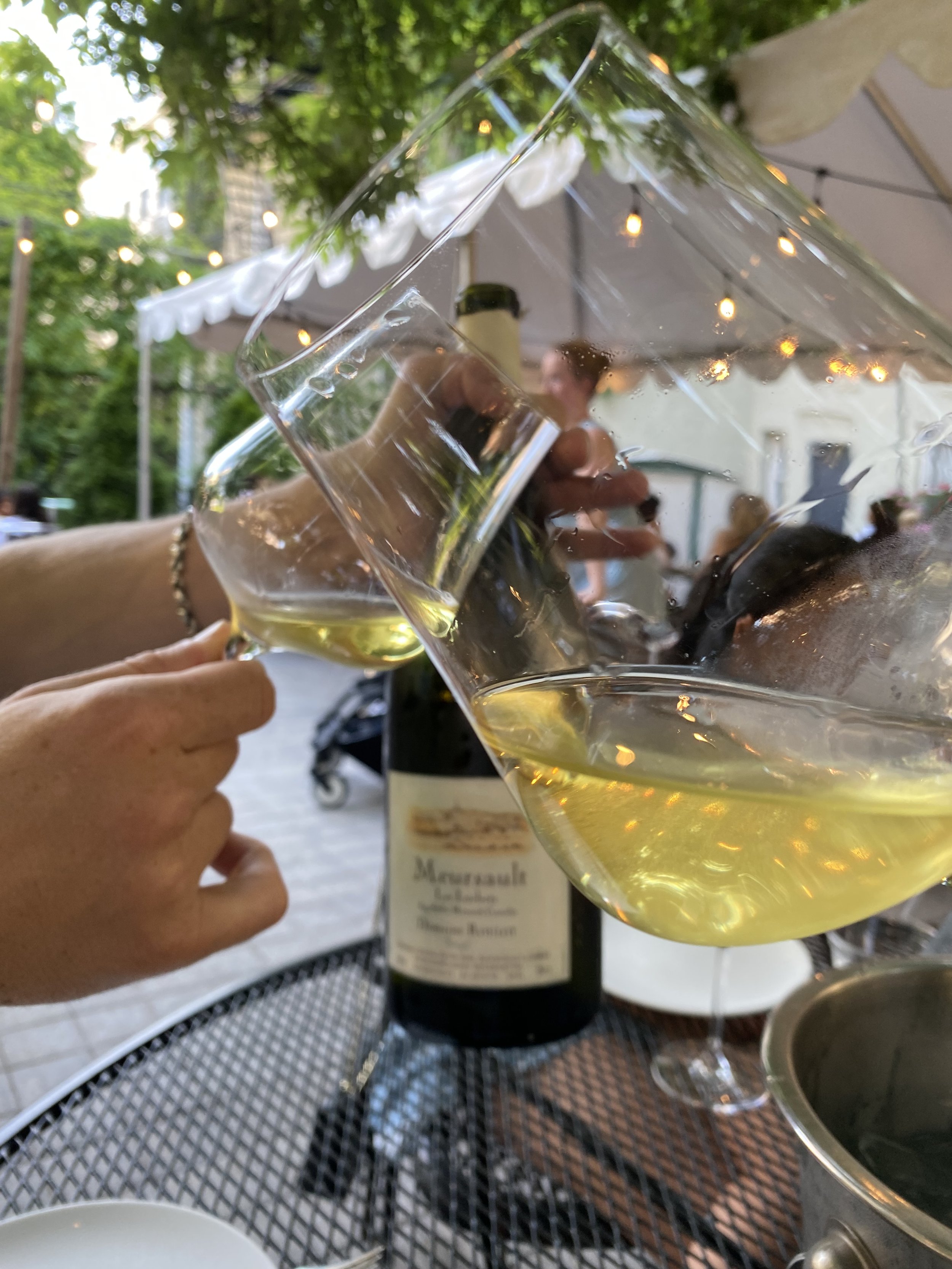
It was a steamy early summer night and I was dining with my family in the wonderful garden at Popina restaurant in Red Hook, Brooklyn.
Knowing we would be eating outdoors on a warm night, I was reluctant to bring an extra special bottle as I have found hot weather does not provide the best environment for nuanced wines.
This night, however, was special. At least for me as it was my birthday dinner.
Thus, I went deep into my cellar and chose a magnum of Domaine Roulot, Meursault “Les Luchets” 2007. Having had it before, I knew it could be a delicious wine to share with my kids, wife and friends but one never knows. Well, this one delivered and delivered again and again. It was a magnificent wine in all its glory, as it is just starting to evolve from a primary stage into adolescence/young adulthood. What struck me and my son immediately was the radiant, golden green color with reflections reminding me of sparks of sunlight and electricity.
It is no mystery that Jean-Marc Roulot is one of the best white winemakers in Burgundy and is known for isolating the “lieux dits” of this domaine; a practice his father, Guy Roulot, started as a way to demonstrate the unique expression of each terroir.
Luchets lies just a bit higher on the slope from the legendary strip of great sites: Narvaux, Tillets, Casse-Tetes, Tesson, Rougeots. Although not as well known as Tesson in the Roulot portfolio, I have loved this vineyard over the years as has Jean-Marc. His love of it is evidenced by him writing a play dedicated to it titled ‘Meursault Les Luchets’, which he performed twice during La Paulée, once in New York and once in San Francisco. It was meaningful to see how the spirit of a vineyard can inspire such creativity and become a force much greater than the banality of a simple bottle of wine.
Back to this magnum. It was spectacular as was the company and food. I can’t wait to go back and enjoy a great bottle from one of the best wine lists in NY.
News from the Vineyard
May 31, 2022
by Justine Puaud
The busy season in the vineyard has started
Do we really know the seasonal cycle of the vine?
In June, in Burgundy, it's the flowering period - grape berries are emerging. These flowers appear when the temperature approaches 20°C/68 °F, the clusters open up and exhale a light fragrance. The number of berries per cluster depends on this flowering. It's a delicate period that will have an impact on the quantity of harvest. Flowering can be strongly influenced by poor weather conditions.

Yesterday I visited winemaker Guillaume Lavollé of Domaine Génot-Boulanger in Meursault who confirmed “la fleur est sortie” (the flowering period has started). Grape berries are emerging almost everywhere in the appellations of whites and should be there everywhere by next week in the appellations of reds.
According to Guillaume, the weather has been pretty good for the vines. The 2022 harvest should be a good one. We usually say to count 100 days after the flowering season has begun until harvest time, but in reality it is hard to predict exactly the date of the harvest. As we have seen over the last few years, Mother Nature can be quite unpredictable. The dates of the harvest will depend on if June and July are going to be hot and sunny or if the summer is going to be sunny but with rainy days every week…
Guillaume thinks he will start harvesting around August 25-28, which is about 1 month early compared to 2021 and a few days later compared to 2020.
Right now, the focus of the month is on “the maintenance of the vine”. In the trellised vines, the winegrower "joins" the vines, that is to say, he binds the young branches against the iron wires. To contain the growth of the vine, which can quickly become bushy and invasive - which is detrimental to the proper ripening of the grapes -, the branches are also trimmed (or topping). With 22 hectares of vines, Guillaume Lavollée has 20 people working in the vineyard full time. It is a big team but it is completely necessary when you own vineyards in both Côte de Nuits and Côte de Beaune. Today, there is a big labor shortage in Burgundy and it is even more difficult to handle it when you have hot temperatures and see the vine growing really fast.


Guillaume recently renovated his cellar in the Château in Meursault. It is beautiful. We will be seeing him in October during our Burgundy trip that we are organizing with American Express. Email me (justine@pressoir.wine) if you want to learn more about this trip or if you want us to plan your next Burgundy trip!

Preparation for La Tablée 2022 - Visiting Winemakers in the Southern Rhone
by Jaime Dutton
Thursday, May 26, 2022
by Jaime Dutton
May 31, 2022
After a few days in Burgundy biking with Daniel and Edouard for Bike to Care Bourgogne, Daniel and I headed down south past Lyon, following the Rhone River, and made our way to Orange. In preparation for La Tablée this November we went to go see many of our friends in the Southern Rhone and also connect with some exciting new names and producers that have not attended our event yet. As with all of our festivals, we want to showcase all the different faces of the region - not just the names we all know and love. We hope to give the opportunity to our attendees to make discoveries, taste the lesser known appellations or meet new faces that are emerging as great new producers in their region. The way to do this is to spend time with the winemakers and go and taste their wines.
The Southern Rhone is a huge area filled with so many wine producing regions and villages; on our next trip we will dedicate more time to tour around. But this visit was short, so we chose Orange and asked a number of producers to meet us for a poolside aperitif. Orange is a central location for the winemakers - just 15 minutes north of Chateauneuf de Pape, 20 mins west of Gigondas and Vacqueyras and a little further from places in Ardeche and Vinsobres, but we were fortunate that our winemaker friends were able to join us to say hello and share a glass together.
We were able to introduce La Tablée to many fantastic wine producers and meet new faces like Thibaud Chaume of Domaine Chaume-Arnaud in Vinsobres, Damien Vache of Domaine La Monardière in Vacqueyras, Marie Giraud of Domaine Giraud, Nicolas Boiron of Domaine Bousquet des Papes, Paul Paumel of Mourre de Tendre, Florence and Thomas of La Durbane, and Didier Negron of Roger Sabon in Chateauneuf de Pape.
Also to reconnect with old friends like Olivier Leriche at Domaine des Accoles and Helene Thibon , with her son Aurelien, of Mas de Libian, both from the Ardeche region. Other great supporters of La Tablée from Chateauneuf and many who we had not seen since La Tablée 2019 joined us, and it was a pleasure to reconnect and taste the wines of Victor Coulon from Domaine Beaurenard, Isabelle Sabon and her father Aimé from Domaine de la Janasse, Isabel Fernando from Domaine Saint Préfert, Baptiste Grangeon from Domaine Cristia, Emmanuel Lemoine from Chateau Beaucastel, and Sandrine and Thierry from Domaine Pierre Usséglio.
We look forward to welcoming many of these producers to New York in November to celebrate La Tablée, and introducing you to them and their wines .

The wonderful winemakers who joined us in Orange chez Chef Pierre and Annie Paumel.

Daniel opening all the great wines that were brought to taste.
What's Pressoir Drinking - Clerget Volnay 1er Cru Carelle sous la Chapelle 2015
by Raj Vaidya
Thursday, May 26, 2022
May 26, 2022
by Raj Vaidya

I have been working with Chef Daniel Eddy of Winner Restaurant in Brooklyn on the menu for our upcoming ‘Volnay & Pommard’ dinner at his place, and since Chef Daniel celebrated his 39th birthday this past weekend I thought it would be appropriate to get together with him to celebrate and inspire his creative juices a bit with a nice bottle. This bottling from my friend and young superstar winemaker Thibault Clerget was the perfect elixir to get him excited and working on the menu.
The Carelle sous la Chapelle sits just north of the Champans vineyard on the gentle, lower slope of the premier crus of Volnay, just downhill from the village center. Thibault’s bottling is characteristically spicy and plum fruited, simultaneously rich and yet soft in tannin. This is, perhaps, a ‘Pommardian’ Volnay given that Thibault’s domaine lies in the village of Pommard, yet it had the distinctive velvety texture of the central area of Volnay. Very long finish and surprising freshness for a youthful 2015, some of which can come off a little heavy.
Hope to see you at the dinner on June 7th where we dig further into the two neighboring villages and get to taste the results of Chef Eddy’s inspiration…

What's Pressoir Cooking - Soupe au Pistou
by Victoire Chabert
Thursday, May 26
The traditional Pistou Soup
by Victoire Chabert
May 26, 2022

Today, I invite you to cook the real Soupe au Pistou to celebrate the beginning of summer. It is a great classic of traditional Provencale cuisine. It is a dish that we prepare all together and we enjoy it every year. An easy summer soup, with fresh summer vegetables delicious both hot and cold.
Here is the ancestral and almost secret recipe...
Ingredients for 6 people (we usually make a larger quantity so we can freeze it, it will be just as good)
600 grams (21 ounce) of white coco (white beans)
300 grams (10.5 ounces) of green beans
3 carrots
2 potatoes
2 zucchini
1 onion
2 tomatoes
Tomato concentrate
2 cloves of garlic
2 handfuls of small pasta like ‘coquillettes’
Herbs such as thyme and laurel
Salt and pepper
Grated or whole Parmesan cheese
For the Pistou sauce
6 cloves of garlic
80 mL (5.6 tbsp) olive oil
1 large bunch of basil
Salt and pepper
Instructions:
1- Hull the beans, peel all the vegetables, rinse and dice them and set aside. (Do it with your family or friends, it will be less time consuming and more convivial!)
2- In a pot, brown the onions in a little olive oil and add the tomato paste.
3- Place your beans, your coco, your carrots, your tomatoes, your herbs and the minced garlic and fill it up with water. Add salt and pepper.
4- Cover the pot and let it cook on low heat for about 45 minutes.
5- While everything is cooking, prepare the pistou with the garlic and basil in a blender and add the olive oil a little at a time to make it a creamy texture. I like to add a little grated Parmesan cheese to the Pistou sauce.
6- After 45 minutes of cooking the soup, add the potatoes and zucchini and a sprig of basil and simmer for another 20 minutes.
7- Put 1/3 of your Pistou in the pot and set it aside the rest for the finishing dressing. Also keep some of it to serve at the table.
8- 5 minutes before the end of the cooking time, add the pasta and continue to cook. Don't hesitate to taste each vegetable of your soup regularly to check the cooking.
9- Serve the soup, add the Pistou and the Parmesan cheese and enjoy.
In terms of wine, Pistou soup calls for a Côte-de-Provence rosé such as a Bandol or Cassis but you can be tempted by other combinations such as a light dry white or an Italian red!

Top Vintages of Burgundy Dinner at Momofuku Ko
Recap Top Vintages of Burgundy
by Edouard
5/20/22
by Edouard Bourgeois
May 20, 2022
What a thrilling opportunity to be able to pick your favorite Burgundy vintages and compile them to match a Korean inspired menu. Last night proved to be successful and even if some wine pairings may have seemed daring, they were unanimously well received. Caviar and red Burgundy anyone?
We started off with a flight celebrating the clean and bright 2017 white Burgundies. Burgundy was blessed with the 2017 harvest, especially for Chardonnay that flourished and gave a rather abundant harvest. Vignerons’ smiles grew even bigger the following year with even higher yields. It should be noted also that if low yields are typically synonymous with high quality for red wines, Chardonnay tends to produce better wines when yields are generous. A slight dilution won’t necessary hurt and might even preserve some freshness, especially in this new era of warmer years.
2017 flight of whites
Bouchard Père Fils Chevalier Montrachet Grand Cru 2017
Quite a way to kick things off! Powerful Grand Cru with still many years of graceful aging ahead. I even found the oak to be still pretty loud. But what a long finish. Note: This noble Grand Cru appellation is divided into four different terraces and Bouchard is lucky to own plots in each one of them, making for a great representation of this site in Puligny-Montrachet, adjacent to the ruler, Montrachet.
Domaine Ballot Millot Les Bouchères Meursault Premier Cru 2017
Absolutely superb bottle. Perfect balance and depth. Impressive and always a good reminder that I should drink more Ballot Millot. Is the producer still under the radar?
Domaine Génot Boulanger Puligny Montrachet 1er Cru Les Folatières 2017
Once again, Guillaume and Aude Lavollée delivered a pristine wine from this ultra-elegant Puligny. Exactly what one wishes a Folatières should taste like. Finesse all the way with discreet but solid minerality.
Time for the reds, and one of Ko’s signature dishes, a runny egg generously paired with Ossetra Caviar. Why did it work? The salinity of the caviar was a great match for the savory, mineral quality of these slightly “bloody-ironed” reds. Great experience.
2015 is one of these vintages that demanded patience but those who waited are now rewarded with great drinking pleasure. The reds did particularly well, and most professionals agree on the exceptional status of this vintage. Ideal growing conditions shaped this beautiful harvest, and most producers recall picking some of the most pristine fruits under the sun. And yes, the sun and the heat were certainly present during the growing season, but rain appeared just when needed. It should also be noted that no heat waves were recorded.
2015 Volnay flight
Domaine Clerget Carelle sous la Chapelle Volnay Premier Cru 2015
My kind of 2015. Savory and snappy with fine grained tannins and a dark fruit finish. Like a Volnay with a Gevrey accent. As the name indicates, Carelle sous la Chapelle is located just under the pretty Chapel but also just below the iconic Bousse d’Or made famous by Gérard Potel.
Domaine Nicolas Rossignol Volnay 1er Cru Chevret 2015
Here, Nico made a surprisingly high-toned wine from a vintage I wouldn’t particularly describe for its firm acidity. A good refresher before moving on to the Santenots…
Domaine des Comtes Lafon Volnay 1er Cru Santenots du Milieu 2015
Dominique Lafon’s pride for his 3.78 ha plot of Santenots where he insists is “du Milieu” is always palpable when you ask him about it. This unique climat is located in Meursault, yet it is allowed to be classified as Volnay when planted with Pinot Noir. The rich clay here typically brings a generous and powerful profile to its wines. I have a bottle of that wine in my cellar and last night was a reminder that I should wait for my three year old to be of age so I can drink it with him. Ten years from now seems right.
2009 Grands Crus
The mysterious rule of the 9’s where it seems that vintages ending in 9 are exceptional in Burgundy applied again with the 2009 vintage. A solar year for sure meant that some wines suffered from a lack of acidity, affecting the balance. But overall, the wines are plush, flamboyant and built on a solid tannic structure that will give them great aging potential.
Domaine de la Vougeraie Clos de Vougeot Grand Cru 2009 MAGNUM
I found a green note to be distracting, with a touch of astringence I can’t quite explain. Domaine de la Vougeraie owns two plots in this famous 50 ha Grand Cru, one by the road and the other by the Chateau de Clos Vougeot.
Domaine Faiveley Echezeaux Grand Cru 2009
I had high expectations here but I found the wine to be a bit reductive, with that typical matchstick aroma. Oxygen was needed to help the fruit come alive from behind the curtain.
Domaine Gerard Julien Fils Echezeaux Grand Cru 2009
I’m still learning from this domaine which has given me an image of making pretty rustic wines, reminding me of Alain Burguet’s in a way. However, that Echezeaux was rather pretty and I am guessing the warm, rich tones of the vintage probably helped wrapping the harsh earthy notes with a sweet layer of ripe fruit.
2005 Gevrey-Chambertin
It’s difficult to find anything wrong with 2005. Power and freshness go hand in hand to offer near perfect balance. While the weather offered beautiful sunshine for the pickers, an unfortunate episode of hail randomly reduced yields, sometimes dramatically such as in Chassagne-Montrachet, but also in Chambolle-Musigny where a storm bursted on May 1st.
Luckily, the village of Gevrey-Chambertin was saved from harsh conditions and the wines are sometimes described as “athletic”.
Domaine Bruno Clair Gevrey Chambertin Clos du Fonteny Monopole Premier Cru 2005 MAGNUM
At the foot of the celebrated Clos-Saint-Jacques, the Clos du Fonteny is entirely owned by well-established Domaine Bruno Clair (who also own a sizeable parcel of Clos Saint Jacques). It should be noted that this was served out of a magnum, which as we know ages slower than a 750 ml bottle. Pulling the cork felt like waking someone up from a sweet dream. With one eye closed, this Gevrey was not completely awake and it took some swirling to shake off some volatile acidity and express its grandeur. It even appeared to be a bit thin at first. An adjective I would not have imagined I would use for this wine.
Joseph Drouhin Chambertin Clos de Beze Grand Cru 2005
Massive showing here. One of the oldest Clos, Clos de Beze is typically quite authoritative, as Cyrielle Rousseau likes to describe it. Once again here, oxygen was a good ally and alcohol seemed pretty high.
Louis Jadot Gevrey Chambertin Clos St Jacques Premier Cru 2005
The ongoing argument of Clos-Saint-Jacques deserving the Grand Cru status was once again justified with this excellent bottling from Jadot, one of the 5 owners, whose plot runs from the top to the bottom of the vineyard, and located in the very middle of the Clos. Incredible length marrying rich, noble fruit with mineral undertones. Delightful way to end the dinner.

Pressoir.wine Direct Access: Two Verticals of Beaune Premier Cru from Domaine de Montille


We are pleased to share this exclusive offer of three-vintage vertical packs from Domaine de Montille.
This historic domaine based in Volnay was founded in the early 18th Century and remains one of the premier properties in Burgundy, today under the charge of Etienne de Montille. Etienne moved the farming over to organic and biodynamic farming starting in 1995, and has expanded the domaine holdings into the Côte de Nuits.
The cuvées offered below are three-vintage vertical packs of each bottling, giving you an opportunity to discover how these wines age. Two Beaune Premiers Crus of tremendous character, the Sizies and Grèves, offer tremendous value and immediate drinkability and are not to be missed. Sizies represents the more approachable of the two, floral, delicate and pretty on the nose. Right in the center of the southern hill, mid-slope and very well situated with directly southern exposure, Gréves is more structured, spicy and lean with substantially more tannin.
Beaune 1er Cru Sizies 2005, 2017 & 2018 $235/pack
Beaune 1er Cru Grèves 2005, 2012 & 2017 $310/pack
Orders must be placed by Friday, May 20. Check/ACH preferred. Credit Card will add a surcharge.
Thanks, and as always, feel free to reach out directly with any questions.
Raj Vaidya
raj@lapaulee.com

Bike to Care en Bourgogne

by Daniel Johnnes
May 17, 2022
Last July, I was standing in the driveway outside Domaine Didier Fornerol in Corgoloin when I received a phone call from Pierre Henry Gagey, President of Maison Louis Jadot in Beaune.
He wanted to share an idea that he and his team had to help a struggling restaurant industry and wanted to know if I would be interested in helping.
Knowing Pierre Henry, I was sure it would be a well thought out and meaningful initiative, so I accepted on the spot without having the full story.
It was going to be called Bike to Care. The plan was to bike 200km over two days in Burgundy. He was calling for 5 countries to each have two teams. One team of chefs and the other sommeliers or wine industry professionals. My role was to captain a team of sommeliers for team USA. Our goal was to raise 20,000 euros.
First question: who are we raising money for? Turns out each team could choose its own recipient. It had to be US based so my client base would be able to get a tax benefit for their generosity.
We decided to raise money for The Roots Fund, an organization dedicated to giving opportunities to people of color in the wine field.
To help in this effort I asked a group of the most accomplished sommeliers I know: Larry Stone, Andre Mack, Richard Betts, Bobby Stuckey, Andy Chabot, Edouard Bourgeois and Jaime Dutton, who is not a sommelier by training but is our Executive Director and partner and has worked in the wine industry for 20+ years. Each one of them was presented with an opportunity early in their career. They each seized their chance and parlayed it into a fulfilling career. This is what we hoped to do by giving an opportunity to ‘scholars’ from The Roots Fund.
The ride started under blue skies and a warm breeze as we wondered along the plains and the canals of the Cote de Beaune. Mostly flat terrain with a few climbs and some real challenges as we moved back north through Santenay. 100km under the belt and energized for a second day riding with new friends from Denmark, England, France and Canada.
An added bonus was having my dear friend Dominique Lafon abandon the French team to ride along with us and give us little tips about the route and vineyards we were riding through.
The second day was as spectacular as the first, though the first 20 km tested our stamina as we climbed through the shaded hillsides of Savigny les Beaune and upwards on a 10% grade. Getting over the ridge allowed us to glide through the Cote de Nuits and back to Beaune for a nice chilled beer.
The evening ceremonies were at the storied Clos de Vougeot where we were greeted by the horn players. We were able to thank Pierre-Henry, who conceived of this wonderful collaboration, and to thank our fellow riders who provided good cheer and camaraderie along the route.
ReplyForward

What's Pressoir Drinking
May 4, 2022
by Justine Puaud
The Terroir of Seyssuel
Last weekend, I drove south to Ampuis for the weekend. I went for the first time to the Marché d’Ampuis. Over 65 wineries were there to represent the Northern Rhône appellations and opened 300 different wines from Côte-Rôtie, Condrieu, Saint-Joseph, Cornas, Hermitage, Saint-Péray and Crozes-Hermitage. It was nice to see some familiar faces of La Tablée like Alexis and Michael Gerin, Guillaume Clusel, Nicolas Champagneux and Yves Gangloff. I also tried some wines I have never heard of before like the wines from Seyssuel.


The history and more precisely the renaissance of the terroir of Seyssuel starts with a group of wine grower friends - Pierre Gaillard, Yves Cuilleron et François Villard - who, each time they went up from Ampuis to Lyon, were intrigued by these fallow hillsides along the highway. They had the intuition that the fields could be beautiful terroirs. They were right. If we go back to the colonization of La Gaule, the Romans identified some beautiful terroirs on which they had planted vines. This tradition continued for many centuries. But unfortunately, as in many other regions, in 1883, phylloxera got the better of the few hundred hectares of vines and the vineyards were completely forgotten.
Pierre Gaillard, Yves Cuilleron and François Villard, young producers in Saint-Joseph and Côte-Rôtie at that time, decided to push their investigations further. They found traces of the disappeared vineyard in old writings, carried out soil analyses and ended up realizing the facts: they had got their hands on a very beautiful schist terroir, identical to that of the Côte Brune d'Ampuis in Côte-Rôtie, on the other side of the Rhône, facing south. This time, they were sure of it: this vineyard had to be revived. They created Les Vins de Vienne and planted 11 hectares of vines: 9.5 in Syrah and 1.5 in Viognier. The first grapes were harvested in 1998.
I heard about this great story while I was having a glass of the cuvée KĀMAKA from Domaine Graeme and Julie Bott at Les Epicurieux in Ampuis. We met Graeme at La Tablée in early January. He is a talented winemaker who moved from New Zealand to France to work for Stephane Ogier as his Chef de Cave. He then met Julie at Domaine Ogier and a few years later they started to make their own wines. KĀMAKA (meaning in Māori the rock) is produced on the exceptional terroir located in Seyssuel. A real wine made from rocks, all vines were planted by hand with the help of a metal bar in rough mica schist rocks. It is 100% Syrah.
This vineyard is in the process of obtaining a protected appellation of origin (AOP), it should integrate the family of Côtes du Rhône, then become a Cru. The application is being studied at the INAO…

