
Sommelier Scholarship trip to Champagne - Part II
by Max Goldberg Liu
June 18, 2026
Day 2 - Côte des Blancs
After a fantastic day one in the Aube, we headed back north to the Marne and the more famous heart of Champagne. Day 2 was all about the Côte des Blancs, the roughly 15km long strip running north to south perpendicular to the Marne river and southern edge of the Montagne de Reims. Squint your eyes and you might almost think you’re in Burgundy; there is a nearly uninterrupted, gentle east facing slope with quaint villages dotting the landscape amongst the vines (lots of fancy cars driving around, too). Sound familiar?
Well, superficial similarities aside, there are obviously a lot of differences here as well - the soil, for one. This is the land of Champagne’s famous Belemnite chalk, a fine and pure example of the mineral from the late Cretaceous period between 70 and 85 million years ago, specifically the Campanian and Santonian stages. (The Campanian is actually named after Champagne!) The chalk’s fantastic porosity allow it to hold enormous reserves of water but also to shed excess rain efficiently. This can be physically experienced by touching the walls in the legendary crayères or chalk pits of Reims — you can immediately feel the moisture. And unlike in other regions where vine roots tend to explore through cracks in the rocks deep underground, the chalk in the Côte des Blancs tends to be more monolithic, and winemakers have told us that the roots tend more to hang out on top of the chalk bed, lapping up nutrients and water as needed.
Another key difference from Burgundy - the best vineyard sites in the Côte des Blancs are actually below most of the villages. What we think of as “midslope,” or the best real estate is sometimes rather unimpressive looking and more undulating than uniformly sloped. Clos du Mesnil and Les Chétillons are like this. The highest elevation vineyards often have more topsoil whereas these terroirs with minimal clay readily express more mineral character.
From north to south, the Grand Cru villages of the Côte des Blancs are Chouilly, Cramant, Avize, Oger, and Le Mesnil sur Oger. In broad strokes, Chouilly and Cramant typically have a more generous and round character to them whereas Avize and Le Mesnil are sharper and tenser, sometimes to the point of austerity. Our guide (and co-founder of La Fête du Champagne) Peter Liem also differentiates the northern and southern parts of the Côte in terms of luminosity. He finds that Chouilly and Cramant present a darker hue on the palate, whereas Avize, Oger, and Le Mesnil show more brightness.
Ultimately, it was going to be a very bright day indeed, as all three of our visits would be in Avize.
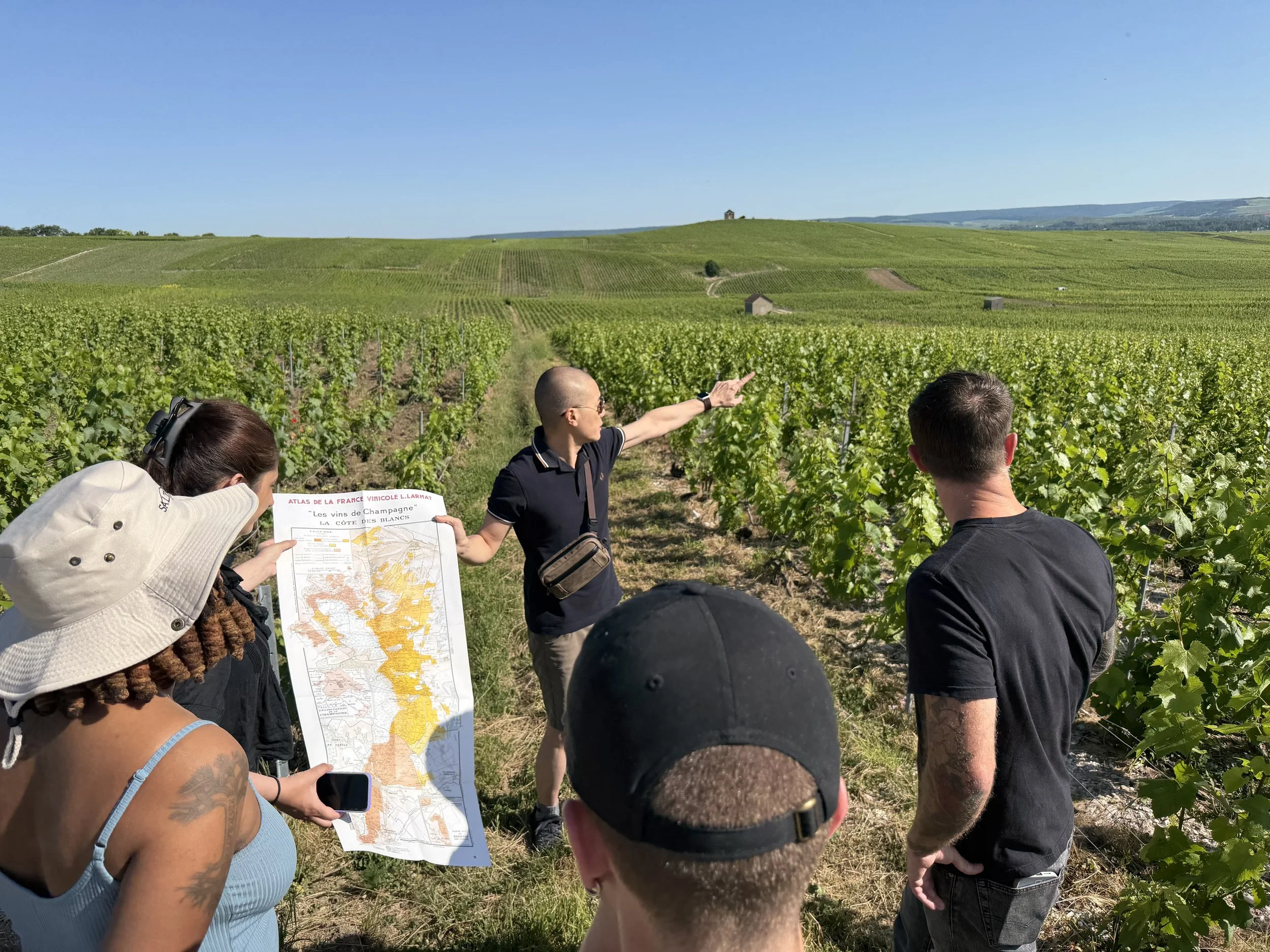
Peter helping us get our bearings in Cramant
Etienne Calsac
Following Peter’s very enlightening orientation on the side of the road in Cramant, we started the day with the rising star grower Etienne Calsac. Although his winery is in a less romantic zone industrielle behind the Avize Intermarché, we tasted in his grandparents’ house in the village proper, behind which is the tiny 0.10 hectare Clos des Maladries, planted in the 1970’s by Etienne’s grandfather. While these birthright vines are in the heart of Avize, Etienne has had to get creative in sourcing fruit as a relative newcomer, and his lineup reflects that geographical diversity.
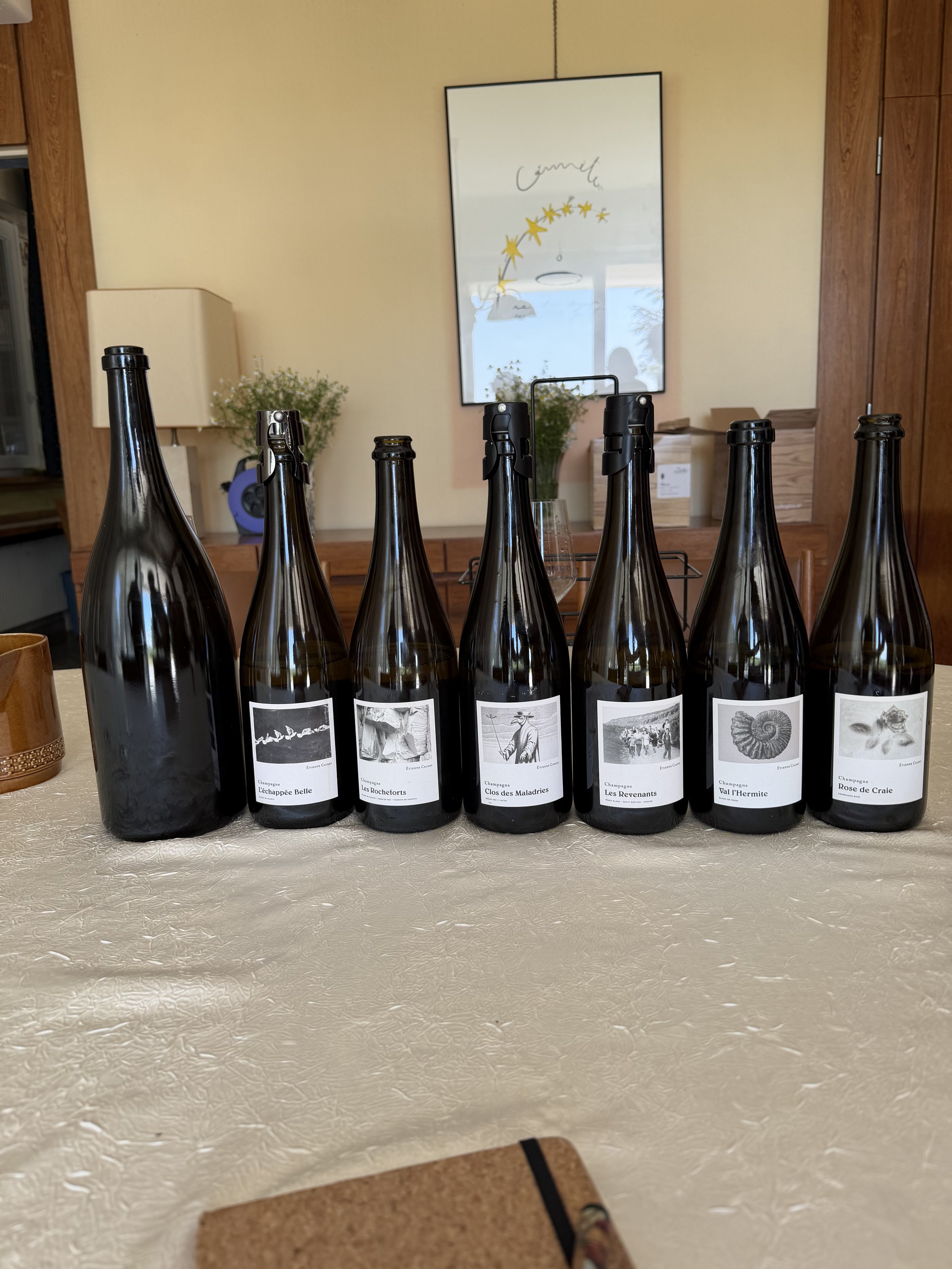
L’Echappée Belle Blanc de Blancs (“The Great Escape”) is his largest cuvée; the fruit comes from the village of Grauves on the other side of the ridge above Avize, known for having a cooler microclimate, the Côte de Sézanne, about 45 minutes southwest of Avize, and Bisseuil in the Grande Vallée de la Marne. Etienne has kept a perpetual reserve for this wine since 2011. The wine is crisp and light on its feet, a common theme we found across much of the lineup.
Les Rocheforts 1er Cru is 100% Chardonnay from Bisseuil, just across the Marne river to the north, from an extremely chalky parcel whose minerality shines through.
Clos des Maladries Grand Cru Avize is always a vintage wine with 1/3 fermented in wood and the rest in stainless. Here the warmth of the walled clos and south-facing exposure are present, but tempered by the great chalkiness of the parcel. “Maladries” evokes the fact that apparently the site was used as a hospital for plague victims in the middle ages. Etienne has playfully leaned into this legend by putting a plague doctor on the label. A bottle of Avize a day…
Les Revenants and Val l’Hermite are the two most extreme examples of Etienne’s curious nature and commitment to experimentation. The former is a cofermented blend of Pinot Blanc, Petit-Meslier, and Arbane — Champagne’s forgotten white varieties — from a family vineyard in the Côte de Sézanne. Powerful and quite delicious! The latter is the true outlier, as a 100% Pinot Noir Blanc de Noirs from the Aube. Its profile is completely different - herbaceous and spicy, a real counterpoint to the Blancs de Blancs.
Up next: Agrapart!
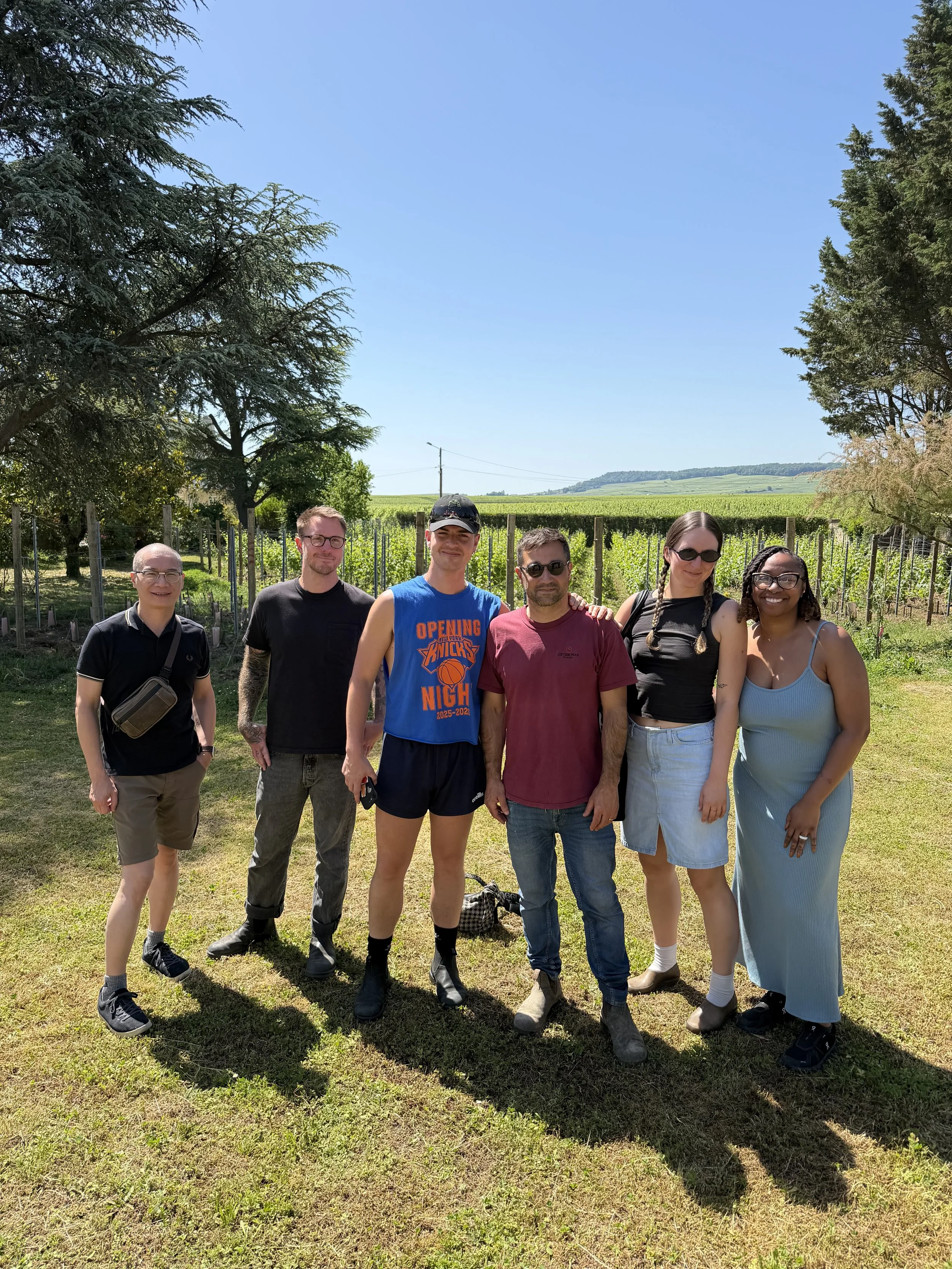
Etienne with Peter and our scholars in front of the tiny Clos des Maladries