Sommelier Scholarship trip to Champagne - Part III
by Max Goldberg Liu
August 12, 2026
Day 2 - Côte des Blancs, Continued
Pascal Agrapart
The Agrapart family recently went through a significant transition in 2025 when brothers Pascal and Fabrice officially completed a split of both brand and vineyard holdings that had been some time in the making. A year later, Pascal and his son Ambroise might be working with fewer hectares, but the quality of the wines has never been better. Ambroise is now solely in charge (though Pascal is close by), and he has continued the fabulous work of his forebears, with the advantage of family savoir-faire and old vines (for Champagne).
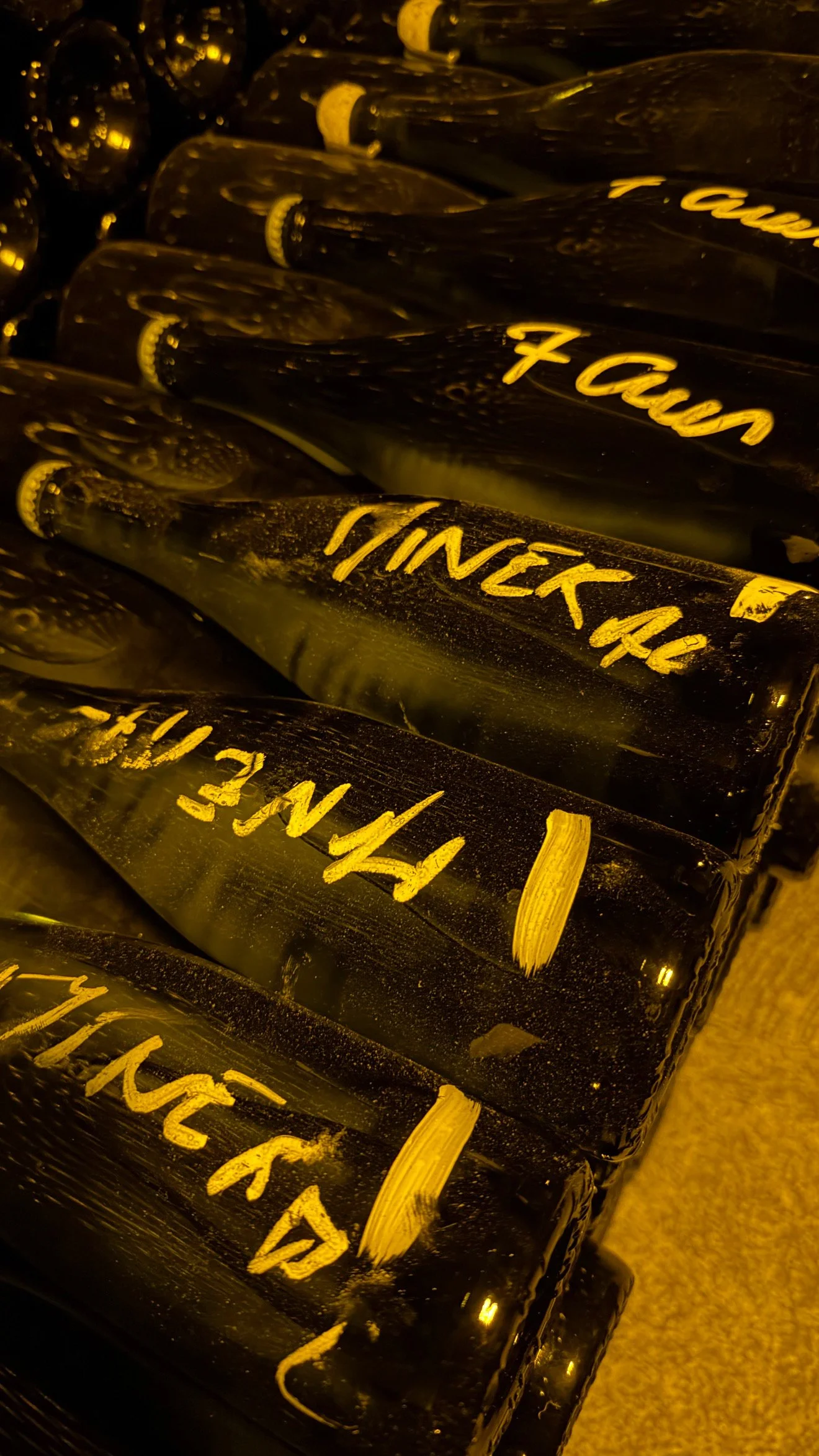
I’ve always found the 7 Crus non-vintage to be one of the great values of Champagne, and Terroirs is a fantastic introduction to Agrapart’s Blanc de Blancs style. We tasted through the 2019 vintage cuvées, always an amazing study of different soil depths in the Côte des Blancs. Minéral is made from two parcels at the bottom of the hillside planted in pure chalk - Les Champboutons in Avize and Les Bionnes in Cramant. It is, true to its name, extraordinarily mineral and salty. Avizoise is from Les Robarts and Les Gros Yeux in Avize grown in a deep layer of clay above the chalk, showing much more density and flesh. Vénus is the iconic single vineyard wine of Agrapart from the lieu-dit Fosse aux Porceaux, planted in 1959. It famously never sees any mechanized machinery, being exclusively plowed by horse and worked by hand. I tend to favor the precision and cut of Minéral but all three were showing amazingly!
We ended with Expérience, an experimental cuvée made exclusively from grapes — no yeast, sugar, or dosage is added. The secondary fermentation is started using fresh grape must from the following vintage, and it shows real purity and calm, if not, for me, as much personality as the other cuvées. The lineup overall displayed a certain restraint that would stand in real contrast to our following visit!
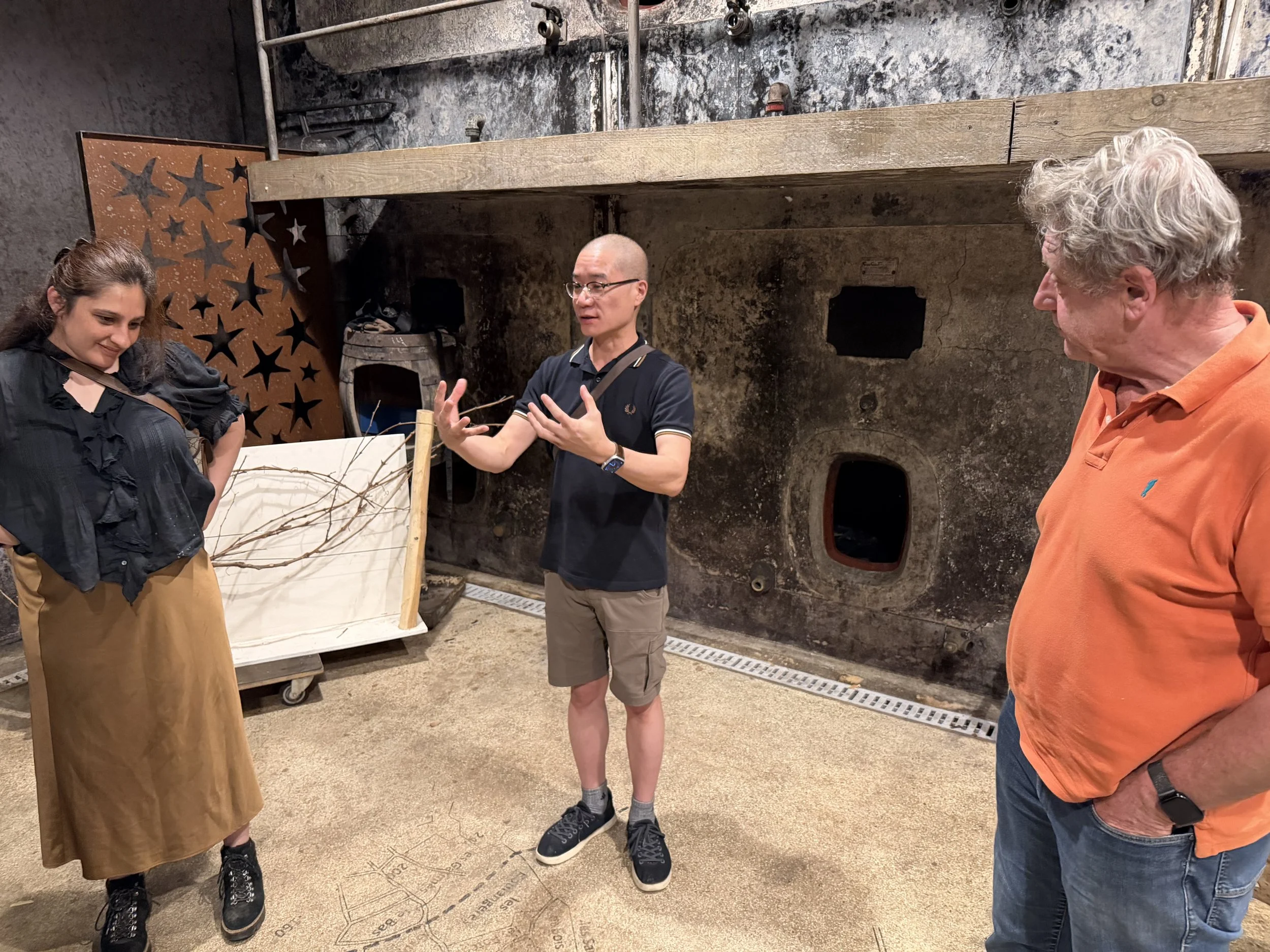
Nikita & Peter with Anselme
Jacques Selosse
I’ve had the privilege of visiting Selosse twice prior to this, and each experience is like attending a philosophy seminar (with bubbles). Anselme Selosse conducts tastings exclusively in French, although he clearly understands English far better than he lets on, and we French speakers in the group had to be on our toes to translate the often untranslatable (and sometimes unintelligible!) for everyone else. Edouard has done this live for him at our events and knows firsthand how tricky this is, especially when Anselme monologues for 3 minutes at a time and then looks at you!
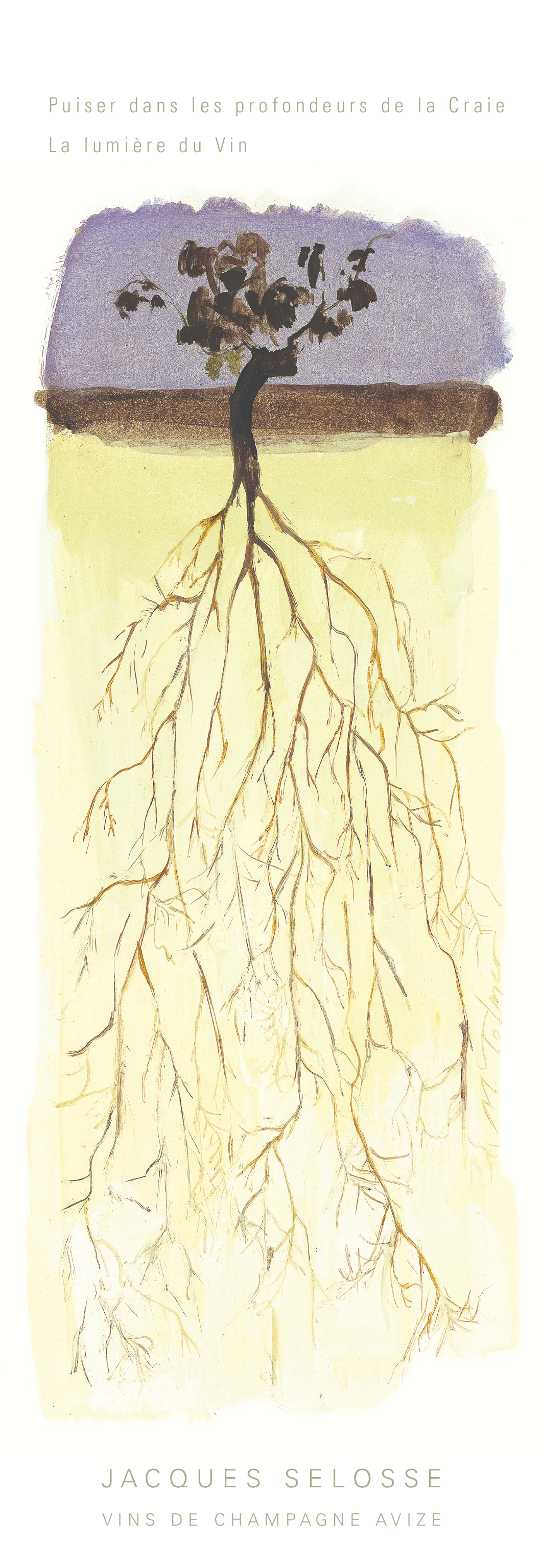
Anselme is full of aphorisms and poetry that he’s had printed in a booklet that everyone receives at the start of the tasting — a highly useful reference as one begins to try to understand his philosophy and way of thinking. Here are some of those:
Le lieu dit: “Où es-tu né?” Le millésime dit: “Quand es-tu né?”
The place says: “Where were you born?” The vintage says: “When were you born?”
365 jours de gestes simples
On ne cherche pas la technique, mais l’Ethique
Chaque cep
marque le vin de son empreinte,
quotidiennement conduit,
dessus et dessous,
pour porter un fruit
seulement accompagné
pour que le vin s’élève
_
365 days of simple actions
We seek not technique, but an ethic
Each vine
leaves its mark upon the wine,
tended day by day,
above and below,
to bear fruit—
merely accompanied—
so that the wine may rise
Le Sel du Vin
Le vin trouve son esprit dans la sève
La roche solubisée par l’infiniment petit,
qui en régit chaque mètre carré,
lui confère son identité
The Salt of the Wine
Wine finds its spirit in the sap;
rock, dissolved by the infinitely small—
which governs every square meter—
bestows upon it its identity.
Tout est joué à la vigne
Reste à attraper le raison à son apothéose
Le vigneron hume, doute, goûte, écoute…
et décide de cueillir,
seulement guidé par son intuition
nourrie du temps et des autres
Everything is decided in the vineyard;
all that remains is to catch the grape at its peak.
The winemaker inhales, hesitates, tastes, listens…
and decides to harvest,
guided only by an intuition
nurtured by time and by others.
Respirer c’est vivre
L’oxydation creuse le masque lisse de la jeunesse
pour livrer les stigmates et réveler le véritable caractère
La fermentation alcoolique est la première oxydation
nécessaire pour faire ressurgir ce qui était enfoui.
Il faut user l’organique pour faire apparaître
la trame minérale.
To breathe is to live.
Oxidation wears away the smooth mask of youth,
laying bare the scars and revealing true character.
Alcoholic fermentation is the initial oxidation
needed to bring to the surface what lay buried.
The organic must be worn away to reveal
the mineral framework.
Anselme specifically points to this page as his response to the conventional wisdom that he makes “oxidative” wines; he makes the analogy that youth, while it can be aesthetically pleasing, is more often than not uninteresting, and that he uses oxygen to dig deeper into the fundamental nature of his wines.
L’Autre Même
Le vin devient ce qu’il a envie de devenir
et non le modèle qu’on s’est fixé
tout comme l’humain…
Une même éducation, une même religion
un même univers mais une autre sensibilité
font de guillaume un autre même
On ne parle plus de vin quand on s’obstine
à refaire le même chaque année
tellement marquée par des jours si particuliers
The “Other Same”
Wine becomes what it wants to become,
not the model we set for it—
much like a human being...
The same upbringing, the same religion,
the same world, yet a different sensibility—
these make Guillaume an "other self."
We are no longer talking about wine
when we stubbornly insist on recreating the same thing every year,
so deeply marked by such distinctive days.
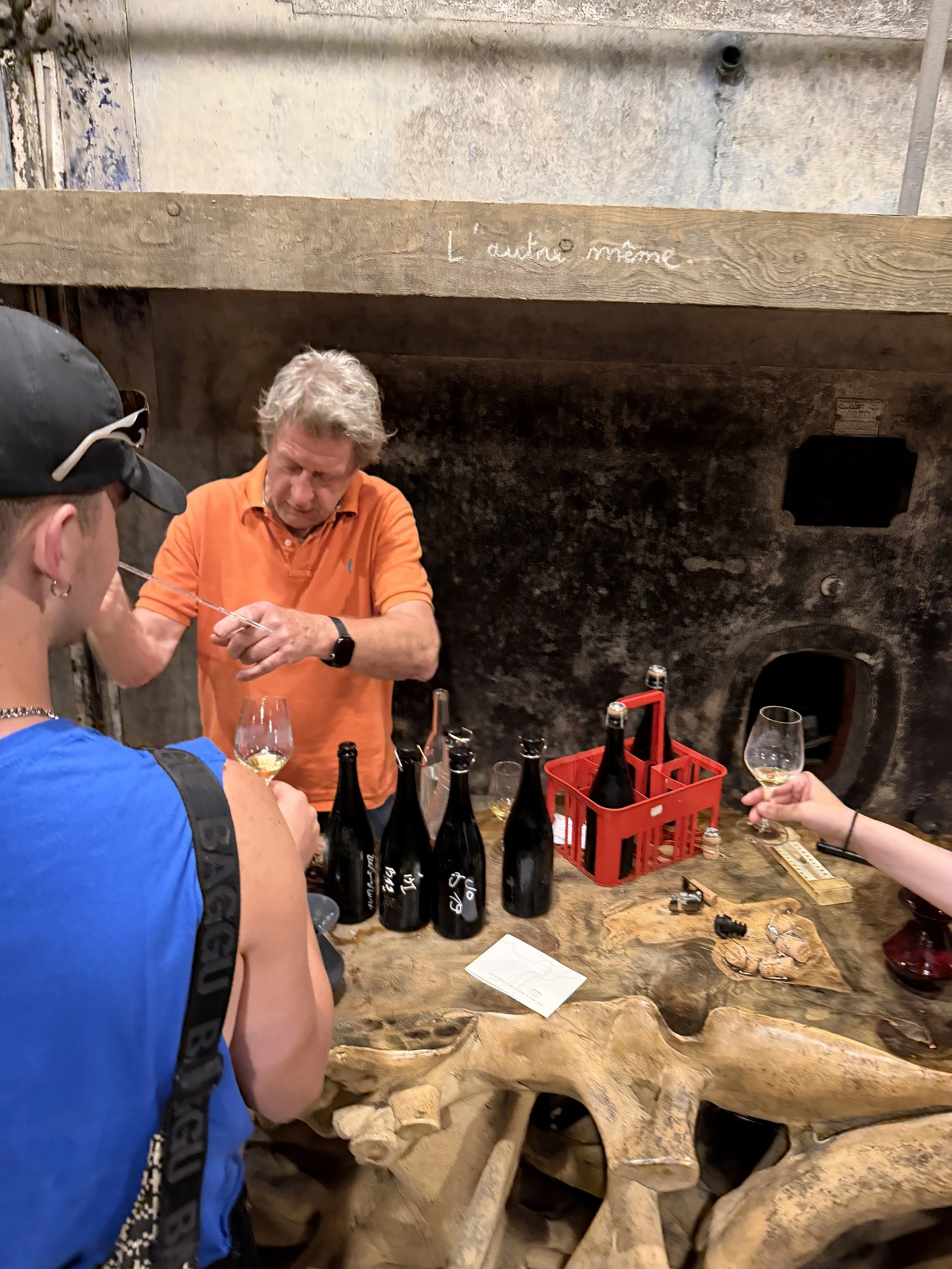
L’Autre Même is inscribed in chalk right above from where Anselme conducts the tasting and it is one of his key maxims. He refuses to confine his wines to a predetermined destiny and insists upon letting them grow up to become whatever they might be, must as how one raises a child. In many ways, this is emblematic of Anselme’s status as the OG “Champagne Grower” who rejected the consistency of the grandes maisons in favor of championing individuality and terroir.
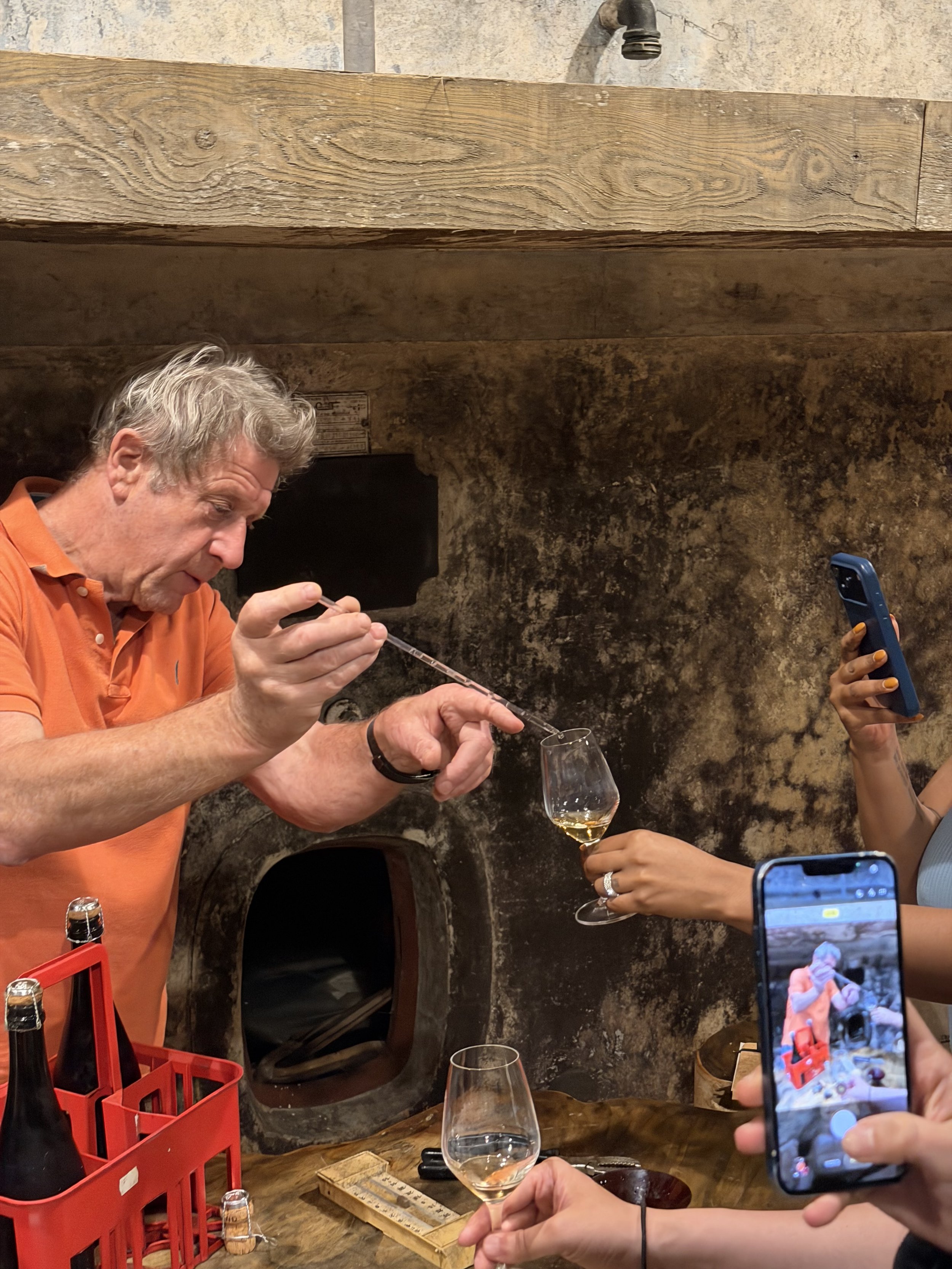
One cool moment from the tasting that will stick with me is when we tasted the lieu-dit Sous Le Mont from Mareuil sur Aÿ. The vineyard is on the side of same hill as Clos des Goisses and the soil contains a significant amount of magnesium which expresses itself in the wine as a pronounced bitterness. Much to our surprise, Anselme whipped out a pipette of water and suggested adding a couple of drops to the wine, much like what one sometimes does with Scotch. This indeed totally revealed another layer of complexity both aromatically and on the palate. This water trick was something I’d never seen before and which was a highlight of this extraordinarily memorable day!