
SCENES FROM THE SOMMELIER SCHOLARSHIP TRIP TO CHAMPAGNE (Part Deux)
Wednesday, February 23
by Raj Vaidya
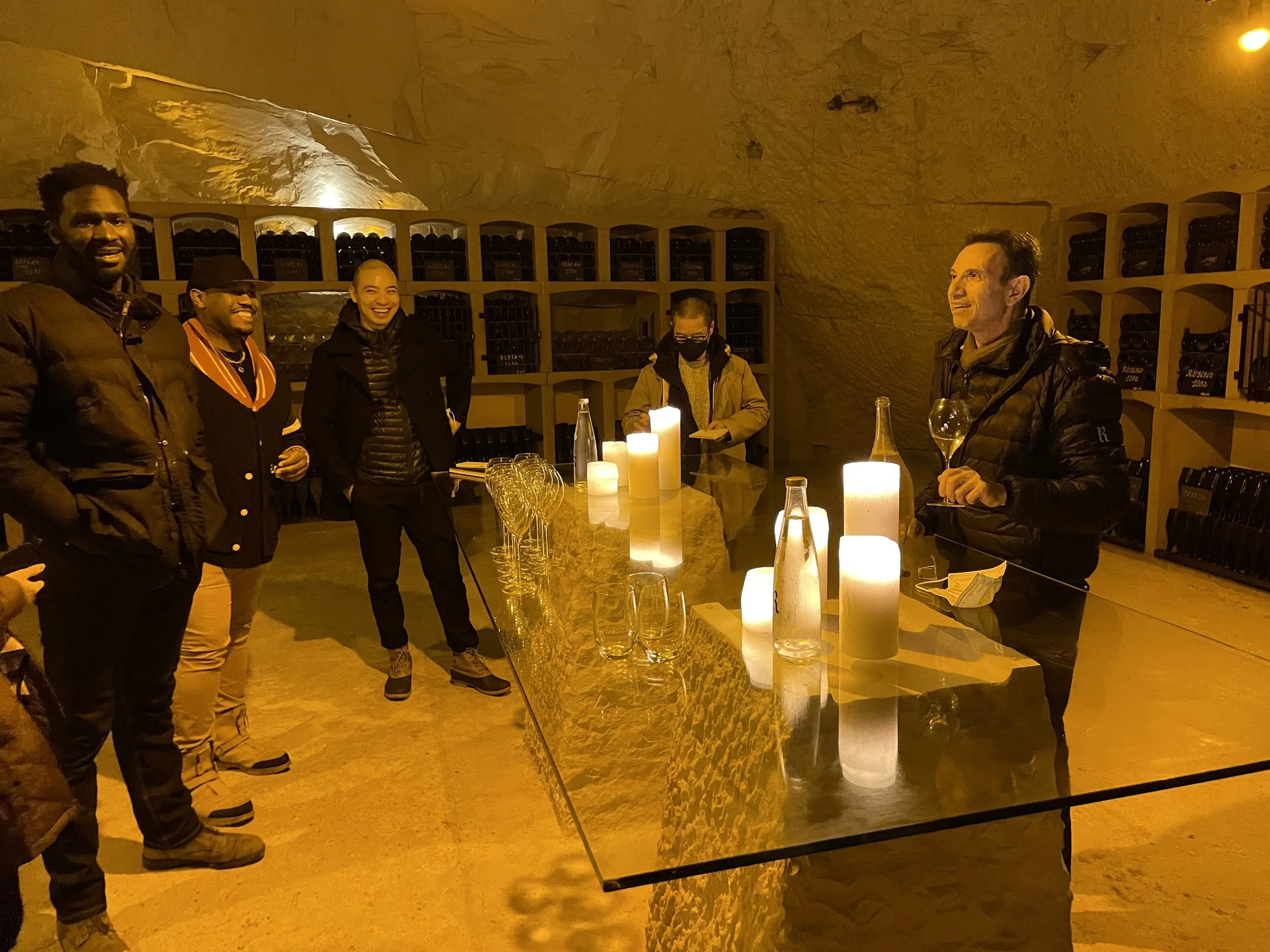
As Max mentioned in last week’s newsletter, we have been hard at work formalizing our new 501(c)3 organization called the Sommelier Scholarship Fund. Last week I had the pleasure of hosting (and chauffeuring) 4 young sommeliers on their first trip to the region of Champagne, and it was an absolute blast! I have always said that I’ve learned much more about wine by standing next to a barrel than from reading any book on the subject, and these four scholars really had a crash course in their education on Champagne…
I was joined by Peter Liem and Pascaline Lepeltier to introduce the region in all its splendor. With Pascaline piping in often with astute questions and Peter providing context and critical direction during and in between visits, we had the chance to really dig into the subjects that are at the forefront of Champagne winemaking and viticulture, for example the rise of organic farming and the use of dosage in crafting the balance of these wines.
It was the first trip to Champagne for each of them, and so maybe the best part for me was watching them discover the people of the region, from the easy rapport enjoyed with Mathieu Billecart, to a conversation that swung from lees aging to hip hop music with Fred Panaiotis, and their wide eyes at the spectacle of Pascal Agrapart sharing a 1991 Cuvée Mineral or Vincent Laval disgorging a bottle for us to taste ‘ala volé’.
We shared a number of our photos and experiences on our new social media channel @sommelierscholarship, if you don’t already follow us there, please do! We will continue to chronicle more as we delve into our mission to educate via experience and human exchange…
To recap Max’s report from last week; the scholars were:
Femi Oyediran - Graft Wine Bar, Charleston SC
Luis Garcia - Per Se, New York NY
Ryanna Kramer - Frasca Food & Wine, Boulder CO
Dwight Alexander Phyall - Roots Fund Scholar
and we visited:
Champagne Moussé-Fils, Cuisles
Champagne Tarlant, Oeuilly
Champagne Agrapart, Avize
Champagne Pierre Péters, Le Mesnil sur Oger
Champagne Larmandier-Bernier, Vertus
Champagne Salon / Champagne Delamotte, Le Mesnil sur Oger
Champagne Henriot, Pierry
Champagne Billecart-Salmon, Mareuil-sur-Aÿ
Champagne Philipponnat, Mareuil-sur-Aÿ
Champagne Ruinart, Reims
Champagne Bérêche & Fils, Ludes
Champagne Georges Laval, Cumières
Champagne Chartogne-Taillet, Merfy
Interested in supporting the Sommelier Scholarship Fund? Email us.
The Sommelier Scholarship Fund is a tax-exempt organization under section 501(c)3 of the Internal Revenue Code. Your donation is tax deductible as allowed by law.




Scenes from the Sommelier Scholarship Trip to Champagne
Raj is in Champagne with four Sommelier-Scholars
Friday, February 18
You may have seen our announcement that our “Sommelier Scholarship” trips and activities we have been hosting for a number of years are now officially organized under a new 501(c)3 organization called the Sommelier Scholarship Fund.
Our first trip under the umbrella of the new organization is underway in Champagne! Raj has joined Peter Liem and Pascaline Lepeltier in guiding four well-deserving sommelier scholars through the region, visiting some of the top producers.
It is the first trip to Champagne for each of them, and it is such a rewarding experience for us to bring the terroir and winemakers to life for the scholars, who have great passion for the wines that grew through much tasting and studying at home in the US.


This trip’s scholars are:
Femi Oyediran - Graft Wine Bar, Charleston SC
Luis Garcia - Per Se, New York NY
Ryanna Kramer - Frasca Food & Wine, Boulder CO
Dwight Alexander Phyall - Roots Fund Scholar
They are visiting:
Champagne Moussé-Fils, Cuisles
Champagne Tarlant, Oeuilly
Champagne Agrapart, Avize
Champagne Pierre Péters, Le Mesnil sur Oger
Champagne Larmandier-Bernier, Vertus
Champagne Salon / Champagne Delamotte, Le Mesnil sur Oger
Champagne Henriot, Pierry
Champagne Billecart-Salmon, Mareuil-sur-Aÿ
Champagne Philipponnat, Mareuil-sur-Aÿ
Champagne Ruinart, Reims
Champagne Bérêche & Fils, Ludes
Champagne Georges Laval, Cumières
Champagne Chartogne-Taillet, Merfy
Interested in supporting the Sommelier Scholarship Fund? Email us.
The Sommelier Scholarship Fund is a tax-exempt organization under section 501(c)3 of the Internal Revenue Code. Your donation is tax deductible as allowed by law.