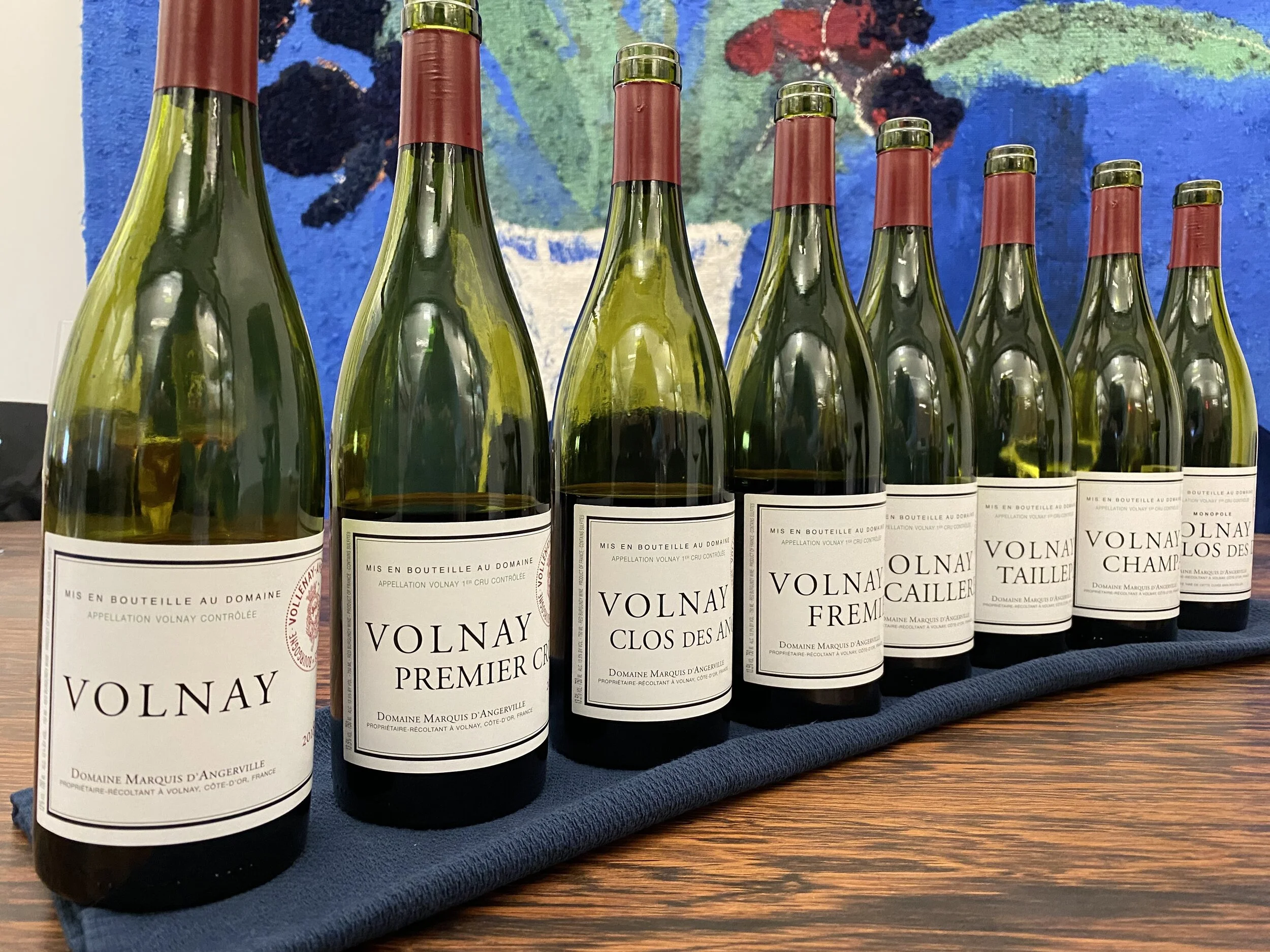
A tasting of the 2018 harvest from the Marquis d'Angerville in Volnay
by Daniel Johnnes, Max Goldberg Liu & Raj Vaidya
Tuesday, December 2, 2020
Tasting the D'Angerville 2018s was exciting and filled with anticipation as it was one of my first post bottling tasting of this vintage and I wasn't sure what to expect. Often a wine can shut down post bottling but these were true to my early impressions of the wines in barrel. It was a sunny vintage but these wines avoided the heavy, raisiny character that can show in a hot summer. They were rich and textured but had a lovely balanced freshness. Two wines stood out for me, punching above their weight class, starting with the Volnay 1er Cru. Although from several fine 1er Cru climats, this one had terrific breadth and class.
The other over-achiever was the Volnay 1er Cru Champans. This is always a charmer but in this vintage I found wonderful depth and complexity that I don't normally get. The Taillepieds, Caillerets and Clos des Ducs came in just where you would expect them to be - Superb! Bravo Guillaume…
~Daniel
A takeaway for me from this tasting is that these wines really characterize how many growers in Burgundy (and especially the crème de la crème like d’Angerville) have mastered these warmer vintages in making wines with superb balance between richness and freshness. All of the wines were delicious and open for business but a standout was definitely the Volnay 1er Cru, which is around 2/3 Mitans and 1/3 Pitures. A clear step up in density and depth from the Volnay Village, the Premier Cru blend is only around 15% more expensive, making it a no-brainer value.
~Max
I was also concerned about this vintage showing too much ripeness or a lack of precision but my fears were quickly put at ease. A few cuvées had some unusual weight to it but all in all the range was quite balanced. Guillaume told us that despite the slightly higher alcohol on some of the cuvées the wines of great pedigree found harmony easily, and I’d agree. As Daniel noted, the Champans stood out as superlative for its place in the line up, usually a wine which I think of as inferior (albeit slightly) to Caillerets, Taillepieds and Clos des Ducs. But the ‘18 seems on par with these in quality. I had a special affinity for the Caillerets, as I often do, being that it is the stoniest. Tremendous showing!
~Raj
Wines we tasted:
Volnay
Volnay 1er Cru
Volnay 1er Cru Fremiets
Volnay 1er Cru Clos des Angles
Volnay 1er Cru Champans
Volnay 1er Cru Caillerets
Volnay 1er Cru Taillepieds
Volnay 1er Cru Clos des Ducs