

What's Pressoir Cooking?
by Daniel Johnnes
Wednesday, October 14, 2020

by Daniel Johnnes
Wednesday, October 14, 2020
I have been ruminating on what to cook for the next La Paulée Selections 3 pack. In case you haven’t noticed our La Paulée Selection is accompanied by a short video of me preparing a dish (or 3) to go with the wines. We believe wine is enhanced by a fine dish just as a fine dish is amplified by a delicious, perfectly chosen wine.
Last month I cooked chicken 3 ways - roasted, grilled and braised. Each called for a different wine.
Now, I am preparing a striped bass one way but with 3 different sauces and seasonings, each having a strong say in what wine I would pair with it.
The bass will be accompanied by couscous tossed with fava beans, celery, carrot, zucchini, chanterelle mushrooms and depending on which wine I want it to pair with, I will incorporate either creme fraiche, lemon and tarragon or bacon and red wine or just a simple butter and lemon sauce.
Here’s the striped bass with bacon and red wine.
Couscous preparation:
1 cup couscous
1 cup chicken stock
- Bring 1 cup chicken stock to boil. Add couscous, mix, cover and set aside
Vegetable mixture
1 carrot
1 zucchini
½ pound fava beans shelled
½ pound chanterelle mushrooms
3 strips bacon cubed
1 onion
Thyme
- Sweat onion, add carrot, sauté mushrooms and bacon until cooked, then add zucchini, fava beans and thyme which cook very quickly. Remove and mix with fluffed couscous and set aside.
Fish & sauce
1 filet striped bass (about 3/4 pound)
1 diced shallot
1 cup red wine
2 tablespoons Glace de Volaille stock (I like the More than Gourmet brand)
1 branch thyme
1 tablespoon butter
- Heat sauté pan with olive oil. Sear bass on one side for 2 minutes, turn and cook for another two minutes and put in 375 degree pre-heated oven for another 2 minutes. Remove fish from pan, add shallots until translucent. Add cup red wine, 2 tablespoons fond de volatile (stock), add branch of thyme and reduce by half. Finish with one tablespoon butter.
To finish presentation
Plate one large tablespoon couscous mixture. Place fish on top and dress with 2 tablespoons sauce. Garnish with a sprig of thyme.
For the other two sauce preparations, you will have to buy the La Paulée Selection pack, available soon.
Bon Appétit et Bonne Degustation!

What's Pressoir Drinking?
by Edouard
10/13/20
Produttori del Barbaresco, Barbaresco 1978, in magnum
by Edouard Bourgeois
October 13, 2020
We pair wine with food, with friends. I even like to push the envelope further by trying to find the right music to play when I sip on a particular cuvée. But what about matching wine and mood?
This morning, I woke up to a rainy, apparently uninviting Tuesday, cold and gloomy. Looking around my apartment, an empty magnum I opened last week and saved as a trophy caught my eye. When I pulled the cork from this 42 year old Nebbiolo, the wine initially seemed ugly, almost limping, and certainly the opposite of a “fruit bomb”. As often with old Nebbiolo, the initial funk character you may smell should not discourage you. The magic rule? Decant, and wait, a long time. The wine does change over the course of a few hours as oxygen seems to be Barolo and Barbaresco’s best friend. I’m also convinced the drinker should also adapt to this metamorphosis. It is a true intellectual exercise where the taster has to be willing to make an effort to understand the wine, just like the first time you heard the curious music of Thelonious Monk, not immediately being able to capture the beauty and humor in his choppy piano strides.
1978 blessed the Piedmont with grapes able to produce ideal, age-worthy wines. It was also the last vintage of the first cellar master at Produttori del Barbaresco Giorgio Boffa. This wine evolved so much, it felt like tasting multiple wines as each layer unveiled as time went by.
So, did I manage to pair the wine and mood? Yes. As the wine unfolded, the mood of the people who shared this magnum with me also evolved to eventually harmonize with the profile of the wine.


News from the Vineyard
October 13, 2020
by Justine Puaud
2020 Harvest in Sauternes and Barsac
Most of the French producers finished the harvest a month ago but we shouldn’t forget about one region in particular which is always the last one to pick the grapes. In the southwest of France, and more precisely, in Sauternes and in Barsac, winemakers started harvesting this past weekend.
As a reminder, Sauternes and Barsac are world-famous sweet wines of Bordeaux. They are made from Sémillon, Sauvignon blanc, and Muscadelle grapes that have been affected by the botrytis cinerea, also known as “noble rot”.

Many Premier Cru Classé Châteaux have skipped the last few vintages because, according to the winemakers, the weather conditions were not optimal to produce a good vintage. From 2009 to 2014, Sauternes and Barsac made unforgettable wines. Each vintage was unique. Some fantastic vintages were recognized for their richness and opulence while some others are appreciated by the connoisseurs for their balance with a high acidity.
So what about 2020? Most of the winemakers in France seem really happy about this vintage, but what do the winemakers from Sauternes and Barsac have to say? The quality of the wines depends on the botrytis, which can be a capricious fungus. It can give the worst as well as the best. Sauternes and Barsac Chateaux were waiting for the botrytis to concentrate the sugars and acidity in the berries. But for that, they needed a set of climatic conditions that the 2020 vintage was slow to grant.

On average, two sortings have already been carried out. Most Châteaux launched a first sorting on the week of September 14th. They harvested some grapes at the earliest stage of botrytis - very small but of good quality. The second sorting took place the week of September 28th and the grapes were very healthy. But the harvest was not done yet. For the final sorting, everything will depend on the weather conditions to come. The beginning of October was marked by significant rain and everyone is waiting for a clearing and wind for it to dry and for the berries to concentrate.
In any case, 2020 will not be a vintage marked by a strong yield though it should be a pleasant and quality vintage.
Next time, I will share my grandmother’s recipe of foie gras to pair perfectly with a Sauternes!
Pressoir.wine Team Picks from La Fête du Champagne Packs
La Fête du Champagne will begin on October 17!
This year the festival will be fully virtual with various opportunities to enjoy the depth of this region in your home or at a friend’s home. With the help of the participating producers, our team has curated over 35 different themed packs of Champagne available for purchase with retail partner Zachys.
Our team shares their picks -
Jaime’s pick: Les Blanches Voies.
I love the Champagnes that Laurent Champs produces at Vilmart & Cie but I have never tried the Les Blanches Voies cuvée. From the beginning this 2-pack has caught my eye. I love the idea of a side-by-side tasting of two wines - discovering a vineyard by a producer I know and love, Vilmart, and another that I am excited to discover, Huré Frères. For me La Fête du Champagne has always been about discovering producers in Champagne that I did not know before. Try out something new that you have never had the opportunity to taste before!

Max’s pick: Dry is the Future
A warming Champagne region means that producers can now more often pick riper and riper fruit with less need to balance out acidity with a healthy dosage. While in some cases Brut Nature and Extra Brut winemaking can be a mouth-puckering exercise in trendiness, these Champagnes from Laval, Leclerc-Briant, and Pierre Paillard are exquisitely balanced, with their low or non-existent dosage allowing the terroir to come screaming through.

Justine’s pick: Rosé Discoveries
Some people will associate Rosé Champagne with richness, higher dosage and mostly Pinot Noir. This is the perfect opportunity to prove they have the wrong idea. In the Rosé Discoveries pack, you have 3 perfect examples of elegant, low dosage and complex Champagnes. Each of them come from fantastic terroirs and have been carefully crafted. However each winemaker has his own identity and style: AR Lenoble Rosé Terroirs is from 88% of Chardonnay from Côte des Blancs and 28% of vin de réserve. Huré Frères Insouciance is mostly made with Pinot Noir from the Montagne de Reims. They are known from their rich texture and racy acidity. Laherte Frères Les Beaudiers is a single-vineyard saignée rosé of pure Pinot Meunier which gives concentrated and meaty Champagnes.

Edouard’s pick: The Savart Producer Pack
I feel particularly animated about this selection because Fred Savart is the perfect example of the winemaker who crafts wines that resemble his personality. In Fred’s case, what comes to mind is generosity, vigor and happiness. While one cannot replace a one on one experience with Fred, great wines have this ability to make the taster travel, whether it is through time, or space and I am convinced that this pack will offer a genuine experience.
L'Ouverture is Fred Savart's entry level Champagne but it is far from one-dimensional. It is 100% Pinot Noir all from the village of Ecueil, half of which was fermented in mostly neutral barrel, while the other half is fermented in stainless steel. The wine only sees partial malolactic fermentation. Fred doesn't guide the malolactic fermentation, instead it is the inclusion of reserve wine that goes through malolactic fermentation because it has gone more temperature swings. The wine is in equal parts a blend of three successive vintages and aged under cork, not crown cap. Dosage is 7g/L.
L'Accomplie is 80% Pinot Noir and 20% Chardonnay from both Ecueil and Villers-aux-Noeuds. The base vintage makes up 70% of the total blend with the other 30% coming from reserve wine of the two previous vintages. The wine is aged in a combination of neutral oak and stainless steel. The dosage is 5g/L.

Raj’s pick: Chartogne-Taillet Producer Pack
I count myself lucky to have many friends in Champagne, and have had the privilege of speaking with so many of then while helping to prepare the digital tasting experience we are debuting in just a few short weeks. But as I think back on the interviews I conducted throughout the process, the one that leaves me smiling from ear to ear with the memory of it is certainly the time I spent with Alexandre Chartogne of Champagne Chartogne-Taillet this past week. Not only is Alex a tremendous winemaker and vigneron, he is an absolutely lovely person, and extremely soulful. In speaking about the wines in this offer, he mentioned to me that the Couarres bottling is one of the best wines he has ever produced, yet did so in the least boastful and most humble manner. Truly a delightful conversation, an amazing guy and brilliant wines, which we are really excited to share with you during La Fête!


News from the Vineyard
10/6/20
Wild Fires on the West Coast
Information sourced from the L.A Times
October 6, 2020
by Edouard Bourgeois
Wildfires on the West Coast
The worst fire in the wine country region's history has scorched 65,000 acres and damaged another five wineries, bringing the total to 18 Napa Valley wineries damaged or destroyed by the Glass Fire. That staggering scale of California’s wildfires reached another milestone Monday: A single fire surpassed 1 million acres. The total area of land burned by California wildfires this year passed 4 million acres, more than double the previous record. Gov. Gavin Newsom said the amount of land scorched by the August Complex is larger than all of the recorded fires in California between 1932 and 1999. There have been 31 deaths and nearly 8,700 buildings have been destroyed, the governor reported.
Numerous studies have linked bigger wildfires in America to climate change from the burning of coal, oil and gas. Scientists say climate change has made California much drier, meaning trees and other plants are more flammable. California remains largely warm and dry but fierce winds that fanned infernos a week ago were gone.
In addition to the tragic deaths, current air quality readings are considered unhealthy for sensitive groups according to the Environmental Protection Agency and of course, the impact on the vineyards is devastating. Some producers have decided not to harvest any fruit from its 2020 vintage due to damage caused by smoke fumes. some vintners say harvesting this year’s grapes isn’t worth the time or investment because they can’t be salvaged. Smoke contains compounds that bind to the skin of grapes and get absorbed into the fruit. The aroma releases throughout the fermentation and aging process, making a seemingly unaffected wine taste more ashy over time. In general, red wines, especially ones made with thin-skinned grapes like Pinot Noir, tend to be most affected. The fruit may taste good if you were to pick it from the vine, but the problem is the smoke taint shows itself after fermentation. In some cases, the larger wineries that would buy from a lot of different vineyards would simply reject the grapes, and the vineyard owner is kind of stuck. For the smaller vineyards, the smoke damage to 2020 vines will be harder to stomach. Some may have wines to sell over the next few years, but it’s 2023 that is going to be really problematic, referring to the year the winery’s 2020 vintage would have been sold. With the whole pandemic going on, and now the wildfires, wine country has really taken a hit. To confirm the smoke damage, grapes have to be tested. But the laboratories that perform tests are backlogged with an unprecedented volume of requests, experts say. Results that used to come back within 24 to 72 hours now take about four to five weeks.
Some wineries are getting creative with their smoke tainted grapes. using the smoky wine for spirits. A second-generation grower, Hoopes, leaned into the charred flavor profile of her wine and used it to make brandy and vermouth. The pivot required additional investment on top of losing expensive crops, but she needed to salvage what she could.
Please consider donating to the Red Cross, using this link
What's Pressoir Drinking?
Raj Vaidya
October 5, 2020
It is becoming a rarity to come across great bottles of humbler appellations in Burgundy these days in many of the great collector’s cellars. Many of our Cellar Advisory services clients have cases upon cases of mature Grand Cru, but to be able to enjoy a delicious and mature Villages level Burgundy is a little harder these days. So while rooting around a friend and client’s cellar on the Upper East Side last Saturday night, him and I were delighted to happen upon this bottle of 1999 René Engel Vosne-Romanée Villages. A bottle that no doubt was purchased on release by his father in the early 2000’s. It was late in the evening, post dinner, and there was a request for an earthy red. Boy, did this deliver! Great length on the palate, somewhat rustic, leathery even. Not one of those floral and light, airy Vosne’s. Much more power here, the richness and intensity of the vintage certainly shined here. Engel’s wines are an important piece of Burgundian history, but over the years since Philippe Engel passed away and the Domaine was sold, these bottles have become quite pricy and all the more rare. Truly a memorable bottle! The Dauvissat Séchet was the follow up, well after midnight, and also delicious, but i’ll save describing that one for another time :)…


What's Pressoir Eating?
by Daniel Johnnes
September 30, 2020
by Daniel Johnnes
September 30, 2020

With summer weather and produce just starting to wind down, we find ourselves at this amazing crossroad of warm weather activities, summer fruit and vegetables, fish and grilled meats and a wink towards the cooler autumn abundance of game, mushrooms, deeper sauces and heartier roasts and braises.
As I like to pair my dishes with what I’m drinking, I was looking at Jaime’s wine selection for this week. While Pommard has a history of being a fairly powerful red overall, the Pezerolles from De Montille is more on the elegant side. Still, I feel a light touch of cooler times ahead and wanted to get into the spirit of the season by preparing a dark meat bird and garnishing it with the first cèpes of the season. Cèpe is my favorite mushroom, combining the flavors and aromas of the forest with wonderful texture and a delicate, woodsy taste. So this fairly simple dish is a roast pigeon or squab seasoned with salt and pepper and pan roasted in butter for about 7 minutes per side for color. Then another 10 minutes in the oven at 400 degrees is all it takes to keep the flesh rosy and tender.
Let the pigeon rest 15 minutes before carving.
Meanwhile add a half pound of cèpe mushrooms, one chopped shallot, one clove of chopped garlic to the hot pan and cook till tender. Add one cup of red wine to deglaze and several sprigs of thyme in the pan and reduce by a third. Add 2 tablespoons of butter and set aside. Season to taste.
Remove the breasts from the bird and keep warm in the jus.
Serve with soft polenta and spinach on the side. Eat with a nice glass/bottle of Pommard!

What's Pressoir Drinking? Pommard!

by Jaime Dutton
September 29, 2020
Domaine de Montille, Pommard Premier Cru “Les Pézerolles” 2012
I have been looking forward to revisit the wines of Domaine de Montille after our At Home Session with Etienne de Montille this summer. Recently, I pulled a bottle of Domaine de Montille Pommard Premier Cru Les Pézerolles 2012 from the cellar. We chose this wine thinking it would be a fun and delicious choice to share with my family to celebrate my older daughter Pilar’s 12th birthday.
As I opened the bottle, I was reminded with a smile of the At Home Session with Etienne this summer on a Saturday afternoon in early July, broadcast live from a boat on Lake Geneva. He had planned an evening with friends Dominique Lafon, Christophe Roumier and Jean-Laurent Vacheron, and was going to join us from the terrace of the restaurant before they went to dinner but plans changed when they ran out of gas! I was impressed on many levels that he still made it happen - first, he was incredibly generous with his time - carving time out for us on a summer weekend during his vacation. He remained focused and engaged from the boat as his friends joked with him and the parade of boats behind him did not phase him at all. He remained jovial and light hearted, sharing the camera with the others on the boat, laughing as they floated in the sun on the lake, all while sharing information and stories about his domaine, his winemaking and experience as a winemaker of one of the most historic and established domaines in Burgundy.
Generous, focused and jovial - I was hoping that these aspects of his personality would come through in his wine and they did. Pommard is known to be hearty and robust, but Les Pézerolles is known to make a lighter style of Pommard. This wine was vibrant on the palette with a juicy character that was balanced with smoky nose and integrated tannins - it was drinking perfectly and we enjoyed it with steaks grilled on the open fire.
Merci Etienne!

Guess the Label - La Fête du Champagne edition
September 29, 2020
by Max Goldberg Liu
In honor of the upcoming Fête du Champagne, test your knowledge of Champagne and Guess the Label!
Post your answers in the comments section below.


News from the Vineyard
by Edouard Bourgeois
9/29/20
by Edouard Bourgeois
September 29, 2020
Hand Destemming at Domaine Lafarge
Since 2016, a very unique and rarely seen device has reemerged at the famous Volnay domaine Lafarge. The “égrappoir a main” or hand destemmer (pictured below), used in the old days before mechanization took over, has been the tool of choice for some of the gorgeous Pinot Noir grapes of the domaine. Clothilde Lafarge, who came back to the domaine in 2018 and is now fully involved, explains how incredibly labor intensive the hand destemmer is. It takes no less than 35 hours per vat and up to seven people at once to do the job. But the juice is worth the squeeze.

The hand destemmer is made of woven wicker
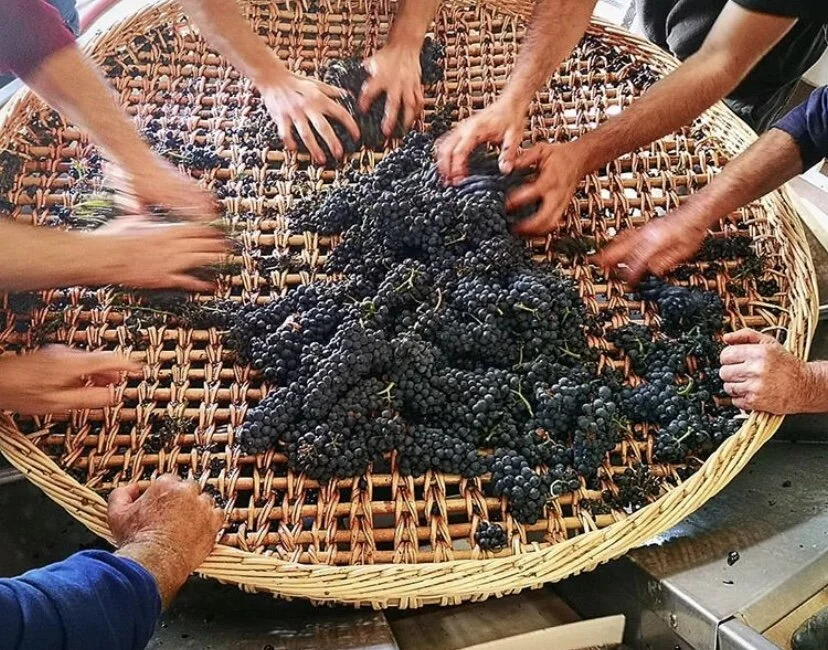
The peaceful, serene atmosphere embraces the feeling of communion at the winery

No, this is not a close-up of a caviar tin, but the pristine berries of Pinot Noir after being delicately destemmed

News from the Vineyard
by Raj Vaidya
September 23, 2020
This week, the work our friends and colleagues in Burgundy are busy with is primarily inside the cellars. During the last two weeks of August, when New York felt a great deal warmer, the harvest in Burgundy was in full swing. I thought it would be fun to share a few fun facts illustrated by this video of a sorting table and destemming machine at the Domaine Marquis d’Angerville in Volnay. Guillaume d’Angerville has mentioned to me in the past that the identity of the wines at his family’s estate has long been defined by the purity of fruit that is associated with destemming the grapes. Though he has pointed out, in his father’s days the destemming was done by hand, and so was rougher and less efficient than today. The destemmer today works quickly and quite gently, and is more precise in removing all the stems.
The resultant wines are perfumed, supple and fairly deep in color thanks to the lack of stems. In this short video, you can observe the team at d’Angerville giving the grapes a last sorting on the conveyor table (unhealthy grapes have already been sorted out while harvesting in the vineyard, so this is a second run) as they make their way to the destemmer.

What's Pressoir Drinking? (Club Member BYO Edition...)
by Raj Vaidya
9/23/2020

We had another lovely Club Member BYO dinner this past Monday evening in the backyard of Popina in Brooklyn. A great way to celebrate the arrival of Autumn! Many great bottles were opened, some more messily than others (scroll down for a short video…) but my favorite of the evening was the Domaine Leflaive Bienvenue-Bâtard-Montrachet. Tremendous depth and texture, but still ever so precise and focused! The wine seemed to last forever on the palate, truly a tremendous bottle.
Here is a recapped list of all the bottles we enjoyed:
Champagne Billecart-Salmon Blanc de Blancs “Cuvée Louis Salmon” 2007
Domaine Louis Michel, Chablis Premier Cru Butteaux 2014
Domaine Pierre-Yves Colin-Morey, Saint Aubin Premier Cru En Rémilly 2016
Domaine Leflaive, Bienvenue-Bâtard-Montrachet Grand Cru 2010
Domaine Nicolas Potel, Vosne-Romanée Premier Cru Les Gaudichots 1999
Domaine Sylvie Esmonin, Gevrey-Chambertin Premier Cru Clos Saint Jacques 2012
Domaine Sylvain Cathiard, Vosne-Romanée Premier Cru En Orveaux 2001
Domaine de Montille, Volnay Premier Cru Champans 1995
Domaine de Montille, Volnay Premier Cru Les Mitans 2003
Domaine de l’Arlot, Nuits-Saint-Georges Premier Cru Clos de Fôrets-Saint-Georges 2009
Domaine Robert Chevillon, Nuits-Saint-Georges Premier Cru Les Saint Georges 1988
Domaine Gros Frères et Soeurs, Grands-Echezeaux Grand Cru 1995
Domaine Hudelot-Noëllat, Vosne-Romanée Premier Cru Les Suchots 2011
Domaine du Comtes Georges de Vogüé, Chambolle-Musigny Premier Cru 2001
Louis Jadot, Chambertin Clos de Bèze Grand Cru 1999
Domaine Trapet, Chambertin Grand Cru 2003
Champagne Vilmart & Cie, Cuvée Création, Champagne 1997 (in magnum)

What's Pressoir Drinking?
Edouard Bourgeois
9/22/20
by Edouard Bourgeois
September 22, 2020
Château des Tours, Côtes du Rhône 2015
Last week, during David Gordon’s THIRST class on Châteauneuf du Pape, I decided to open a bottle of Château des Tours, Côtes-du Rhône 2015. It did not disappoint! As soon as I sank my nose in the glass, I was reminded of the importance of the producer over the appellation or even the vintage. After all, this was only a simple Côtes-du-Rhône, an appellation that designates the entry level wines of the region. Frankly, many wines made under this lower designation can be very uninteresting. However, in the hands of Chateau Rayas’ superstar winemaker Emmanuel Reynaud, even this Côtes-du-Rhône had the panache of some of the best Chateauneuf du Pape. Light in color, the Grenache core was evident, offering a generous, heady bouquet of sweet figs, laced with Provençal herbs. The alcohol level was high (14.5%) but not overwhelming. Yet, I suggest to drink it at around 55 Fahrenheit as service temperature is key to kind of “tame” that power.


Emmanuel Reynaud
What's Pressoir Drinking?
by Raj Vaidya
September 14, 2020
This past weekend as the cool evening air returned to the North East and NYC, I fired up my grill to try and take full advantage of the last wisps of summer. Grilled Tandoori spiced chicken was on the menu, so I figured an aged red with some ripeness would be appropriate. Digging around in my wine fridge, I turned up this delightful bottle of village level wine that proves Daniel’s oft repeated motto: read the label from the bottom up! Drouhin has long been a favorite producer of mine, and the pedigree of their excellence in wine making plus the superlative vintage 1999 promised that this wouldn’t be a simple village level experience. The wine did not disappoint. Layers of spice and small red berries on the nose, tremendous depth on the palate with earthiness just starting to develop but the primary fruit flavors still very much present. Still youthful, though it was delicious and long on the palate. Lesson to be gleaned; age your Villages!

What's Pressoir Drinking? Club Member BYO Edition
Club Member BYO on Zoom - Tuesday, September 1 - Chablis
At our last Virtual BYO of the summer we shared some lovely examples of Chablis. William Fevre had a big showing with a number of different lieux-dits and vintages. It was a great opportunity to come together and learn more about the northernmost region of Burgundy and the saline and mineral driven whites we all love.
Here is a recap of the wines that were shared and enjoyed:
Domaine William Fevre Chablis Grand Cru Vaudesir 2008
Domaine William Fevre Chablis Grand Cru Les Clos 2012
Domaine William Fevre Chablis Grand Cru Les Clos 2007
Domaine Moreau-Naudet Chablis 2018
Domaine Moreau-Naudet Chablis Grand Cru Valmur 2010
La Chablisienne Chablis Perrieres 2015
Domaine Roland Lavantureux Chablis 1er Cru Fourchaume 2013
Rene & Vincent Dauvissat Petit Chablis 2017
Louis Michel & Fils Chablis Premier Cru Montee de Tonnerre 2010 (x2!!)
Christian Moreau & Fils Chablis Grand Cru Les Clos 2008
Join us for our next Club Member BYO on Monday, September 21 at Popina.
Cheers!


What's Pressoir Cooking? Bangladeshi Chicken Korma
September 15, 2020
by Max Goldberg Liu
September 15, 2020
by Max Goldberg Liu
Bangladeshi Chicken Korma

My girlfriend and I love Indian food, and this Bangladeshi variation of the takeout classic Chicken Korma caught our eye from the NY Times cooking recipe archive.
Much less saucy and more aromatically intense than the Mughlai version that is much more commonly seen, this chicken korma was extremely easy to make - purée the aromatics, combine with chicken thighs, yogurt, and spices (cardamom, cloves, bay leaves, cinnamon, peppercorns, chilies), and simmer for around 40 minutes. Stir in some butter-fried onions and it’s finished.
The resulting braised chicken is not the prettiest dish in the world but is intensely flavorful and delicious.
We served it on riced cauliflower which made for a delicious and low-carb (though certainly monochromatic!) weeknight meal.
While we might think of Indian food as being difficult for wine pairings, this rich and well-spiced dish would definitely pair well with an energetic and complex Red Burgundy like the Drouhin Chambolle-Musigny 1999 that Raj enjoyed this week - and it turns out that he paired it with grilled Tandoori spiced chicken!

News from the Vineyard
By Edouard
9/14/20
Sources: The New York Times, The INAO website, La Revue du Vin de France, Wine Searcher
Finally some Premiers Crus in Pouilly-Fuissé!
When I started learning about wine in my teenage years in France, it was my dad’s favorite quiz question to ask “what’s the difference between Pouilly-Fumé and Pouilly-Fuissé?” If you don’t know the answer, the former is a wine produced from Sauvignon Blanc grapes and a neighbor to the famous Sancerre in the center Loire Valley of France, while the latter comes from the southernmost sub-region of Burgundy and is of course made from Chardonnay. Even if Pouilly-Fumé has been quite famous and present on many French restaurants’ tables in the US for the last decades, its reputation as the “Burgundy of the poor” still seems to be deeply rooted in consumers’ minds. But this may change. A couple weeks ago, 22 climats were finally identified as Premiers Crus. Pouilly-Fuissé, despite being among the first wines to gain an AOC (appellation d’origine contrôlée) in 1936, never had the permission to claim Premiers Cru status. The overlooked appellation of the prestigious Burgundy wine region has finally earned the official recognition it’s been fighting for since 2007.
This area, part of the Maconnais and famous for the towering Roche de Solutré, a pilgrimage destination of former French President Francois Mitterrand, offers similar soil and subsoil as the rest of Burgundy with the typical clay and limestone combination, with the addition of a solid granitic base, a wink to its southern neighbor Beaujolais.
The news of elevating some Pouilly-Fuissé terroirs to Premiers Crus arrived in the middle of the historic 2020 harvest and is bringing a smile to many producers’ faces as it could translate into a financial boost in the region.

The Roche de Solutré, in the heart of the Pouilly-Fuissé AOP, towers over the vineyards at 1,640 feet

CHARLES PHILIPPONNAT DISCUSSES AN ALREADY HISTORIC HARVEST 2020
September 16, 2020
by Edouard Bourgeois
Through these highly informative videos made by our friend Marie-Pascale, you will learn the ins and outs of the 2020 harvest for the Champenois, starting with the testimony of Charles Philipponnat from the eponymous Champagne house. Charles explains the contrasted nature of the year and goes over the different stages of the season, starting a with a wet winter that proved essential to replenish the water reserve for the months that followed. The historic drought that hit France led to early debudding and early flowering. The precociousness of the vintage is the signature of a year that recorded one of the driest months of July ever. The exceedingly small canopy (the amount of leaves that developed during the growing season) helped reduce the rot pressure but exposed the grapes to sun, resulting in a decrease of 30% of the production due to sun burnt berries. M. Philipponnat also explains how he adapted his viticulture methods through grass management in between the rows of vines. And finally, some exclusive news regarding the illustrious Clos des Goisses where the last rows were just purchased by Philipponnat, now sole owner. The increase is small but symbolic, as the house has been working on acquiring these last rows for 85 years.

The Clos des Goisses, now entirely owned by the Champagne house Philipponnat, is a fully south exposed, unique vineyard.

News from the Vineyard
Aÿ Grand Cru "La Côte Linguard"

Aÿ is one of the 9 Grand Cru villages in the center of the Grande Vallée de la Marne. Considered like “the champagne of kings”, this region is known for producing very high quality and full-bodied champagnes. While Aÿ is most notable for its Pinot Noir (90% of the vines planted), you can also find some excellent Chardonnay.
Aÿ is not a homogeneous terroir, which is also part of its magic. This large area is composed of various folds of the slope across the hillside which create sites of different exposition and elevation. The blend of cretaceous chalk and sedimentary slope wash create subtle and complex wines that exhibit power and finesse. Peter Liem says (and I’m sure Daniel will agree) “if Aÿ were in Burgundy, it would be in Vosne-Romanée”.
Today, we highlight one lieux-dit in particular in Aÿ, "La Côte Linguard". In the northern part of Aÿ, in the extension of La Côte Faron and La Côte Aux Enfers, you will find this tiny area of La Côte Linguard. It is a historic vineyard which is part of the UNESCO classification.
Our dear friends and fervent supporters of La Fête du Champagne, Bérêche et Fils* recently acquired 1 ha (2.5 acres) which represents exactly 8,010 Pinot Noir Vines and 846 Chardonnay vines. They are extremely proud and excited to add this beautiful Grand Cru vineyard composed of massale selections vines, flush chalk and steep slopes to their impressive array of holdings. Those characteristics should create beautiful wines with a lot of tension and complexity. Cheers to Raphaël Bérêche and his family - we look forward to tasting the juice!!

Bérêche et Fils (NM)In the village of Ludes, in the northern portion of the Montagne de Reims, brothers Raphael and Vincent are quietly crafting sophisticated, terroir-expressive champagnes that are poised to rival the region’s best. Their 22 acres of vines are located in several sectors of Champagne with the three primary areas being the immediate vicinity around Ludes. A portion of the vines are farmed biodynamically, and about three quarters of the production is vinified in barrels with indigenous yeasts. Unusually, Bereche bottles a number of cuvées with cork rather than crown caps for the second fermentation, which Raphael thinks results in greater depth and complexity in their wines. NM stands for Negociant Manipulant.
Information courtesy of Peter Liem's Champagne book.

Credit photo @philippemartineau_foodart

Christophe Roumier Discusses an Already Historic Harvest 2020
Christophe Roumier talks about an already historical harvest 2020
The Pressoir team is proud to present a series of videos brought to us by Richard Betts, our correspondent in Burgundy, who was able to interview some of the most celebrated winemakers of the region. We are really grateful that these talented men and women took the time to share their views on the unprecedented 2020 vintage. Among them, Christophe Roumier, interviewed in his legendary vineyard of Les Amoureuses, a climat classified Premier Cru but believed to deserve Grand Cru status by many, shares some rare and precious news on the vintage. Christophe, with his expert knowledge of the land, explains his strategy on when to pick each parcel, according to the rain that was expected the day after that interview while also touching on the role played by old vines. The winemaker also gives his opinion on the polarizing subject of whole cluster fermentation.
We hope that you will enjoy this video as much as we did. Stay tuned for more of these with other luminaries such as Dominique Lafon, Veronique Drouhin, Jean-Marc Roulot and many more...

Christophe Roumier in his vineyard “Les Amoureuses”