

Winemaker Interview
by Justine Puaud
Friday, March 31, 2023
The next generation at Maison Joseph Drouhin

1 - The history behind Maison Joseph Drouhin is fascinating. Can you give us a quick overview of Maison Joseph Drouhin?
Maison Joseph Drouhin is intimately connected to Beaune and Burgundy. It is here that the family business was established in 1880 by Joseph Drouhin, my great great grandfather, and where its wonderful history has been written especially through the 14 Grands Crus the estate produces. Today it is still held by the 4th (and 5th) generation of the family: my mother Véronique, and her three brothers Frederic, Laurent and Philippe.
My mother joined in September 1986 and quickly went to Oregon for harvest and did vinification at three different pioneer wineries there. In 1987 they bought land in Oregon that became Domaine Drouhin Oregon, and since then she is between Oregon and Burgundy and has made 37 vintages in each growing region.
Today we own 100 hectares (250 acres) in Oregon and 93 hectares (230 acres) in all of Burgundy, acquired gradually over the years. Two thirds of our vineyards are in Premier and Grand Cru sites, and some are among the most famous in Burgundy, such as Clos des Mouches, Musigny, Amoureuses, Griotte-Chambertin, Corton-Charlemagne….
Robert, my grandfather, was one of the first in Burgundy to introduce "culture raisonnée" (doing away with pesticides and other chemicals) and my uncle, Phillipe, moved to organic and biodynamic viticulture in the late 80’s, making Joseph Drouhin today one of the largest Burgundian estates entirely organically farmed, something we are very proud of!
2 - "Passing the baton" - Was it easy for your grandfather to pass the baton to your mom and your uncles? Did everyone find his or her right place at the beginning?
It has not been easy and it took some time and adjustments for each of them to find their own place but it finally happened naturally. Today they all occupy key and complementary positions. Philippe is passionate about viticulture, my mother about winemaking, Laurent and Frédéric on the business side.

3 - What about you? Have you always wanted to be a winemaker? What were your motivations - to work in the winery, work in the vineyards … did it take a few years to realize you wanted to be a winemaker?
Laurène Drouhin: Whenever I was asked in my early twenties if I would be seduced by winemaking one day, I always answered “well I love wine but only to drink and share it”. During my business studies I travelled, met a lot of people from all around the world, worked for Champagne houses where I got the chance to spend time with the winemaking teams and, finally growing up, roots were catching up.
I became more and more sensitive to what Drouhin means to me today: heritage, family, winemaking and sustainability. And this is how I ended up going back to school in 2018 to study viticulture and oenology in Beaune and finally joined the family estate in 2020 which definitely makes sense.
4 - Une affaire mère-fille - Véronique is simply wonderful! How is it to work with your mother? Did she help you realize you wanted to be a winemaker?
LD: She is wonderful! She never pushed me or my two siblings to be winemakers. Both my parents gave the three of us a sensibility to wine and respect for nature. I remember being really happy during harvest when after school we were going to the winery to taste the grapes and the juice. Maybe this is where it all started! Or possibly during her pregnancy as it was harvest time and she might have had a few sips…
I would say like mother, like daughter... and like great wine, always better together! We share a passion for winemaking and a deep respect for the land and the grapes that make it all possible.
5 - Can you tell us a little bit about your winery in Oregon? What is the cuvée Laurène?
LD: The history of Joseph Drouhin is not only rooted in the Côte-d'Or. It has also been written in Oregon in the USA since July 1987, when my grandfather decided to buy land in the hills of Dundee in the Willamette Valley. It was a bold idea but also part of a great pioneering tradition that has always been in the family DNA. This is how Domaine Drouhin Oregon was born, complete with the motto: “French Soul, Oregon Soil”. Our story in Oregon is also the story of a family partnership. Right from the estate’s first vintage in 1988, my grandfather asked my mother Véronique to be the winemaker and my uncle Philippe to plant and cultivate the vines.
So in 1988 they produced the first cuvée of Pinot Noir Dundee Hills. This was a crazy gamble, when they had neither vines nor winery in this lesser known winegrowing area. Today, it is the emblematic cuvée of the domaine, combining balance, elegance, and sophistication. As the first family from Burgundy to venture into Oregon, we have helped change the image and economy of an entire region.
Cuvée Laurène and its 30 vintages are something I am really proud of! I enjoy them more than I have made them... but I am really honored of having my name on this cuvée that is produced entirely from Pinot Noir grown on the family’s estate in the Dundee Hills. The fruit is handpicked into small totes, destemmed, fermented with indigenous yeasts, and then placed into French oak barrels. Once the vintage is safely in the cellar, my mother and I begin the process of selecting barrels which have an extra complexity, length, and depth — barrels which will work together as Laurène. Cuvée Laurène is not only good but it also ages very well since first vintage 1992 that is still stunning!
6 - Does climate change make it more difficult to work in the vineyards now compared to the generations before? What is your opinion about this?
LD: I would say global warming, that is a consequence of climate change, has had a positive impact on the quality of the crops in Burgundy for a few vintages. When we look at my grandfather’s time or early vintages of the 4th generation, maturity was sometimes complicated to reach.
However, we do face a huge immediate challenge with climate change. We have milder winters, dry and hot summers, harvests start earlier and earlier…we really need to adapt to the world’s changing climate, especially while working with nature.
But even more importantly we have to act now to prevent or at least slow this climate change. I am very concerned about this so we’ve just started to measure our carbon footprint to know what we should do to reduce our emissions. I am also very hopeful as we joined a group of French companies willing to be a regenerative business in the future: a company that gives back more to our planet and society than it takes.
7- Did you make some changes in the vineyard and cellar work? Any new projects you would like to talk about?
LD: Well at this point I am still in the learning part, especially because we produce around 110 appellations in Burgundy, which takes almost a life to know about... And I have to say previous generations and our teams have done and still do remarkable work. Thanks to my previous experiences, I am able to bring a little bit more structure to our processes so we can focus even more on the quality of our wines.
I have worked with our Technical Director Jérôme Faure-Brac, on following very closely our growers’ partners to guarantee the maturity we are looking for to have excellent and healthy crops.
As I mentioned before, climate change is a huge 360° challenge so the project is to bring Drouhin towards more sustainability in every step of our process: viticulture, oenology and distribution.
8 - Are your cousins and siblings thinking about joining Maison Drouhin?
LD: I am the eldest of the 5th generation so it is still too early to know about others joining. They are all having their own experiences for now but we definitely all share an interest in wine on different levels, vineyard or winemaking or business, so hopefully some will join soon!
——————————
Merci Laurène!!!

Recap - Pressoir.wine Dinner Chevillon
by Edouard Bourgeois
Friday, March 24, 2023
by Edouard Bourgeois
Friday, March 24, 2023
Domaine Chevillon has been around for quite a while. The family traces back its history in winemaking to the early 1900’s and the current fifth generation is led by brothers Bertrand and Denis, following the teachings of their father Robert who retired in 2003. As traditional as it gets, the winemaking is expertly managed. Despite a recent trend in the region where more and more domaines decide to include whole cluster in their fermentation process, at Chévillon grapes are fully destemmed. The result is a wine with deep color and an authentic Nuits-St-Georges with plenty of structure and black fruit. With age, Chevillon’s wines are stunning and the one thing that fascinates me about the style of the domaine is the rigorous consistency of the quality, one vintage after the other. As you will read below in the tasting notes recap, we decided to show both “easy” vintages and some more challenging ones. The consistency could be explained by the strict use of very old vines, usually around 50 years old but sometimes well into their 70s.

The first flight was a vertical of the Premier Cru Chaignots. Named after the oak trees (Chênes in French) that once grew there, the vineyard is located in the northern portion of the appellation, close to Vosne-Romanée. Typically fresh in style with good acidity, Chaignots was a great “opener”. 2017 was electric. Too young? Certainly. But so much pleasure. Tannins were present but refined and the acidity obviously still high. 2012, a more challenging vintage due to erratic weather patterns and mildew pressure, showed the expected concentration and tightness both on the nose and the palate. I found the wine to be quite tannic but certainly a good pairing with the first beet dish. Many guests I spoke to liked this 2012 and the one served after. Finally for this flight, the warm vintage 2009 surprised me. One should expect 2009 to express the hot weather patterns associated with that year and it was certainly a signature here but I would have liked a bit more balance and I found some “raisiny” notes plus a wine that showed more age than I had expected.
Moving on to the same trio of vintages, this time from the climat Roncières. Planted on a very steep slope at 20% incline, Roncières got its name from the gnarly bramble bushes that covered the area before Pinot Noir made its home there. The Chevillon work one hectare on this climat, located this time south of the village. The 2017 once again showed vibrant youth with more homogeneity than Chaignots. A great bottle. I couldn’t get past the distraction of a rather strong grapefruit rind flavor profile in the 2012. A pronounced bitterness marked the palate and lingered. 2012 might be in a bizarre phase right now. Again here I think the food pairing Pascaline and Chef Jonathan came up with was excellent. A perfectly cooked Arctic char was served with the Roncières flight. 2009 showed better than in the first flight. More balanced and the wine started to express black fruits and a suave texture.
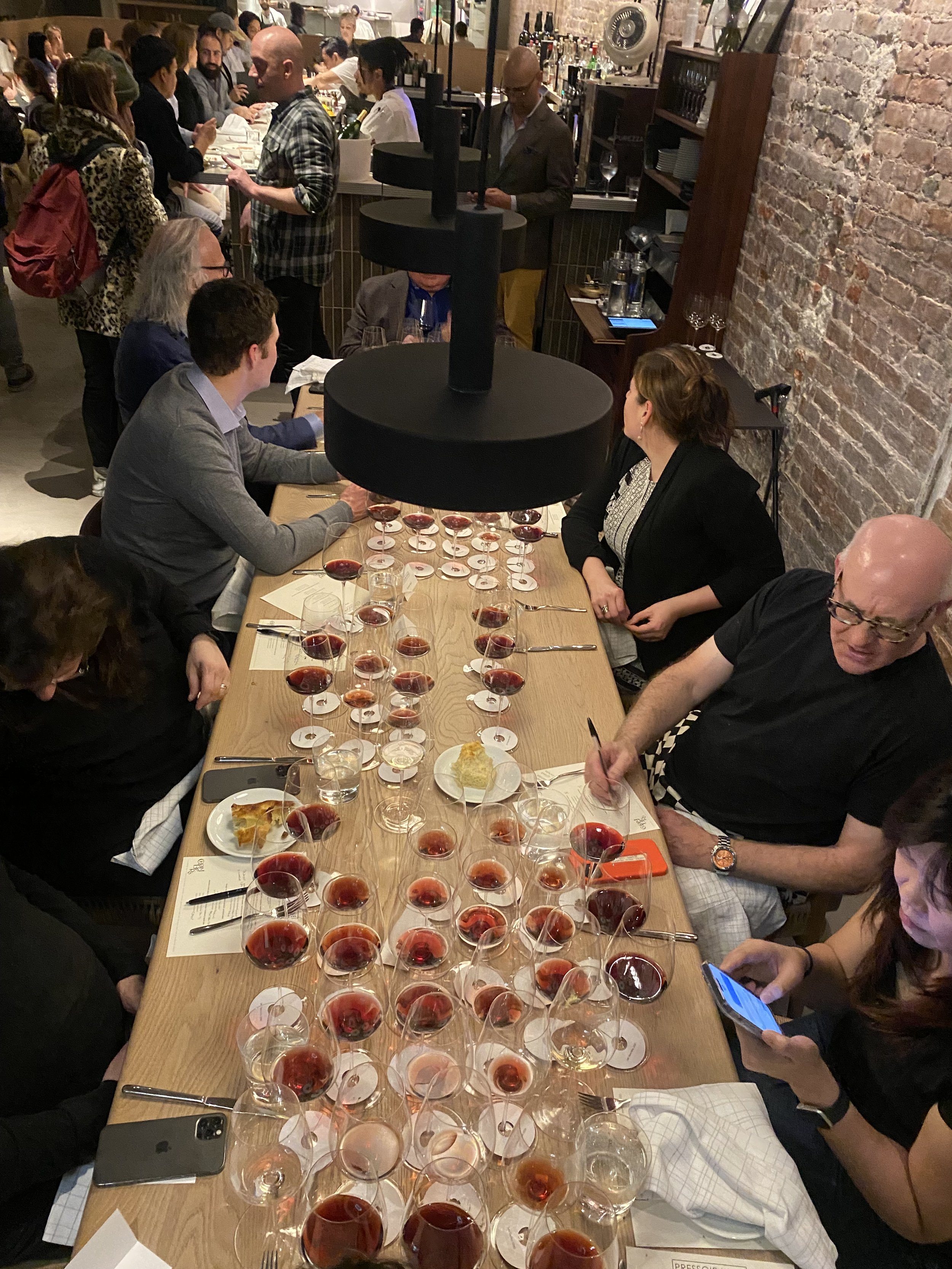
The hanger steak was paired with an incredible vertical of “Cailles”. We took a leap back in time here with a beautiful trio, starting with a gorgeous 2010. With more acidity than in 2009, 2010 gave great results in Burgundy, especially in the Côte de Nuits. We just wish the quantity produced were higher. Cailles 2010 was in a lovely stage of its life. Impressive balance and real depth. Plenty of black cherry and just a hint of secondary aromas suggested a great evolution ahead of this wine. And then, 2003… This atypical vintage marked a new era in many European vineyards and the punishing heat waves that year gave birth to extreme wines. Even in Burgundy, one can be mistaken with a wine from the Rhône when tasting these powerful cuvées. The consistency I referred to above when it comes to Chevillon really came into play here as the 2003 Cailles remained charming. Sure the vintage style was present, with drying tannins and a bit of a short finish, but aromatics were pretty, suggesting roasted plum.
We closed the flight with arguably the wine of the night: Cailles 1990. The expectations were high but they were met. An overall blessed vintage for Burgundians, that is the year when Denis and Bertrand created the family company with their father Robert. The richness and power from 1990 was enhanced by the generous and joyful character of Cailles. Here the vines are almost 80 years old and planted on a clay-rich soil. The wine had irresistible sweetness and beautiful secondary notes of forest floor and underbrush while bursting with red fruit.

The last flight was built around the same last vintages (2010, 2003 and 1990) but from “Vaucrains” this time. Interestingly, “Vaucrains” comes from the French “vaux rien” literally meaning “worthless”. If the wine made there certainly is highly valuable, it is the land that was considered for a long time worth very little because nothing would grow. Steep and hard to work, it is also one of the few vineyards in Burgundy to be planted with a slight northern exposure. It is located just above the previous Cailles and next to the prestigious “Les Saint-Georges”, all of them once again in the southern portion of the appellation.
2010 seemed more closed than its cousin Cailles. The nose required oxygen but blossomed nicely after a while. I thought the 2003 showed even better than Cailles 2003, with less of the “‘03 hot style” and deep aromas of roasted fig and tar. Finally, the 1990 Vaucrains showed more austerity than Cailles. A touch dirty suggested the presence of TCA. It certainly didn’t perform as brilliantly as the Cailles 90.


Nuits St Georges and Chevillon
Nuits st Georges and Chevillon
by Edouard
3/16/23
Edouard Bourgeois
March 16, 2023
If each wine producing commune of the Côte d’Or is known to give wine its distinctive signature style, I have always thought that Nuits-St-Georges truly has an expression of its own. After Beaune, the unanimous wine capital of Burgundy, Nuits-St-Georges plays an important role in the region and covers over three hundred hectares of vines, with the vast majority planted with Pinot Noir. Its pivotal location in the heart of the Côte d’Or also helps strengthen its impact. In popular culture, Nuits-St-Georges was mentioned in “Voyage around the Moon” by Jules Verne and the story gets better when, in 1971, the Apollo XV team decided to honor the village by bringing a bottle of Nuits-St-Georges and left it in one the moon’s craters famously named “Crater St-Georges”.
Vineyards are planted both to the north of the village where the proximity of Vosne-Romanee is often believed to confer elegance and charm to the wines, and to the south of the village, towards Premeaux. This portion is where the most famous climat, Les St-Georges, which gave its name to the commune, is found.
A myriad of producers may be listed such as Domaine de l’Arlot, Jean-Jacques Confuron, the large house Faiveley, the historic Henri Gouges and of course we can’t forget to mention the unofficial sister of the Hospices de Beaune, the Hospices de Nuits, holding its own wine auction in March rather than in November.
But of course, here we want to speak particularly about my favorite producer in Nuits-St-Georges, Domaine Robert Chevillon. I guess what I like most in Chevillon’s wines is their consistency, no matter how rainy or challenging a vintage can be, the wines are always great. Furthermore, they’re delicious young and old. The fruit is black and succulent during the first decade in bottle but the patient drinker gets rewarded with a festival for the senses when tasting a wine from the 1990’s or older. Last year, I had the pleasure of visiting the domaine with Daniel and our host, Bertrand who, after tasting the entire range out of barrels, poured us a blind wine from a dusty bottle. It was a gorgeous bottle of Bousselots 2001, a vintage that is not particularly praised for its quality but showed wonderfully. More recently, during La Paulée in New York, I shared a glass of Vaucrains 1983 with Bertrand. This was a wine I have had the chance to taste during my sommelier years at restaurant Daniel and always an amazing experience.
The eight Premiers Crus proudly vinified by Bertrand and his brother Denis are completely de-stemmed and going over the winemaking process would be useless as it follows the most traditional methods everyone is familiar with. The wines are just like Bertrand Chevillon. Honest, generous, and full of life, without compromise.

WHAT'S PRESSOIR COOKING?
Victoire Chabert
March 15, 2023

A few more days of cold weather before the spring season... why not get a head start and start thinking about sunny recipes? Here is the recipe of a dish that my mother makes every year and that delights the tastebuds of many… and which I must now master to take over the tradition and heritage!
Ingredients for 4 persons :
4 tomatoes
100 g of white ham
100 g ground beef
100 g sausage meat
1 shallot
1 clove garlic
10 g butter
2 tbsp olive oil
1 egg
1 tbsp fresh cream
2 tablespoons of parsley and oregano
Salt, pepper and breadcrumbs
With a knife, cut off the top of the tomatoes (reserve the caps). Gently scoop out the tomatoes with a teaspoon, keeping the pulp removed: be careful not to pierce the tomatoes. Salt the bottom of the tomatoes and turn them over on a plate so that they give up their water.
Peel garlic and shallot. Chop the garlic after removing the germ. Finely chop the shallot. Drain the tomato pulp well to remove excess water and cut into small pieces.
Preheat the oven to 410 degrees F. Put the butter and 1 tablespoon of olive oil in a pan. Brown the shallots and garlic. Add the tomato pulp, sprinkle with parsley and oregano. Season with salt and pepper. Simmer over low heat until most of the liquid has evaporated (about 8 to 10 minutes).
Meanwhile, finely chop the white ham. Put it in a bowl with the ground beef and sausage meat. Add the garlic/shallot/tomato mixture and mix well. Add the whole egg and cream. Mix well. Season with salt and pepper if necessary.
Put this filling in the hollowed-out tomatoes and place them in a pre-oiled casserole. Cover tomatoes with their caps. Drizzle with 2 tablespoons olive oil and sprinkle with breadcrumbs. Place in the oven for about 45 minutes (if the top of the tomatoes becomes too brown, cover with aluminum foil to finish cooking). In your dish, add the rice between all your tomatoes and put it back in the oven for a few minutes to brown the rice and get the sauce’s taste.
Here is the classic recipe of the famous stuffed tomatoes but I love to have a dish with several vegetables like zucchini, onion or eggplant where you can follow the same instructions. I personally find the mix of tastes and flavors even better together.

La Paulée at Blackberry Farm
Daniel Johnnes
03/08/2023
La Paulée at Blackberry Farm
Coming to Blackberry Farm has always been a dream of mine.
This idyllic 4200 acre paradise nestled in the great Smokey Mountains of Tennessee invited me and Jaime, under the banner of La Paulée and the Sommelier Scholarship, to host three days of Burgundy, lunches, dinners and seminars with two winemakers.
Since the reputation preceded the invitation, it was easy work convincing Nicolas Rossignol from Domaine Nicolas Rossignol and Loic Dugat-Py from Domaine Dugat-Py to make the journey.
Both contributed significant quantities of wine from some of their best appellations to accompany the meals and to present at the seminars. The most notable wines from Nicolas were the Volnay Caillerets 2018 and Pommard 1er Cru Epenots 2017 for the first meal and Dugat-Py’s Gevrey-Chambertin Evocelles 2018, Gevrey 1er Cru Petites Chapelle 2018.
In addition to those stunners were fascinating comparative tastings of the 2017, ‘18 and ‘19 vintages from Nicolas’s Pommard Petit Noizons and Volnay Santenots. I’m still a big fan of 2017!

Not only were we treated like royalty but Blackberry made a significant pledge to our Sommelier Scholarship from the event’s proceeds, and hosted an additional auction fo the non-profit’s benefit. The auction lot was for a couple to spend a day in the most prestigious cellars of Burgundy on the next Sommelier Scholarship trip in 2024. Bidding was fierce and came to a tie where we agreed to satisfy both by taking a second couple on an additional trip.
All in all we raised $80,000 which will fund 4 or 5 trips over the next year or two, enabling us to bring up to 15 young scholars to France with the hope of having an impact on their career and introducing them to the culture and traditions of viticultural France.
To top it off, one of the attendees made an separate contribution today.
We are completely exhausted after La Paulée de New York and then 3 days at Blackberry but in spite of the fatigue, I feel completely energized by the new contacts and knowing the Scholarship is thriving.
Cheers,
Daniel

La Paulée Recap: Domaine Dujac Clos Saint-Denis Dinner at 63 Clinton
3/8/2023
Raj Vaidya
Daniel has been dreaming of hosting a focused Clos Saint-Denis dinner with Jeremy Seysses for quite some time, as it has long been a favorite appellation of his (and mine also…) and is somewhat overshadowed in the eyes of many collectors and enthusiasts by the Clos de la Roche from Dujac. Indeed, Clos de la Roche tends to be a richer, more structured and generally larger wine than the Clos Saint-Denis, which perhaps is more akin in style to Grand Crus from the Chambolle side of Morey-Saint-Denis.
This fantastic retrospective ran us from the 2017 vintage back to 1990 and provided some really exceptional experiences and some surprises to boot. Jeremy was keen on having the restaurant be a bit more modern and inventive than a very classic French place so we tapped the skills and warm hospitality of 63 Clinton, a jewel box of a restaurant on the Lower East Side with Michelin pedigree (and a star of its own.)

Chef Samuel Clonts of 63 Clinton with Diana and Jeremy Seysses and the Paulée team: Raj Vaidya and Jaime Dutton
After starting with some 2014 whites (Puligny Folatières stole that show) we dove into Clos Saint-Denis fully, leading with younger vintages and moving chronologically back to 1990. The 2017 was the standout in the first flight, superbly open and singing, with great salinity already noticeable and yet a core of ripe and balanced fruit. I had fully expected the 2010 to be a stunner and indeed it was, though in the same flight the 2012 stood out as a surprise, much fuller than I’d experienced previously and with tremendous energy and length.
As we entered into some older wines, Jeremy spoke about ‘famous’ vintages in Burgundy and a belief he has that many heralded vintages create the scenario where a collector comments upon drinking 10 out of the 12 bottles in a case, “…this is going to be really great, someday!” The concern over so called ‘great’ vintages is that they’ll fail to offer actual pleasure during consumption…
2005 certainly could be accused of this, and even though we double decanted this vintage quite early, the wine still showed somewhat closed and burly, fine but without elegance or pleasure. The 1999 on the other hand proved to be a 'great’ vintage which is also a GREAT wine, and a delicious experience.
The last flight proved Jeremy’s point well also, with the 1990 showing very well (as expected) but the ‘98 and the ‘95 exceeding most guests’ expectations. 1998 had a lovely brooding savory quality to it, yet because of Jeremy’s dad Jacques’ light touch and inclusion of whole clusters, the wine had a balancing effect of very light body and tremendous aromatic complexity.
The 1995 was my wine of the night, classic Dujac spicy nose, salty mineral notes throughout, very light in color and body yet superbly long on the palate. Truly an expression of mastery.
The Menu and Wine Line Up
Razor clam tostada, white bean puree, calabrian chilies and lime zest
Domaine Dujac, Morey-Saint-Denis 1er Cru Les Monts Luisants 2014 en magnum
Domaine Dujac, Puligny-Montrachet 1er Cru Les Folatières 2014 en magnum
Domaine Dujac, Puligny-Montrachet 1er Cru Les Combettes 2014
Grilled prawns, foie gras and house furikake
Domaine Dujac, Clos Saint-Denis Grand Cru 2017
Domaine Dujac, Clos Saint-Denis Grand Cru 2015
Domaine Dujac, Clos Saint-Denis Grand Cru 2014
Wild caught turbot, nantua sauce and grilled spring onions
Domaine Dujac, Clos Saint-Denis Grand Cru 2012
Domaine Dujac, Clos Saint-Denis Grand Cru 2010
Domaine Dujac, Clos Saint-Denis Grand Cru 2008
Roasted squab, braised and spiced red cabbage
Domaine Dujac, Clos Saint-Denis Grand Cru 2005
Domaine Dujac, Clos Saint-Denis Grand Cru 2002
Domaine Dujac, Clos Saint-Denis Grand Cru 1999
Black truffle stuffed lamb chop with black pepper and comte cheese potato gratin, lamb jus
Domaine Dujac, Clos Saint-Denis Grand Cru 1998
Domaine Dujac, Clos Saint-Denis Grand Cru 1995
Domaine Dujac, Clos Saint-Denis Grand Cru 1990
Mignardise
Orange and raspberry mignardise

What's Pressoir Drinking?
What’s Pressoir Drinking
by Edouard
2/27/23
Edouard Bourgeois
March 1, 2023
When I moved to the US in 2008, one of my motivations as a sommelier was to learn about American wines. Soon I had my first sip of Cabernet Sauvignon from Ridge Vineyards and I was sold. But the most surprising discovery for me was Ridge’s Zinfandel. I have been a fan of Ridge wines ever since and I am always on a hunt for an old bottle of their Zinfandel. Although I am not typically a fan of big, bold flavor wines, I have always found a great energy in these wines and the powerful character of the grape variety never speaks too loudly, letting terroir express itself.
30 years ago, Ridge made its first Monte Bello, now a legendary US Meritage. Two years later, Ridge bottled their first Zinfandel. The winery has been on a constant hunt for California’s ideal vineyard so the climate, soil, and varietal are perfectly matched. To bring the distinctive character of each vineyard to the wine, they use minimal handling that is typical of traditional winemaking.
I recently acquired a bottle of a 1991 Beatty Vineyard Zinfandel from the online Acker auction and opened it last week. Ridge is known for their numerous experiments with different grape varieties and vineyards, and it is easy to get lost on their website trying to navigate the plethora of wines that have been made there. Because of that diverse portfolio, some cuvées were made only a few times before a vineyard got replanted or a lease ended. This Beatty vineyard is a good example of that, having been made only four times, in 1983, 1984, 1988 and 1991.
Though Howell Mountain is on the dry side of Napa Valley, and the open, chaparral-covered slopes seem to bake in the August sun, this is a cool microclimate. With a late start and full crop in 1991, these grapes did not ripen completely until the first week of November. Anticipating firm tannins, the winery used small, five-ton fermentors; a third of the grapes in each tank were whole clusters. This approach adds a floral, bright fruit character, and Petite Sirah contributes spice and structure.

Paul Draper in 2014
Draper first gained recognition for his 1971 Monte Bello Cabernet Sauvignon when it placed fifth at the Judgment of Paris wine tasting. I was blessed to meet this true gentleman in 2013 at Cafe Boulud during a marvelous Ridge wine dinner and later during a visit at the Santa Cruz winery.
The Beatty 1991 was everything I love about Old Zinfandel. The nose at first was a touch dirty and not completely homogeneous with a touch of dusty old library. But the fruit started to blossom quickly with aeration and displayed stewed plum and roasted berries with the signature of herbs and spices that makes the greater Zinfandel very unique wines.

Ridge Winery


Pressoir.Wine Dinner Recap – Domaine Mugneret-Gibourg
Pressoir.wine Dinner Recap Domaine Mugneret Gibourg
By Edouard
2/17/23
Pressoir.Wine Dinner – Mugneret-Gibourg

It is always such a pleasure to revisit the gorgeous wines from this family that we like so much. The Mugneret sisters are running an impeccable eight hectare estate spread on nine different appellations, mostly concentrated around Vosne-Romanée, where the winery has been based since 1933. Although the domaine was founded that year, important vineyards were acquired with the second generation, embodied by the legendary Georges Mugneret who purchased plots in various Premiers Crus of Nuits-Saint-Georges, Clos Vougeot, Chambolle 1er Cru Feusselottes and the mythical Ruchottes Chambertin, acquired from Thomas Bassot. Georges Mugneret made the domaine famous but the generations that followed, driven by women, have been making stunning wines - brilliant and authentic wines - that are often placed at the highest level.
After Georges passed away suddenly in 1988, both his daughters helped their mother at the domaine. They changed the name back to Domaine Mugneret-Gibourg in 2009 (Georges Mugneret had named it Domaine Georges Mugneret when he took over). Today, Lucie (Marie-Christine’s daughter) oversees the winemaking while Marie Andrée’s daughters Fanny and Marion are also involved in the family activities.
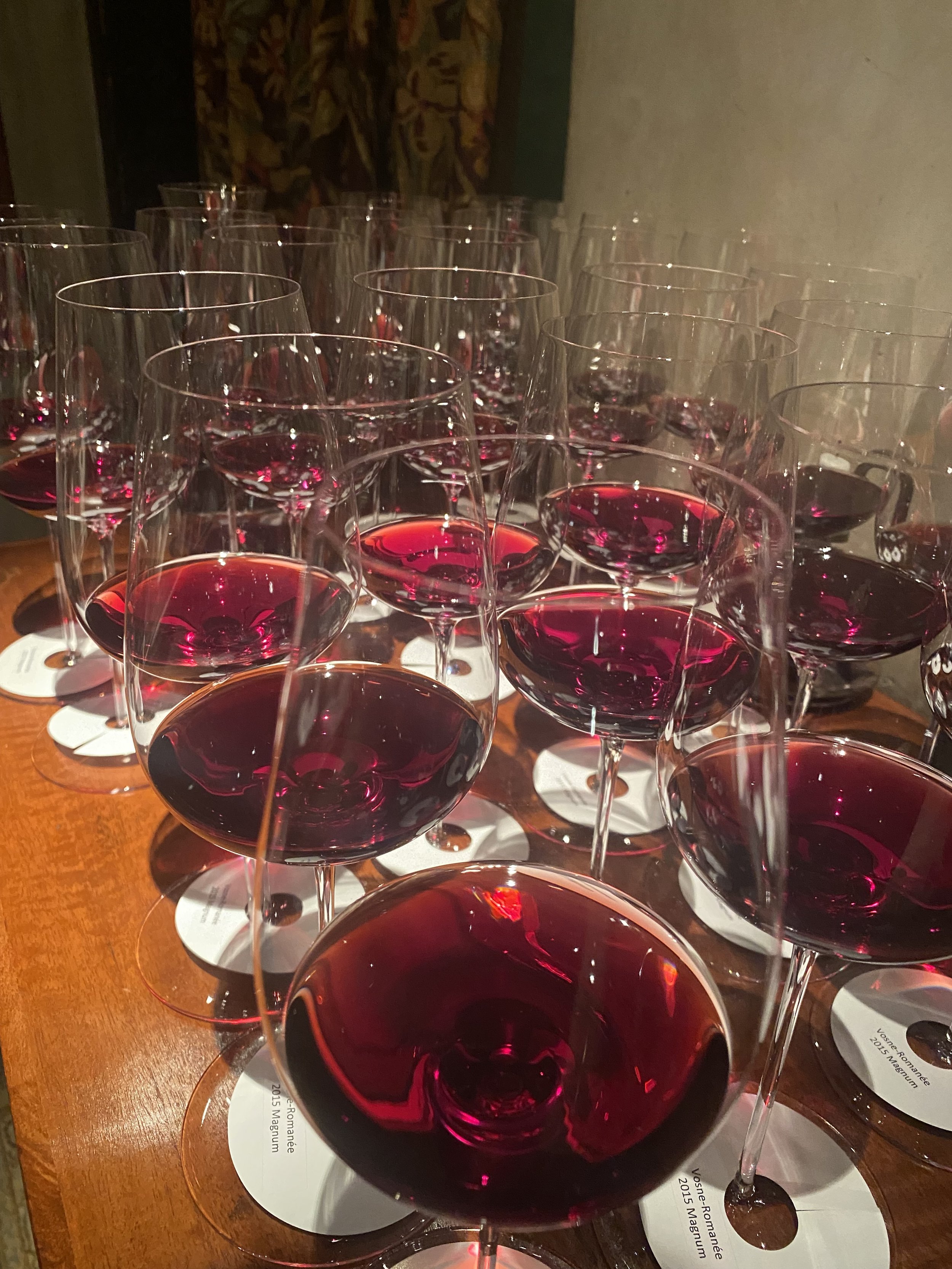
1st FLIGHT: VOSNE-ROMANEE
Our dinner focused on four wines from various vintages, starting with a flight of Vosne-Romanée. The domaine sources this village level wine from five climats, all acquired from the initial 1930’s domaine creation (Champ Gourdin, Croix Blanche, Colombiere, Pré de la Folie and Chalandin).
2018. I still feel the heat of that vintage in red Burgundy overall. Although I will say this bottle was very elegant. It was a good idea to double decant it I think.
2017. A very different wine with fresh acidity. In 2017, the domaine decided to light up bonfires in the vineyards in April to avoid frost damage on the young buds. Interestingly enough, it is not the heat of these fires that helped fight the frost effect but the smoke it created. That screen of smoke reduced the burning effect of the sunlight on the ice-covered buds.
2015. That vintage showed beautifully in each flight. The hot and sunny summer of that year produced concentrated wines with tannins that took some time to soften but patience is rewarding us today.
2ND FLIGHT: NUITS-SAINT-GEORGES 1er CRU CHAIGNOTS
“A Nuits with hints of Vosne”, according to the family. The Chaignots vineyard was acquired by the visionary Georges Mugneret who purchased these vineyards in 1971, along with the parcels of Clos Vougeot, Ruchottes-Chambertin and Chambolle Feusselottes, purchased during that same decade.
2017. Overall, the flight of Chaignots was marked by sharp acidity and I almost feel like we could have reversed the order on flight #1 and flight #2. 2017 was particularly austere but in the best way, reminiscent of tart griotte cherries.
2015. Another delicious 2015 here, offering darker fruit and a meatier wine with depth and concentration as the ultimate vintage signature.
2014. This challenging vintage rewarded the vignerons who were meticulous enough to sort out grapes affected by rot. An invading fruit fly hungry for black grapes did a lot of damage in 2014, in Burgundy but also in the northern Rhône Valley where Syrah suffered from the insect bite. It is not a surprise to find a beautifully balanced wine here as we know the Mugneret sisters’ attention to details and skill.
3RD FLIGHT: ECHEZEAUX GRAND CRU
With nearly 100 acres, the Grand Cru Echezeaux is a large appellation where quality can vary. With two plots, one located in the upper portion of the slope (Rouges du Bas) and one in the lower one (Quartiers de Nuits), Domaine Mugneret-Gibourg is able to offer a complete lecture of the vineyard and the wine is superb.
2015. Irresistible notes of kirsch. Magnificent and multi-layered.
2014. Another gorgeous wine, maybe my favorite of the night, most certainly because of the surprise factor. I didn’t expect such a generous aromatic burst from a 2014. Blooming with red fruits and almost exuberant.
2011. A very similar happy surprise here. While 2011 is often overwhelmingly vegetal and green, this wine was solidly anchored with high quality tannins and developed beautiful violet flowers laced with cranberries and damp earth. Congratulations on making such a pretty wine in such a difficult, rainy season.
4TH FLIGHT: RUCHOTTES-CHAMBERTIN GRAND CRU
“A Chambertin raised in Vosne” as legend Henri Jayer wrote about Ruchottes. Georges purchased his parcel of Ruchottes from the Thomas Bassot estate after M. Rousseau himself decided not to buy it all for himself! This rocky vineyard with very little topsoil is located at the end of the Combe de Lavaux and mirrors the Clos saint Jacques, on the other side of the Combe.
2015. Another slam dunk for 2015! Real Grand Cru material with intensity, built like an athlete.
2014. Back to sharper acidity, fortunately balanced by enough depth and a lovely grippy texture, excellent with food.
2011. I felt the green undertones that are characteristic of the vintage, more obvious here than with the Echezeaux. Nevertheless, a gorgeous wine.

What's Pressoir Drinking? Some Rousseau bottles which taught me to reconsider decanting...
2/21/2023
Raj Vaidya
I recently had occasion to taste a couple of bottles for a friend and client who was entertaining at home. She loves Domaine Armand Rousseau so I took the opportunity to pick out a couple of bottles I wanted to check in on to see how they were developing. The perks of having friends with such a deep cellar!

1980 was a peculiar vintage for red Burgundy, sometimes having produced superlative wines though many of which are now sadly on their way downhill, somewhat over-mature. Rousseau’s Clos de la Roche was vastly replanted after the frosts of 1981, so I figured the vines were pretty old at the time of the ‘80 harvest, and decided to give it a go.
The bottle showed some moldy aromas at first, I even wondered if it was simply corked, but upon tasting I realized it just needed air. With decanting it opened up quite beautifully, with aromas of black truffle dominating the nose and woody, earthy notes on the palate. It was a delightful wine, light in body and not powerful but very compelling and long on the palate. I had been worried about decanting such a delicate, old wine, and so had decanted just before serving it, meaning that when the dinner guests tasted it at first, that moldy aroma lingered and distracted from the prettiness of the wine. As it turned out the wine was excellent, even 4 hours later in the decanter at the end of the meal. It would have been best handled with an earlier decant.
Just before opening the ‘80 CDLR I double decanted the 1996 Clos Saint Jacques. I know ‘96s need air to mellow the intense acidity of the vintage, indeed it is a vintage Daniel and I disagree on often, I am more of a fan of this bright style of wine while he finds them often to be too acidic. I served the wine blind after the 1980 and just told the rest of the party it was Rousseau, asking them to guess the vintage and appellation. Everyone believed it to be Grand Cru, unsurprisingly, as the Clos Saint Jacques from this domaine is Premier Cru only in name, not in stature. This cuvée often outperforms the rest of the domaine’s holdings, save for Chambertin and Clos de Beze. But nobody guessed the vintage, with several experienced tasters placing it in the early 2000s, vintages generally thought of as more rich and powerful. The high acidity stayed with the wine but the double decanting aggressively introduced a good bit of air to the liquid and brought out superb fruit and spice aromas which made this the wine of the night. I have been wary of double decanting in the past when it comes to maturing Burgundy, the worry being that too much air could make the fruit dissipate and leave only that acidic backbone with nothing to balance it. But my intuition on this bottle turned out to be correct, and the wine sang.
All around a lovely evening thanks to these two very special bottles!

HENRI JAYER
February 14, 2023
by Daniel Johnnes
Born in 1922, Henri Jayer’s intention was not to be a winemaker but as the youngest of three children, rather than going to war, he stayed behind to look after the family holdings in Vosne-Romanée and worked alongside his father at the age of 17. He later went to the University of Dijon to study oenology and allegedly had another resident of Vosne-Romanée, René Engel, as his professor.
Little by little he expanded his production to around 6 hectares from his own holdings and later from a sharecropping arrangement with Madame Noirot-Camuzet where he took care of the vineyards, made the wine and shared the production, with his portion bottled under his own name and label. This arrangement lasted until 1987 though he remained as a consultant until Jean-Nicolas Méo took full control in 1989.
Those vineyards mostly around Vosne-Romanée were Richebourg, Echezeaux (Les Cruots and Les Treux lieux dits), Vosne Romanée 1er Cru Les Brulées, Vosne-Romanée 1er Cru Les Beaumonts, Vosne-Romanée Village from 3 plots (Les Barreaux, Les Saules et Les Vigneux), Nuits Saints Georges 1er Cru Les Meurgers and the famous Vosne-Romanée 1er Cru Cros Parantoux.
Cros Parantoux (1.1 hectares) has mythic status. It is a vineyard high on the slope just above Richebourg and wedged between Richebourg and Petits Monts. The soil is poor and was abandoned after World War II. A previous owner turned it into a field of jerusalem artichokes but Henri purchased 0.72 hectares (with Meo-Camuzet owning .30ha) and with the aid of dynamite blasted through the rocks - and artichoke - and planted Pinot Noir).
Henri nurtured his plot and bottled it along with his Vosne-Romanée village until 1978, after which he decided to label the wine as Cros Parantoux until his last vintage in 2001. Today it is owned by his nephew Emanuel Rouget and the remainder stays with Meo-Camuzet.
Even though Jayer retired officially in 1995, he continued to produce one or two barrels of his legendary Vosne-Romanée 1er Cru Cros Parantoux wine until 2001. As one can imagine, this wine is extremely rare and can sell for around $10,000 for one bottle.

One wonders what caused Jayer to achieve the status he had up until his retirement and retains today. No question the wines were delicious but his personality was one of an artisan who had an instinctive, intuitive approach to making the wine. Once when I was speaking with him in his office, I asked what his philosophy was about making wine. His answer shocked me but also informed me that he was not following any formulas or recipes whatsoever. He told me he looks at his grapes in the vineyard close to harvest and has a vision of what kind of wine they could become. His imagination of this wine would guide him through the work in the winery and cellar.
He was ahead of his times with a visionary approach to viticulture and winemaking. Where chemical treatments, fertilizer and high yields were the norm after World War II and Burgundy wines were not in high demand until the late 90s and early 2000s, he did not succumb to the chemical sales pitch. He was not concerned with the market for his wines. Instead, he was driven by minimal intervention and quality first.
He was an early practitioner of low yields in the vineyard, sorting out any unripe or disease infected grapes, fully destemming the grapes before vatting and a cold presoak for 3-5 days prior to fermentation with natural yeast. This seems natural and almost trendy today but at the time he had more of a look of a heretic. After pressing, the baby wine would always go into expensive 100% new oak barrels. If a taster asked him if his wine was over-oaked with such an abundance of new oak, his answer was, “if a wine tastes of oak, the wine is not over-oaked, it is under-wined”. Meaning the wine was not concentrated enough and could not handle the oak.
He was always practical. I remember talking to him about the wines produced after the hot 2003 summer. It was the first time Burgundy had experienced such extreme heat and started its harvest in August.
The theory is a grape vine requires 100 days of ripening between when the vine flowers to when the grapes are ready to pick. Pick too early and the wine is underripe, the stems green and can produce a green tasting astringent wine. The sugar levels may have looked good in a laboratory but in reality, the vine was not ready to deliver its fruit.
When I asked Henri about those who picked around August 16-17, because they were afraid of the grapes shriveling on the vines and producing raisiny, pruney flavors, he said, “You can’t pick after 87 days. The vine isn’t ready. It needs 100 days!
There are quite a few examples of 2003s that show under ripe flavors. A winemaker needs to take chances, as they are at the mercy of mother nature. But time and time again, I hear the great winemakers are willing to push the limits and wait through risky conditions because they know or maybe sense that the grapes are not at perfect ripeness. This is how Henri lived.
He also lived with a big heart. Until fairly recently it was uncommon for winemakers to share their knowledge with anyone outside the family and the domaine. I remember once at La Paulée de San Francisco I had a panel discussion and tasting with several winemakers. One of them was from Meursault and the question came from the audience how he would describe the wines of Meursault compared to those of Puligny-Montrachet. His answer was shocking and funny at the same time. He hesitated a moment and then said, “I’m not really sure although I did at one time go to Puligny”. Puligny is only about 4.5 kilometers from Meursault! I have also observed numerous times at La Paulée de New York or San Francisco or Los Angeles how, among the 35 or 40 different domaines representing the Cote de Nuits and the Côte de Beaune, many of them had never met before. It is common to hear, “I had to cross the ocean to meet my neighbors”.
This was not the case with Henri. He was an open book and had nothing to hide. In the mid 80s, when a new generation was succeeding their parents, he would either visit or receive in his cellar rising superstars such as Dominique Lafon, Christophe Roumier or Veronique Drouhin. He would share his knowledge and offer his wisdom in a nearly mystical yet unpretentious way. And always with encouragement, joy, confidence, a splash of humor and a twinkle in his eye.
His wines clearly reflected his personality. They were/are lively, joyous, clear, textural, nuanced, balanced complex and always delicious. Delicious was his key descriptor. I remember asking him about when would be the best time to drink his wine. His answer was, '“a good wine should always be delicious. It should not need to age to come into balance and give pleasure. It should give pleasure from the moment it is released from the cellar. Of course, it develops different traits with age but it is always DELICIOUS!”
Of the many times I would meet, speak and taste with him, there are two moments that stand out for me. The first was during a tasting in his cellar. He went into another room and came back with a bottle. There is nothing more troublesome than to be blind tasted by a legendary winemaker in his or her own cellar. First, the wine has never traveled. So, even if I had tasted the wine before, it would not taste as youthful as one that just traveled a few feet and had been stored at the perfect temperature. So, there is the fear of saying it is older than it is. There is also the fear of saying the wine is from a lower appellation than what he is tasting me on. How could I say an Echezeaux 2000 tastes like a Vosne-Romanée village ten or fifteen years older? I would lose credibility. This one had brilliant ruby reflections. It had an aroma of crushed black and red berries, cherries, violets and a hint of spice. It had a texture of velvet and a persistent long finish. “Cros Parantoux 1990!”, I declared. Wrong. Vosne-Romanée Village 1992. I was glad it wasn’t the other way around. Simply delicious but it clearly over delivered on its appellation and vintage. Typical Jayer
The other memorable experience was the last time I saw him.
We had become fairly close ever since I threw a retirement party for him in New York in 1997. I would pay him visits in his office. There was no longer any wine to taste yet he enjoyed sitting and sharing stories and his experiences, answering any questions I might have. How I felt privileged! I never felt intimidated or embarrassed speaking with such a legend. He became my Burgundy Yoda.
Henri suffered for several years with cancer and when I would ask to visit he would politely and quietly say, “not now, I’m tired. Call me another time”. After a couple of years of trying to see him again, he answered by asking me to come to the office.
This time was different. We talked and after about 20 minutes about his life as a vigneron, he said, “Daniel, I wanted you to come so I could say goodbye”.
PRESSOIR.WINE DIRECT ACCESS: DOMAINE CLOS DE LA CHAPELLE IN VOLNAY
2/14/2023
Raj Vaidya
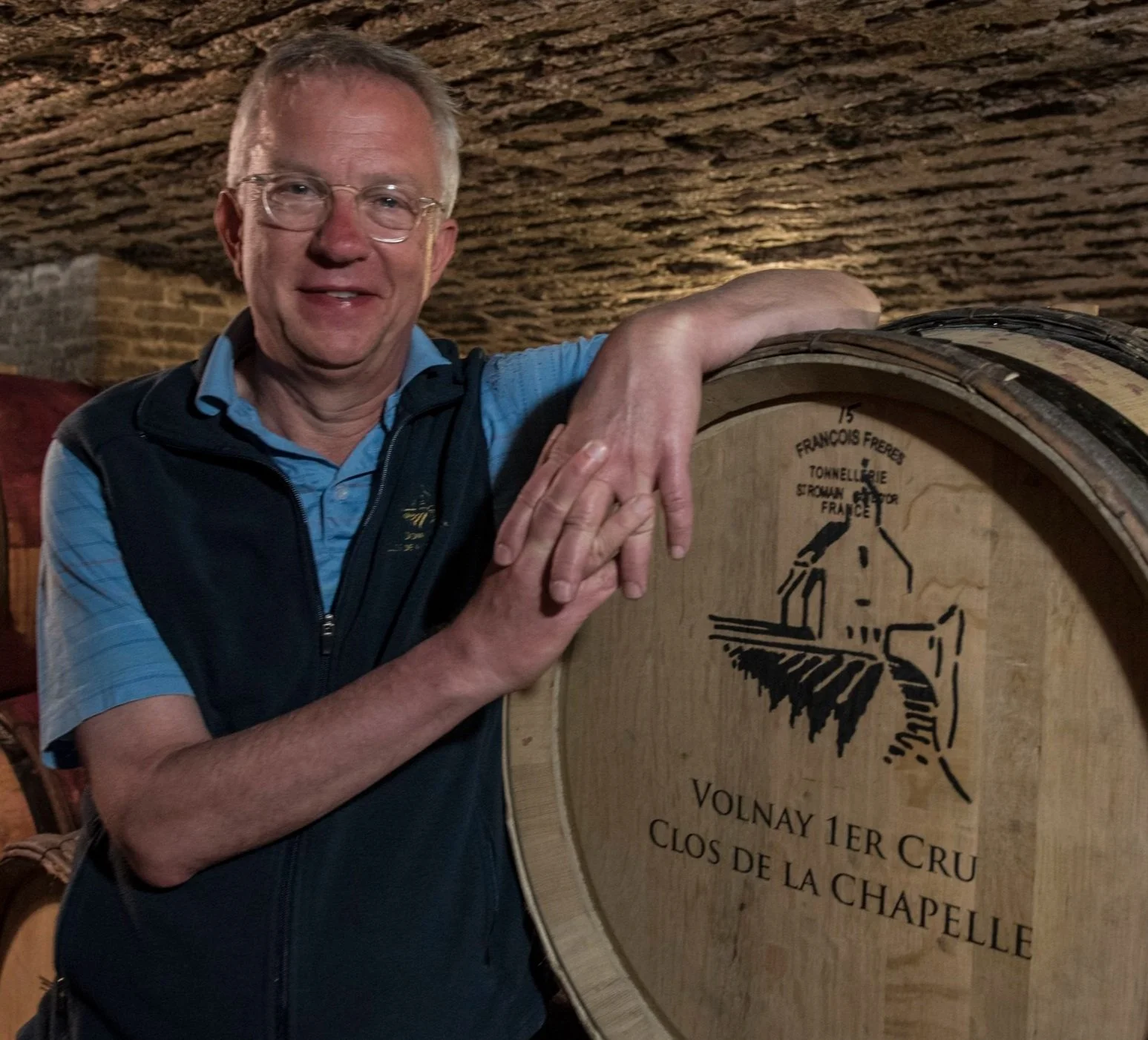
The first trip I took to Burgundy with Daniel was, to say the least, a memorable one. We visited the great domaines I’d been following throughout my career; Rousseau, Roumier, Roulot, DRC, and indulged in tasting some of the greatest bottles we could find. It was around the middle of the trip where we found ourselves dining with a friend in the courtyard of the Hotel de Beaune and drinking a fancy bottle of Jayer Cros Parentoux 1990, a very generous gift from said friend. Given that we had such a fancy bottle on the table, it was no surprise that other diners at the restaurant stopped over to say hi (perhaps hoping against reason that our host would share a taste with them?) and amongst the visitors was an American gentleman who introduced himself as Mark O’Connell. Mark knew Daniel and our host well and after a little chit chat to catch up told us he had just signed a deal purchasing a Volnay domaine which he was renaming after the most famed climat amongst the holdings, Clos de la Chapelle. This was back in 2010 and so began Mark’s deep dive into Burgundian culture, along with his business partner and winemaker, Pierre Meurgey.
The wines have soared in quality, and many more appellations have since been acquired since 2010. Today marks the occasion of our fourth offering of the domaine’s wines via our Direct Access program, and I couldn’t be happier to present the stellar 2020 vintage to our club!

Dear friends,
We are pleased to share this exclusive offer of the great 2020 vintage from a superb estate in Volnay, Domaine Clos de la Chapelle.
The domaine is named after its signature monopole vineyard which can trace its history back to 1789 when it was purchased by the négociant Patriarche et Fils. The Boillot family acquired it in the mid 19th century and were the first to ever use the name Clos de la Chapelle. In 2010, Mark O’Connell was approached by his friend Pierre Meurgey who asked him if he had ever considered the life of a vigneron. Mark has had a great love for Burgundy for decades, and had been buying barrels from the Hospice de Beaune auctions since 2005, and so had dipped his toe into the métier, but had never considered it possible to become an owner of a vineyard. With Pierre’s help and partnership, he found that opportunity and bought the domaine in 2010, with 2011 being their first commercial vintage. Since then Pierre and Mark have grown the domaine to 11 appellations and a total of 4 hectares.
Orders must be placed and paid by Monday, February 20. Check or ACH preferred. Credit card payments will add a 3% surcharge.
Thanks, and as always, feel free to reach out directly with any questions.
Raj Vaidya
raj@lapaulee.com

News from the Vineyard
by Daniel Johnnes
February 10, 2023
Domaine de la Grange des Pères
My quick trip to France this week was inspired by an invitation from the Vaillé family to come visit.
Vaillé owns Domaine de la Grange des Pères in the commune of Aniane in the Languedoc about 45 minutes north west of Montpellier.
My first stop was the fast train train to Lyon and a quick drive to Côte Rôtie to visit my friends, Guillaume, Brigitte and Gilbert Clusel-Roch. Brigitte and Gilbert are semi-retired although Gilbert’s preferred form of retirement is rebuilding the stone wall terraces around his vineyards. A quick click on their website will direct you to a Rolling Stones song “Don’t Stop” with Gilbert performing a Herculean task of reinforcing his century old walls.


Of course I can’t visit Clusel-Roch without timing it for lunch. This time, it was Brigitte’s classic blanquette de veau, accompanied by Côte Rôtie La Viaillère 2010 (2nd vintage).
Next stops were Julien Cecillon, Maxime Graillot and Jean Gonon. All three taking me further south on my journey to the Languedoc and the Vaillé residence, providing snapshots of both the 2022 and 2021 about to be bottled. Both good to excellent vintages with more depth and concentration in the 2022s, which does not necessarily mean better. 2021 is delicious and more approachable early.


I was full of emotion arriving in Aniane chez Vaillé. This is a property I visited in 1993 when his first vintage 1992 was still in barrel. I remember that visit like it was yesterday. We took a quick tour of the cellar and then spent a very long afternoon by the canal with my wife, Sally and our young 4 year old Lionel and one year old Barnaby.
Laurent, the genius behind the wines, had spent several years learning from the masterful Eloi Durrbach of Domaine de Trevallon (Baux de Provence) and Coche-Dury in Meursault. Laurent had to dynamite a hillside to plant his Syrah, Mourvèdre, Roussanne, Marsanne and a splash of Counoise, Chardonnay and Cabernet.
Over time, these wines achieved cult status and found their way onto the top tables of France and abroad.
Sadly, Laurent tragically died in the spring of 2021 and I had not been back until today. The wines are still magical, with deep rich flavors, yet light on their feet with fresh acidity, silky tannins and a hint of game.
These deep soulful wines never had a Languedoc appellation other than IGP Hérault or Vin de Pays de l’Hérault. Laurent did not want them to be associated with a place. They were and still are simply La Grange des Pères. May Laurent rest in peace.

Burgundy 2021, A First Look
Raj Vaidya
2/1/2023
I’m just back from a week of tasting the spoils of the minuscule 2021 harvest in Burgundy and wanted to share some of my (broad) observations about the vintage. At first glance, the season was such a difficult one that many producers saw production levels drop to levels as low as 20% of a normal crop, which can be truly disastrous for domaines which are small family owned businesses.

Veronique Drouhin’s Instagram post showing the candles burning in April 2021
The vintage was precursed by a mild winter which led into an unseasonably warm spring, allowing the beginnings of bud break as early as March 25th in some areas of the Côte de Beaune with Pinot Noir, and by early April both Chardonnay and Pinot Noir across both Côtes were full of sap and beginning to bud. Then, as happens often in April, the weather changed dramatically and temperatures plunged on the 4th of April to near freezing. Two nights of cold and dry weather wasn’t too worrisome, but on the morning of the 7th of April a frost warning was sounded, and much of the Côte prepared candles to burn in the vineyards overnight to combat the deep freeze.
There are several ways in which frost can damage the buds of the vine. If temperatures are cold enough, the buds simply freeze solid, and the sap inside the plant retreats towards the roots, leaving the buds lifeless. Other times, on mornings after very cold temperatures the rising sun can cause a sort of burning within the frost settled around the buds, effectively the magnified and refracted light of the sun burns the buds. On this occasion the frost damage was a combination of the freezing of the buds completely, along with a heavy snow which began to fall unexpectedly (mostly in the southern Côte de Beaune.)
The damage was truly epic, with vineyards on all parts of the slope severely damaged and in some cases, wiping out some mid-slope vineyards completely. Usually frosts tend to affect the highest parts of the slope (Village or Premier Cru) or the low lying flat areas (typically village or generic vineyards) but this time, the damage was truly universal, affecting all parts of the Côte.
Some buds survived the frost, and as the season warmed up and vegetative growth of the vine exploded, most vignerons were left to survey the damage and realize that their crop would be very small. This is always a tough pill to swallow, as the tiny amount of grapes does not mean any less work in the vineyards through the season, so they had to look forward to a big workload with very little reward. Sadly, the tiny yield was only the beginning of their worries. The uneven bud structure amongst what remained caused vineyards to overcompensate with vegetative growth, so the canopies of the plants grew quickly and wildly. This wouldn’t have been problematic by itself were it not for the weather of June and July, which saw a tremendous amount of rain spread throughout the months. Mildew and oidium pressure arrived by late June and with no end to the rain in sight, producers were scrambling with how to deal with the fungi. Quickly the powdery mildew took hold, forcing growers to spray copper and sulphur repeatedly throughout the growing season. The effect of the mildew further decreased the yields, leaving growers wondering what condition the few harvestable grapes would be in at the end of the season.
Finally, when August arrived, the region dried out a bit. As the harvest approached, many worried that because the yield was so small the level of concentration in the grapes would be heightened but this did not appear to be an issue after all, as the difficulties of the season caused the grapes to be light in color and alcohol, and a little bit diluted. The dilution actually helped fight that concern of over concentration and yielded wines that seem very pretty, light and a little ‘old fashioned’. The wines are in their infancy now, but still there are a few takeaways I gleaned from tasting quite a few…
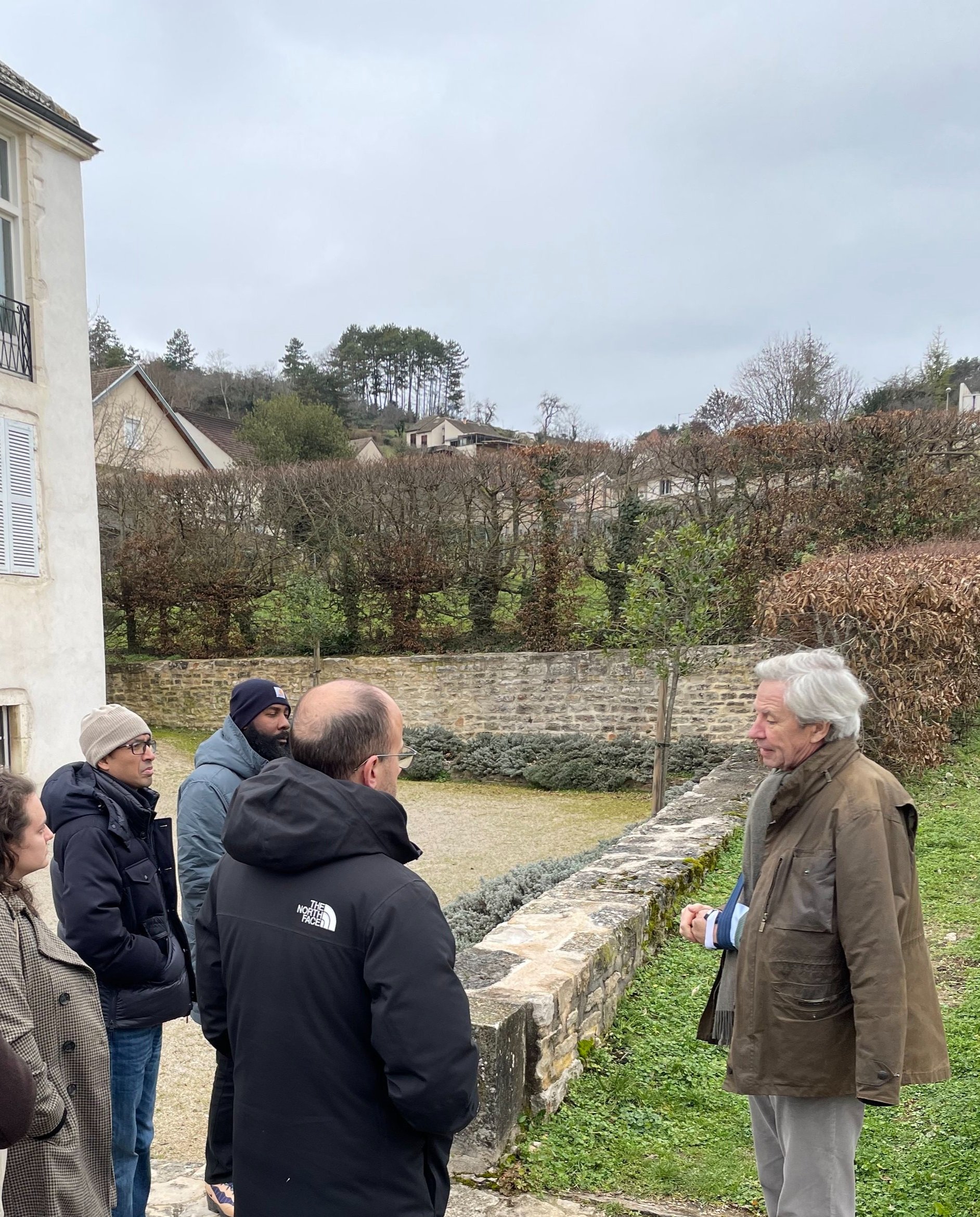
Guillaume d’Angerville welcoming us to taste the 2021 range, perhaps for the first and last time!
Whites seem to show beautiful energy, but not in the way vintages like 2007 or 2014 would, rather a somewhat subtle and light bodied freshness and length. The wines are very salty, saline from the mineral expression. The lower yields caused some of the whites to have a slightly angular structure, but I believe these will resolve themselves in time. The reds are extremely fine, reminding me of vintages like 2001, 2002 and 2008 in some weird combination. They have sneakily good structure, but the velvety tannins and light body are the primary impression one walks away with after tasting them. At this stage, just prior to the bottling of the 2021 vintage, the Pinots are almost tasting like more mature wines, showing fragrances and openness suggestive of wines with a little bottle age. They will surely revert to being a bit closed after the shock of bottling, but I forsee them aging extremely well down the road.
That is, if there are any bottles to put away in one’s cellar to begin with. Guillaume d’Angerville welcomed us at his domaine stating, “we will be tasting the 2021 vintage, so pay attention, and remember this experience, because there are so few bottles that you may never taste them again…”. This was a sentiment shared by many, which must be all the more frustrating for the producers; a difficult vintage which produced beautiful wines which almost nobody will get to enjoy because of the rarity of the bottles.

Frédéric Mugnier
Daniel Johnnes
February 3, 2023
For me, the red wines of Domaine Jacques Fédéric Mugnier are among the most compelling in all Burgundy. Not only are they aromatically seductive; they often display the silky texture and vibrant intensity found in the best expressions of Pinot Noir.
Yet there is so much more to appreciating a wine than just its aroma and taste. I am lucky to have the advantage of knowing many winemakers and somehow this knowledge has an impossible to explain influence on my palate. If I don’t sympathize with a winemaker for whatever reason, I am less inclined to be moved by his or her wines.
If you know Dominique Lafon and his gregarious character, you understand (and perhaps like) a little better the exuberant style of his wines.
With Fred Mugnier or Freddy as his friends call him, a tasting is always more than a simple exhibition of the current vintage. There can be a deep reflective conversation about the world we live in and somehow the discourse makes a full circle back to the topic at hand, his wine.
On my most recent Sommelier Scholarship trip, I asked him if he had done experiments with biodynamic treatments in his vineyard and did he see any improvements. A simple question very commonly asked to winemakers. His answer was a simple, “no”
Biodynamics and organic viticulture have become more and more common in Burgundy, France and throughout the wine producing regions of the world. This movement also coincides with a growing awareness of our carbon footprint and also the commonly heard phrase, that ‘the quality of the wine starts in the vineyard’.
Fred answered my question simply by saying “no”. It was only later in the day that I realized he had unleashed a proverbial bomb recently in publishing an article on his website questioning biodynamic practices.
In the middle of harvest 2022, an article appeared in a wine publication saying how, ever since Mugnier started with biodynamics in his Clos de la Maréchal vineyard, his wines have improved dramatically. This article set him off and even with the harvest in full swing he published this article to set the record straight and express his thoughts on the subject, which he says have been percolating in his mind for 30 years.
It is a fairly long, thoughtful and factual article dissecting and questioning the adherence to this type of viticulture. So polarizing was the article that it provoked a response from several of his friends who have long embraced biodynamics and a call from Aubert de Villaine from Domaine de la Romanée Conti for a meeting.
Fred is not afraid of stirring the pot but he doesn’t do it for the sport of it. He does it in a most logical way to question practices that people apply. He thoughtfully weighs the risk benefit of it - something that many people do not do because they simply do it with a herd mentality. This is the same behavior people apply when they say “natural” wine is better or “organic” is better. No sulphur is better. Filtration is bad. These are just some examples that may or may not be true but so often are used and applied for the wrong reasons. Often, they are just marketing slogans.
Well, Fred pulled back the curtain and there is a dialogue that is now circling the planet on this topic. It may make some people uncomfortable but from discomfort comes change and intelligent conversation.
Because of his thougtful critique I think I like Fred’s wines even more today than before my visit!

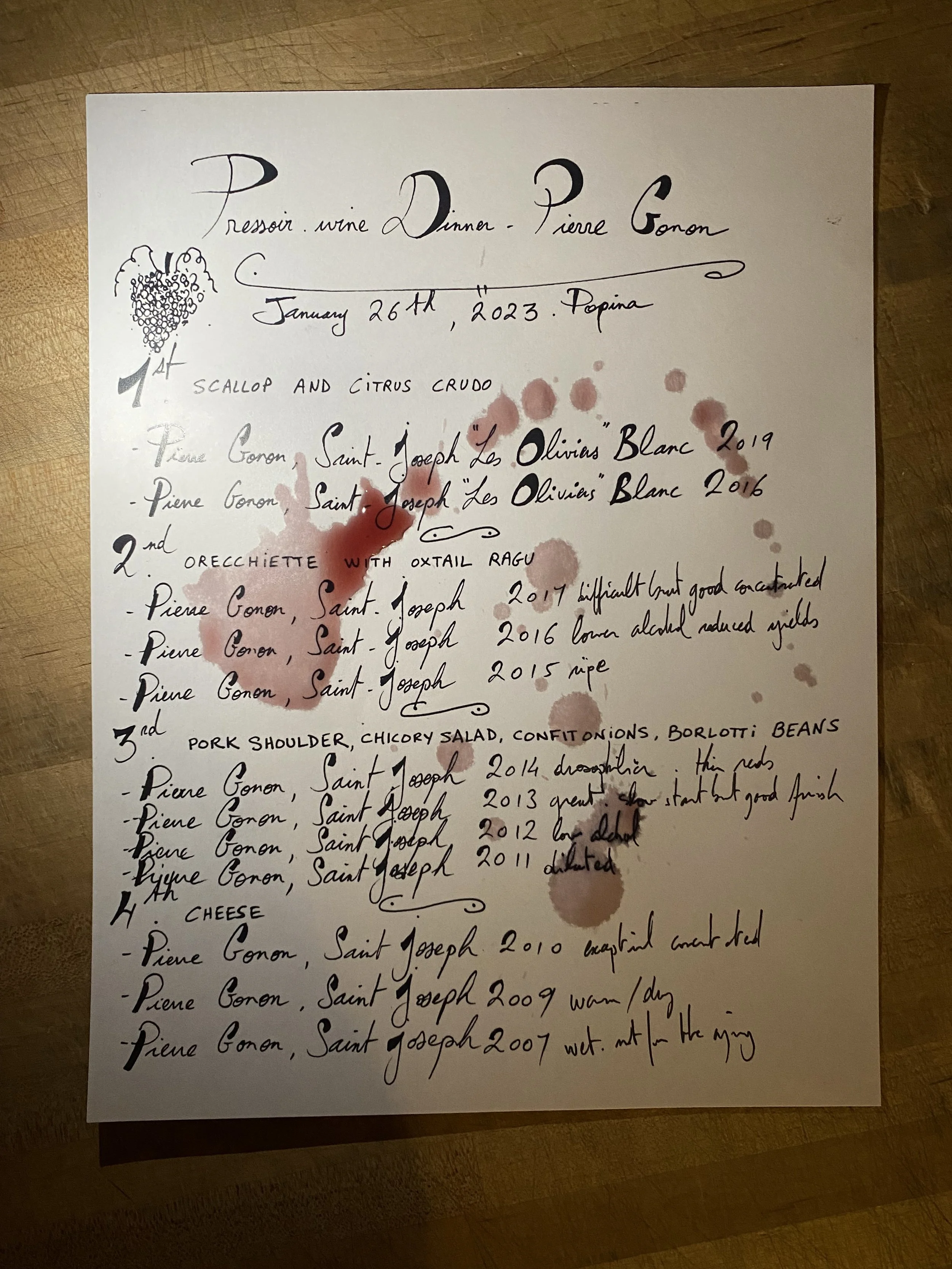
Pressoir.wine Dinner - Pierre Gonon recap
Pressoir.wine Dinner - Pierre Gonon recap
by Edouard
1/27/23
January 27, 2023
by Edouard Bourgeois
Jean Gonon was only twenty years old when he started making wine alongside his brother Pierre and their father Pierre. It was in 1986 and the two brothers released their first vintage together in 1988. Not much has changed at the estate since then. Jean focuses on the farming while his brother is the man in the cellar, but he is also managing the horses that plough the precious land.
Father Pierre started as a vigneron in 1956 although back then, wines of the northern Rhône were certainly not where they are today in terms of recognition, which explains why many farmers would prefer growing apricots or cherries rather than the labor-intensive grapes to make wines they were not sure would sell. So, until 1964, the Gonons would sell their grapes to local negociant Chapoutier to ensure revenue. Raymond Trollat, another highly respected vigneron in the area, started bottling his own wine earlier in the 1950’s, leading the way to daring emancipation. Others followed such as the Grippat family in the 1970’s.
But back to Gonon. I remember tasting my first bottle years ago. I was with a bunch of sommeliers on my day off from restaurant Daniel and someone opened this “simple vin de pays” called “Les Iles Ferays”. Talk about a “sommelier wine” … I couldn’t believe vin de pays could taste so good! As I found out later on, it turns out this bottling is quite rare with less than an hectare of vines planted and it comes from the flatter land, technically in Saint-Joseph, but Gonon prefers to bottle separately as vin de pays instead. That already tells a lot about the level of dedication from this family who saves the very best, hillside vineyard grapes to produce what Jean calls the real Saint-Joseph. It needs to be said, the appellation Saint Joseph has an issue. It started as a mere one hundred of hectares spread around 10 villages on these hillside vineyards where granite reigns supreme along with gneiss. But in the early 1970’s, political decisions led to expand the appellation area stretching it all the way north by Côte-Rôtie, not only spanning many different micro-climates but also including the flat lands as part of the appellation. The result was inevitable. Today Saint-Joseph doesn’t mean much in terms of quality and unfortunately, consumers can easily be disappointed. Gonon’s Saint Joseph is always made from grapes grown in the initial designated area of the appellation, indisputably the best vineyards.
When you ask the very affable Jean Gonon the simple question “what do you do to make such good wine?” he quietly answers that the wine is made in the vineyard, not at the winery. Sure, you hear that answer often, but when I saw the vineyard workers came back from their long day in the field as I exited the three and a half hour long tasting, I understood. Although they seem joyful and glad to be done with their daily work as the sun went down, these courageous people look like they had run a trail marathon! It is no easy task to work on the steep incline, but it pays off. Only selection massale is used in the vineyard so the best performing vines are used. These vigorous plants respond better to the terroir for example by avoiding over ripeness. The same cannot be said about the cloned vines largely used in the area by the majority of producers in the area.
At the winery, at least 80% of whole cluster is used. New oak is not used and Jean describes the winemaking as “simple”, what we know as “non-interventionist”.
The farming has been organic since 2004 although certified only nine years later.
The wines were incredible last night and as usual, I started writing tasting notes going through the deep vintage vertical. But after writing “wow!” “amazing!” “pure” or “deep” for most wines, I figured it was pointless to continue. Sometimes there is not much to say when you’re so close to perfection. One particularity about superior wines like those of Gonon is that they amaze me whether they are in their adolescent stage or with more bottle age. Their irresistible charm is consistent no matter the vintage or the age, a trait that I find is rarely seen.

My conservative notes below. Note: all the wines were double decanted two hours prior.
Domaine Pierre Gonon, Saint Joseph Les Oliviers Blanc 2019
Domaine Pierre Gonon, Saint Joseph Les Oliviers Blanc 2016
Les Oliviers is a tiny vineyard, not planted on granite. Mostly clay is seen there and Marsanne is king. The richer soil produces a generous wine with low acidity. The wine is fermented in oak and stays on its lees for a year with a few lees stirring the first months.
Domaine Pierre Gonon, Saint Joseph 2017
Excellent quality of fruit.
Domaine Pierre Gonon, Saint Joseph 2016
Amazing length and the brininess starts to show black olives.
Domaine Pierre Gonon, Saint Joseph 2015
Flamboyant! The exceptional quality of the vintage paired with the expert craft of Gonon is a marriage made in heaven.
Domaine Pierre Gonon, Saint Joseph 2014
2014 is known for its « greenness » in Burgundy but also in the northern Rhône. There was a touch of that here at the opening but it magically disappeared after aeration. Although tannins could be felt. Patience should reward the taster.
Domaine Pierre Gonon, Saint Joseph 2013
A deep wine. incredible
Domaine Pierre Gonon, Saint Joseph 2012
2012 reminds Jean Gonon of a vintage of the past, with a lighter, elegant body. It was a rainy year that produced less ripeness and less concentrate wines. The tasting confirmed that with a wine that is a bit thinner, not a fault by any means.
Domaine Pierre Gonon, Saint Joseph 2011
Juicy and vibrant! I have one bottle left at home and I will surely be saving it for the right occasion!
Domaine Pierre Gonon, Saint Joseph 2010
The tannic structure felt tighter here. A bit more austere with some bitterness. Like the 2014, a few more years should polish off the hard edges.
Domaine Pierre Gonon, Saint Joseph 2009
The fruit is more exuberant and lovely. Saying it was my favorite doesn’t mean much in this lineup, but I REALLY liked it!
Domaine Pierre Gonon, Saint Joseph 2007
I was amazed by the youthfulness. It is delicious now and I feel confident it will continue to amaze the drinkers for decades to come


What's Pressoir Drinking?
January 27, 2023
by Justine Puaud
2013 in burgundy
This week was clearly epic. I had the chance to follow Daniel, Raj, Max and 4 sommeliers on our Sommelier Scholarship trip on fantastic visits in the Côte de Beaune and Côte de Nuits. We were really fortunate to taste the 2021 vintage. It was maybe the only time I would be able to taste 2021… but my article this week is focusing on a different vintage! I think if we have to sum up what we tasted over the last 4 days we would say that the 2021s are incredible, delicate and fine wines. We were also all shocked how the 2013 has evolved and in such a good way. Every time we talked about vintages during the tastings, the winemakers and our team agreed on how well the 2013 wines are drinking now.

2013 was not an easy vintage but it is one of the great ones now because it surprises everyone and the winemakers are really happy about it.
Here is a quick overview of the 2013 vintage in Côte d’Or - marked by a difficult spring, 2013 was characterized by a production volume well below the average (approximately 20% less). The flowering was affected by rains and cool weather. Despite a pretty hot summer which favored good ripeness, the harvest only started at the end of September and ended, in some vineyards, in mid-October. These are the latest harvests in a quarter of a century. Nevertheless, these remain historically traditional dates for Burgundy.
Our first surprise was at Domaine Jacques Frédéric Mugnier when Fred Mugnier ended his 2021 tasting with a blind tasting… It is always difficult to say your thoughts to the winemakers. You don’t want to say Chambolle-Musigny Village if Fred just opened Les Amoureuses. For this one we all gave wrong answers, Echezeaux, Bonne-Mares … it was actually a Chambolle-Musigny 1er Cru Les Fuées 2013. Great concentration and good structure with florals, spices and dark cherries. .
Still in Chambolle, we went to see Charles Van Canneyt of Domaine Hudelot-Noellat. We did a vertical Les Suchots from 2021 to 1996 and we ended with Richebourg Grand Cru 2013. Definitely a cooler, red fruited vintage. The Richebourg was lighter, silky with a lot of elegance.
I will finish with THE Meursault Les Perrières of Domaine Jean-Marc Roulot 2013. Unbelievably focused nose displaying concentrated ripe yellow fruit. On the palate, it was incredibly rich yet pure. A big scale wine with a very good balance.

Pressoir.wine Session - 2012 Vintage Recap
Session Recap
By Edouard
1/20/23
Edouard Bourgeois
January 17, 2023
“What do you smell?” or “what food is best with this wine?” are questions I have been asked many times as a sommelier. But the one that might be even more common is “when is the best time to drink this bottle?” That last question, just like the other two, is never easy to answer. Although there is no doubt that some wines are meant for aging and others are deliberately made in a way that suggests early drinking, it remains a matter of personal taste. When it comes to Champagne for example, I like to feel effervescence and a vintage Champagne from the 60’s or even the 70’s is typically not my go-to. I know plenty of people who love these old Champagnes however…
Anyway, I thought that trying to understand how time affects a bottle of wine would be an interesting topic to discuss at a Pressoir Session. So I selected six wines with a decade of age, all from the 2012 vintage and from various regions of France, to see how a similar bottle age affects each wine differently, depending on the grape variety, the region and the winemaking style. And the goal was ultimately to determine which one showed best which turned out to be an engaged and polarized response from the attendees.
2012 was not an easy vintage for most French wine regions.
The damp summer that affected Burgundy gave mildew an ideal terrain to develop, forcing vignerons to drastically sort rotten grapes, resulting in low volumes at harvest. The quality can be very high in some places however, with soft tannins in red and concentrated whites. Champagne fared better and 2012 is recognized as an exceptional vintage with very healthy grapes and it is not surprising that most Champagne houses decided to declare the vintage for their prestige cuvée. The Rhône did good too and the particularity of the year was lower alcohol levels and quite surprisingly lower acidity levels too with some rigidity to Condrieu.
Here is a recap of the wines:
Champagne Pierre Paillard, Les Maillerettes Bouzy Grand Cru 2012
Pierre Paillard owns 11 Ha in Bouzy. Pinot noir 70%, Chardonnay 30%, 25 plots, average 30 years in age
Les Maillerettes (36Ares|0,9 Acre plot) is a single vineyard, single variety (Pinot Noir) and single vintage champagne crafted every year since 2007 and farmed sustainably. It was planted in 1970.
The wines are fermented in oak and aged sur lies for 11 months before bottling. Les Maillerettes then benefits from extended aging“ sur lie”: 5 years in the 19th century cellars.
Dosage: 2 grams per liter (Extra-Brut) Soil: pure chalk with only 50 centimeters (20in) of clay topsoil.
The wine was incredible and maybe my favorite. Champagne has a long history of aging its wines for an extended period of time.
Domaine Moreau Naudet, Chablis 1er Cru Vaillons 2012
Moreau-Naudet's holdings in Vaillons are around 1.7 hectares of 35-50 year old vines.
Fermentation is always with indigenous yeast, followed by a long maceration on lees (3 months). The wine is then aged for an average of 18 months (varies according to the vintage) on lees in a combination of stainless steel and 600-liter French oak barrels, of which only 20% is new.
Moreau-Naudet's holdings in Vaillons are around 1.7 hectares from Roncière, Séchet (75 year old vines) and Epinottes. In the new winery, the barrel room has a thermal floor that helps kick off fermentations.
The Chablis showed a lot of richness that made me a think of the presence of botrytis perhaps. I was expecting a crisper wine and if I knew how the wines showed, I would have served it after the Mâcon rather than before.
Domaine Olivier Merlin, Macon La Roche Vineuse Les Cras 2012
2.5 hour by car from Chablis, Macon produces 45 million bottles on average each year and many of these bottles can be forgetful and not very impressive.
Olivier Merlin however, is an old-school winemaker who prides himself on crafting non-manipulated wines with low yields in the Mâconnais and Olivier makes serious, long-lived, and delicious wines. Since starting his domaine in 1987 he has worked tirelessly to promote the wines of the region and now, as trends have come and gone, Olivier can be considered one of the region’s benchmark producers.
The majority of the wine is fermented in stainless steel tanks with around 10% going into older Burgundian barrels. The wine goes through malolactic fermentation and is bottled after 15 months of aging without being fined.
Superb bottle that should really help people realize the potential of this overlooked part of Burgundy.
Domaine Matrot, Meursault 1er Cru Les Charmes 2012
The domaine exists since the early 20th century. It went through farming changes to finally embrace organic viticulture along with ploughing, rigorous pruning and debudding in the spring to help control the yields. If necessary, a green harvest is carried out before veraison. The sanitary state, yields, and maturity are carefully observed.
Long and uneventful fermentations for 8-10 weeks are employed, and the quality of the lees is carefully monitored since they accompany the wine during the maturing process.
Bâtonnage (stirring of the lees) is done according to each vintage.
Chaptalization is avoided whenever possible and the alcohol content is never rectified by more than half a degree in order to maintain the natural balance of the grapes. It is important to recognize and respect variability with each vintage, for example, knowing that one year a grape can be ripe at 12 degrees of potential alcohol, and the following year reach ripeness at 14 degrees.
The wines are matured for 11-12 months in oak barrels with a capacity of 228 liters. One- to five-year-old barrels are used for the white wines and 10-20% new barrels for the reds.
When it comes to the climat Charmes, you enter the very best of Meursault. Matrot owns four plots within Charmes, of which 70% are located in Charmes-Dessus. Les Charmes is a well-balanced wine with both the ampleness of the Charmes-Dessous and the minerality and elegance of the Charmes-Dessus.
We all agreed on the classic profile of this deliciously hazelnutty and buttery Meursault. Quite opulent, I would drink this wine now although a few more years wouldn’t hurt.
Domaine Yves Cuilleron, Condrieu Les Chaillets 2012
The Cuilleron family domaine, located in the hamlet of Verlieu (part of the town of Chavanay), was founded several generations ago (1920). Yves Cuilleron’s grandfather was the first to bottle wine for commercial purposes in 1947. Antoine Cuilleron, the uncle and immediate predecessor of Yves, assumed control of the domaine in 1960 and significantly increased the percentage of wine bottled at the estate and extended the scope of the domaine. Yves assumed full ownership and direction of the domaine in 1987 and, since that time, has built an entirely new facility while at the same time acquiring additional vineyard property. The domaine is now (as of 2012) significantly larger in scope with 52 hectares of vineyards that cover multiple appellations, including principally, Condrieu, Saint Joseph Rouge and Blanc, Cote Rotie, Saint Péray and a series of Vin de Pays from the Collines Rhodaniennes.
A large majority of the vineyards are set on terraces which makes most mechanization difficult, if not impossible. Thus, much of the vineyard work continues to be done by hand. To control yields, Cuilleron does extensive debudding and, when necessary, practices a “green harvest”.
In the cave, the grapes (harvested manually) are fermented using indigenous yeasts. The fermentations of the appellation controlée white wines are done in small barrel of one to four years age; malolactic fermentations are done in barrel as well and the elevage continues for nine months before the wines are bottled.
Condrieu Les Chaillets: This cuvée is sourced from the best exposed and the oldest Viognier vines of the domaine (south-southeast exposure, planted on terraces in the commune of Chavanay). Barrel-fermented and barrel-aged with regular batonnage during the nine-month elevage. The whites are lightly filtered before bottling.
Condrieu is a very unique wine and Viognier may find its most exuberant expression in this appellation. Pineapple, pear and mango exploded from the glass. Low acidity.
Domaine Bruno Clair, Gevrey Chambertin 1er Cru Les Cazetiers 2012
The classic domaine farms around 24 hectares in Marsannay la Cote, at the very northern end of the Côte de Nuits.
The vineyard of Cazetiers is 0.9 ha (2.2 ac) and the domaine’s plot was planted in 1958, 1972, 1996. Direct neighbor of the famous Clos St. Jacques, Cazetiers shares its poor marl soil and limestone deposits.
“For a while, people mentioned a derivation of the word castel, in reference to the position of the climat above the castle of Gevrey-Chambertin. According to Françoise Dumas, the more plausible explanation is that Cazetiers was derived from cassis, which would indicate the presence of wild cassis or red currant bushes.”
Bruno Clair points out an interesting difference between Les Cazetiers and Clos Saint Jacques: In his cellar Les Cazetiers always has a higher pH (lower acidity). This translates into the flavors of the wines, with Cazetiers always feeling like blacker fruit, and Clos-Saint-Jacques like redder fruit.
Because of its location, it lies exclusively on stark white, completely decomposed marl, or terres blanches. Here, it has a very hard, cement-like quality, causing the vines to struggle. The topsoil is only about 10 cm deep and consists of up to 45% gravel and up to 10% cobbles. It is followed by a thick layer of laves, followed by a second layer of terres blanches soil before reaching the limestone bedrock.
Despite the fact that Les Cazetiers is more sheltered from the wind from the Combe de Lavaut than Clos Saint Jacques, Bruno says it systematically ripens one week later.
Of all the 2012’s we tasted, this Gevrey seemed the youngest with still grippy tannins and a certain austerity. The fruit was dark and concentrated in the glass. Notes of black pepper and cassis.
As a blind wine, we poured another Gevrey Cazetiers, from the Bruno Clair once again but this time from 2002. A good vintage. Summer was not especially hot, though it was reasonably dry. Sugar levels were boosted in September but some grapes were adversely affected by scattered rains then. Sugar levels were quite respectable in the end and most wines showed their charm at an early stage.
The wine clearly showed more age but probably not ten more years than the 2012. The austerity of the 2012 was well polished here although a hint of volatile acidity could be felt. It didn’t distract too much from the experience as the richness of fruit was in full bloom.
What's Pressoir Cooking?
Truffle season
Eggs and truffle purée by Chef Jean-Michel Belin of Le Beauvallon Hotel in Provence
by Justine Puaud
January 18, 2023
We are in the middle of the truffle season. The famous truffle market is in Richerenches in France and is open from November to March every year. If you plan to visit the Provence region around this time of year, you have to make a stop there. It is not like a traditional farmer market. You enter a quiet street where there are a dozen mini vans and people will be selling truffles from the back of their cars…
The tuber melanosporum, also called black truffle, is quite strong on the palate. I tried many recipes with truffles and I think overall the simplest recipes are the best (omelette with truffle, pasta with truffle, French coquilles Saint-Jacques carpaccio) But, I have to say, the soft boiled egg with a truffle purée is among my favorites. The mix between truffle, béchamel sauce and madeira makes this recipe just delicious and really enhances the truffle.
Ingredients
12 fresh eggs
120g fresh truffle
30g béchamel sauce (if you don’t know how to make a béchamel, check out this recipe)
40 cl heavy cream
120g of butter
25 cl of madeira
25cl of truffle juice (buy a can of truffle juice from Plantin)
6 slices of bread (ie traditional baguette)
salt and pepper
Instructions
Sauce
Put the eggs and truffles in an airtight container in the refrigerator the night before.
Put the eggs in the blender to obtain a very fine purée or cut the truffle into very small pieces.
Make a béchamel.
Then, in the saucepan, reduce the Madeira and truffle juice to dryness, add the cream and the béchamel. Leave to cook for a few minutes, stirring.
Add the truffle purée and the béchamel to the Madeira and truffle juice and leave over low heat for 3 minutes.
Cook the eggs for 3 minutes in salted boiling water. Remove the egg from the shell, then using a teaspoon, remove the little white that is not cooked.
In a frying pan, brown the slices of bread with a little butter, then cut them into "mouillettes" and keep them warm.
It's almost ready to eat. Fill the egg cavity with the truffle purée, dip the bread in the egg with the sauce and enjoy.

Pressoir.wine Dinner - Grands Crus of Joseph Drouhin Recap
Pressoir Dinner Drouhin Recap
By Edouard
1/13/23
Edouard Bourgeois
January 13, 2023
Joseph Drouhin is one of the most recognizable producers in Burgundy in terms of the size of their operation but also when it comes to producing fine wines from some of the best terroirs. From Chablis down to the Côte Chalonnaise, Drouhin has been producing a myriad of ninety different appellations for four generations. The house was founded in 1880 and has been acquiring vineyards in the most coveted areas while their negociant activity also allows them to buy grapes from long term contractors.
Joseph Drouhin is also synonymous with clean farming practices, as the domaine became organic in 1990 and biodynamic a few years later.
Last night’s dinner at Le Pavillon was sensational with a focus on four iconic Grands Crus from Drouhin. We kicked things off with a flight of Grands Echezeaux followed by Clos de Beze and Griotte Chambertin and crowned the event with the majestic Montrachet from Marquis de Laguiche. My recap below:

GRANDS-ECHEZEAUX 2013/2010/2005
Out of the nine ha of this large Grand Cru climat, Drouhin owns almost half an hectare. The geographic situation of Grands Echezeaux is quite exceptional and that didn’t go unnoticed by the monks of Citeaux who already owned the nearby Clos de Vougeot. Although they didn’t get to put their hands on vines in Musigny, when they acquire Grands Echezeaux, the motivation was to make a wine as fine as its prestigious neighbors. The three vintages we tasted showed really well. Starting with the complicated 2013, a vintage that brought cold, rainy weather with an episode of hail, 2013 forced vignerons to be cautious to sort out rotten grapes. Here, I thought the 2013 showed really well and didn’t lack maturity as I sometimes find in 2013. Although I could detect a touch of dried grapes on the nose. 2010 delivered a cleaner, delicious fruit quality with the concentration often associated with the vintage. Great bottle with necessary acidity to lift the wine. Drouhin used a generous portion of whole clusters that year, good call! 2005 behaved as expected, a powerful, high alcohol wine that in my opinion need more time to develop secondary aromas. I could feel some “heat” in the finish.
CLOS DE BEZE 2013/2010/2005
It was really interesting to repeat the same flight of vintages from a very different site. Clos de Beze is one of the oldest clos in Burgundy. Although the walls are now gone, the Clos de Beze was a very important plot for the monks of the Abbey of Beze, who became owners in 630 AD, until they lost ownership in 1219. This exceptional vineyard, due east and on a mild incline, covers fifteen ha and Drouhin only owns a mere 0.13 ha of it. So tasting three vintages side by side is quite a treat!
That was a brilliant flight, starting with a really pretty 2013 that had a juicy fruit character. 2010 may have produced low yields, this was a stunning wine. I really am a fan of the vintage in general and this bottle had the ripe cherry and almondy aromatics I crave in a red Burgundy along with ultra elegant tannins. Bravo! Once again, 2005 felt a touch too alcoholic for my taste but finesse is indisputable.
GRIOTTE CHAMBERTIN 2002/2000/1990
Joseph Drouhin is among the nine lucky owners of Griotte Chambertin, this tiny gem of a Grand Cru nestled just below the Clos de Beze. Drouhin’s plot is about half an hectare, out of the total 2.5 hectares of Griotte. The dry summer of 2002 was saved by needed rainfalls at the end of August. The results were balanced wines that seem to have everything in good proportions, between alcohol, sweetness and acidity, while tightly packed in a fine tannic structure. The Griotte 2002 was superb with noticeable acidity that suggests a long life ahead. 2000 Griotte Drouhin has been a favorite of mine for a while. The wine is highly seductive and dare I say “Chambollesque”. The small red fruit profile is irresistible. Finally 1990 performed highly. We decanted the bottle right before serving it, not so much for oxygen but to get rid of the good amount of sediments in the bottle. The tertiary aromas were delicious and the wine still pristine with hints of confit oranges and a delicate body.
MONTRACHET MARQUIS DE LAGUICHE 2014/2012/2010
Sitting almost equally on both villages of Chassagne-Montrachet and Puligny-Montrachet, Montrachet is at the pinnacle of white Burgundy. Of the eighteen owners of this eight hectare grand cru climat, the Marquis de Laguiche family owns the largest plot, all in the Puligny-Montrachet side. Two hectares of glorious land in the Laguiche family since 1776. Joseph Drouhin started running the farming and making the wine from this plot in 1947 and continues to do so today. Along with Clos des Mouches or Griotte Chambertin, Montrachet Laguiche is an iconic wine at Drouhin.
2014 was powerful, a true Montrachet! The exuberance was matched by incredible minerality and a mind blowing length. Really impressive bottle. 2012 was another big hit. Pristine wine in a great spot. Some hints of coconut and again this powerful character with oily texture and mouthfeel. Delicious citrus jam quality. 2010 followed the same pattern. The harvest was a bit rushed by finnicky stormy weather conditions but the result is highly satisfying.

Finally, a special thank you to Eric Foster, our guest and Club Member, who generously shared his bottle of Montrachet Laguiche Drouhin from 1996. After having a few disappointing bottles from that tricky vintage, that bottle showed a healthy profile with no trace of oxidation. What a way to close the night!


What's Pressoir Cooking? Crispy Porchetta
by Max Goldberg Liu
Wednesday, January 11, 2023
by Max Goldberg Liu
January 11, 2023
Tasked with cooking the main course for a New Year’s Eve dinner party, I wanted to try something different than the typical prime rib or steaks that we usually spring for on special occasions. I’d always wanted to try making a porchetta, the savory rolled Italian pork roast that feeds a crowd - and then some. My go-to recipe source, Serious Eats, came through yet again with a dead-easy version of the dish that omits the often-dry pork shoulder component in favor of the pure succulence and fatty goodness of pork belly.
My local Whole Foods had slabs of rind-on pork belly that were around 12 inches wide, so I ended up making multiple porchettas. I deeply scored the meat-side and rubbed in a flavorful mixture of garlic, red pepper flakes, fresh thyme, ground fennel, and plenty of salt and pepper. Once rolled and tied, I rubbed the skin of each porchetta with a mixture of salt and baking powder which, Serious Eats tells us, lowers the PH of the skin and helps it get as crispy as possible, which definitely worked! After 24 hours in the fridge, the porchettas were ready to roast for 3 hours in a 275º oven, followed by around 25 minutes at 500º to put the final crisp on the skin.
This was seriously one of the best things I’ve ever cooked at home, and the ultra-crispy skin, super flavorful belly meat, and delectable fat made for an awesomely rich New Year’s Eve. We first paired it with a 2015 Barbaresco from Cantina di Glicine, whose acidity and tannin made for a great foil to the pork. A 2019 Côte-Rôtie from Clusel-Roch also paired quite well with it. And while ultimately we ended up hosting fewer people than expected at the dinner, it turns out that leftover porchetta also makes for great sandwiches!
I highly recommend giving this recipe a shot if you like crispy, fatty pork - I can’t overstate how easy it was to do.

All Belly Crispy Porchetta (from Serious eats)
Ingredients:
1 whole boneless, rind-on pork belly, about 12 to 15 pounds (5.4 to 6.8kg)
2 tablespoons whole black peppercorns
3 tablespoons whole fennel seeds
1 tablespoon crushed red pepper
3 tablespoons finely chopped rosemary, sage, or thyme leaves
12 cloves garlic, grated on a microplane grate
Kosher salt
2 teaspoons baking powder
Instructions:
Place pork belly skin-side down on a large cutting board. Using a sharp chef's knife, score flesh at an angle using strokes about 1-inch apart. Rotate knife 90 degrees and repeat to create a diamond pattern in the flesh.
Toast peppercorns and fennel seeds in a small skillet over medium-high heat until lightly browned and aromatic, about 2 minutes. Transfer to a mortar and pestle or spice grinder and grind until roughly crushed.
Season pork liberally with salt, then sprinkle with crushed pepper and fennel, red pepper, chopped herbs, and microplaned garlic. Use your hands to rub the mixture deeply into the cracks and crevices in the meat.
Roll belly into a tight log and push to top of cutting board, seam-side down. Cut 12 to 18 lengths of kitchen twine long enough to tie around the pork and lay them down in regular intervals along your cutting board, about 1-inch apart each. Lay rolled pork seam-side down on top of strings. Working from the outermost strings towards the center, tie up roast tightly. Combine 2 tablespoons kosher salt with 2 teaspoons baking powder. Rub mixture over entire surface of pork.
If roast is too large and unwieldy, carefully slice in half with a sharp chef's knife. Wrap tightly in plastic and refrigerate at least overnight and up to 3 days. If desired, porchetta can also be frozen at this point for future use (see notes).
Adjust an oven rack to the lower-middle position and preheat oven to 300°F (150°C). Place pork in a V-rack set in a large roasting pan, or if cooking both halves at the same time, on a wire rack set in a rimmed baking sheet. Place roasting pan in oven and roast until internal temperature of pork reaches 160°F (71°C), about 2 hours, basting with pan drippings every half hour. If you'd like to cook potatoes along with the porchetta, see note. Continue roasting until a knife or skewer inserted into the pork shows very little resistance asides from the outer layer of skin, about 2 hours longer.
Increase oven temperature to 500°F (260°C) and continue roasting until completely crisp and blistered, about 20 to 30 minutes longer. Alternatively, you can remove the roast from the oven and tent with foil for up to 2 hours before finishing it in a preheated 500°F oven.
Tent with foil and allow to rest for 15 minutes. Slice with a serrated knife into 1-inch thick disks and serve.